
I tested six candy thermometers—analog and digital—to find tools that give me accurate temps, reliable clips, and easy-to-read displays for candy, jam, and deep-frying.
I make candy, jam, and deep-fried food regularly, and temperature control is the difference between glossy caramel and a burnt mess. For this roundup I put six thermometers through hands-on kitchen tests so I could recommend the ones that actually make my life easier.
In the sections below I focus on what I used each thermometer for, how it performed in real recipes, and which cooks each one suits best.
I found that digital models win for speed and repeatable accuracy, while analog paddles remain unbeatable when you want a battery-free, dependable tool. Probe length, pot clip quality, and display visibility were the features that mattered most across the board.
1. TempPro TP19H Instant-Read Thermometer – Best Overall
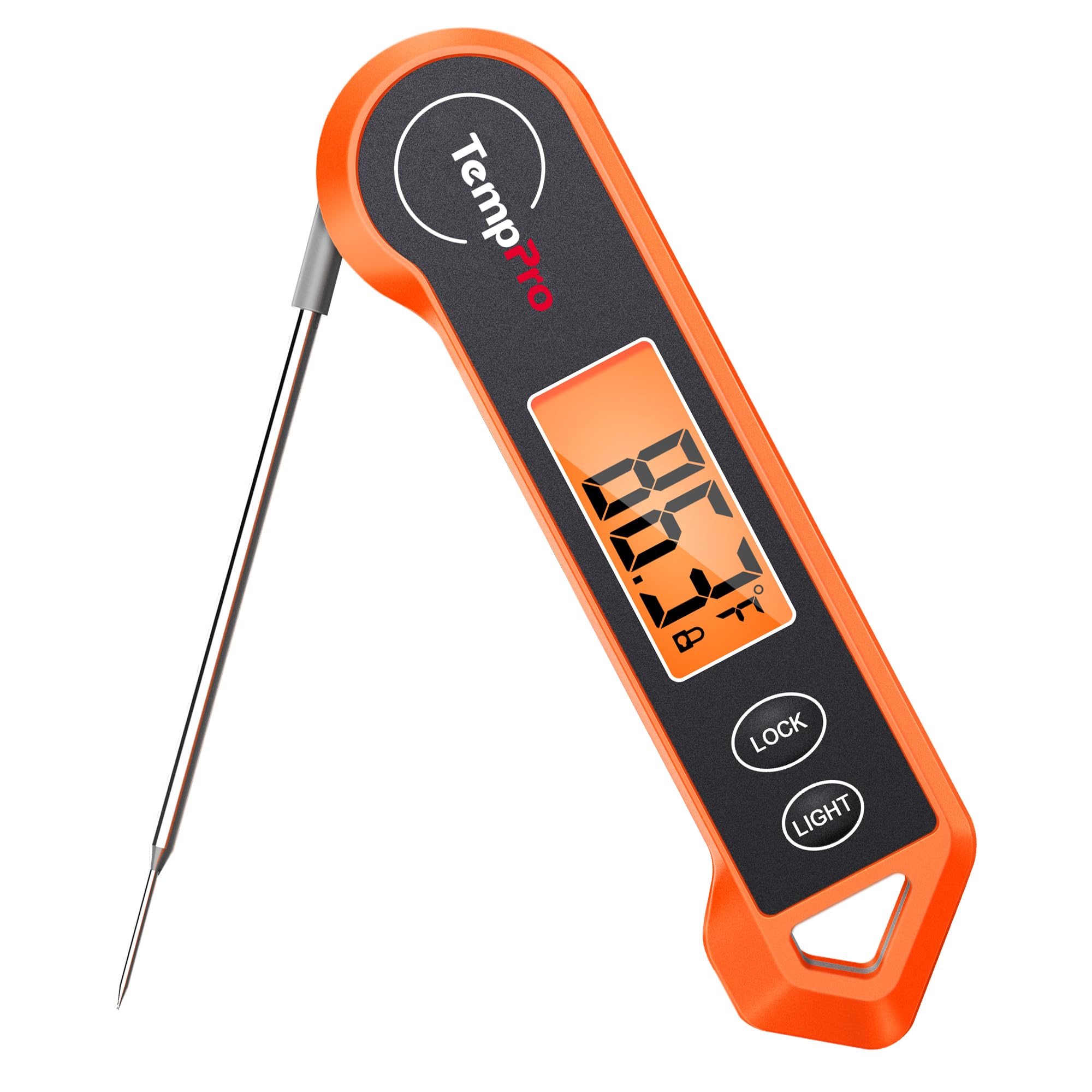
A fast, versatile instant-read digital thermometer with a rotating backlit display, long stainless probe, lock/calibration features, and waterproof construction.
Why I picked it: Fast 1-second reads, rotating backlit display, and probe length that works well for most pots.
Best for: Everyday candy making, frying, and quick temperature checks where speed matters.
High value for an instant-read digital with useful features.
Pros
- 1-second ultra-fast readings
- 180° auto-rotating backlit display
- Long 4.3" food-grade probe
- IP65 splash resistance
Cons
- Requires a battery
- Not specialized for candy stage presets
My take
I reached for the TempPro TP19H when I needed instant, repeatable readings while making caramel and when deep-frying. The display wakes as I open the probe and the numbers are bright enough to read over steam.
The long stainless probe felt secure and kept the tip well into the syrup without me leaning over the pot. Lock and calibration functions gave me confidence for delicate sugar work, and the fast response meant I could catch narrow temperature windows.
The magnetic back and the motion-sensing sleep/wake are small conveniences that add up in a busy kitchen. For general candy and frying work this is the tool I use most often.
2. Polder 12" Candy Thermometer – Best Budget
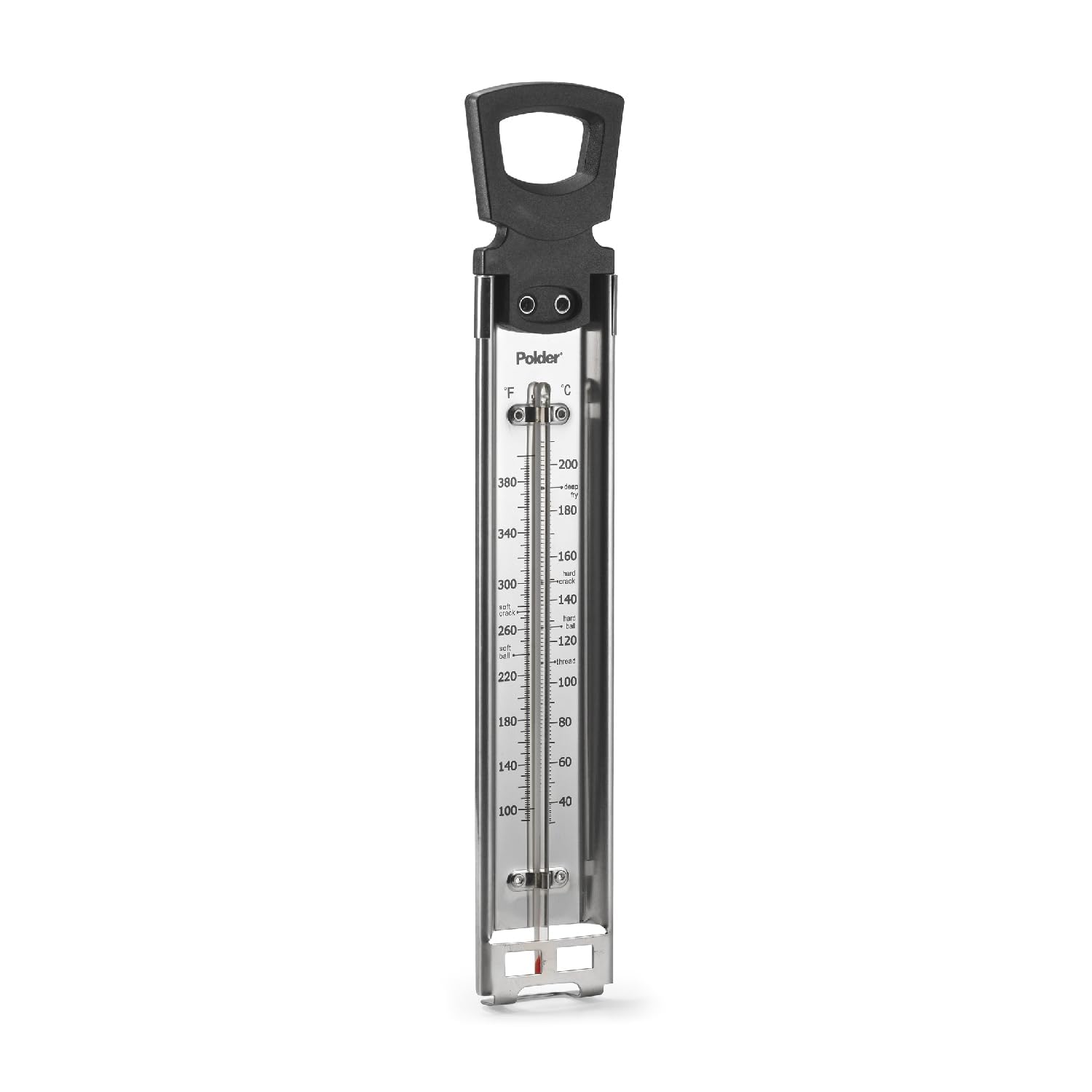
A straightforward analog candy thermometer with printed candy temperature zones, a 12" stainless body, and an adjustable pot clip for hands-free monitoring.
Why I picked it: Clear printed candy stages and a full-length clip make this a reliable low-cost option.
Best for: Home cooks making jams, syrups, and small-batch candy on a budget.
Very affordable analogue option for occasional candy makers.
Pros
- Printed candy temperature zones
- 12" rust-resistant stainless body
- Adjustable pot clip
- Cool-touch insulated handle
Cons
- Edge can be sharp
- Analog takes practice to read precisely
My take
When I need a simple, no-fuss tool for jam or toffees, I use the Polder 12" thermometer. The temperature guide printed right on the face removes guesswork for stages like soft-ball or hard-crack.
The pot clip holds it steady while I stir and the insulated handle keeps my fingers safe. It cleaned up easily after honeycomb toffee and fit nicely on the side of my saucepan.
A word of caution: one batch I nicked my finger on a raw edge, so I handle it carefully when wiping the stem. For the price and functionality, this is the go-to backup in my drawer.
3. Taylor 12" Candy & Deep-Fry Thermometer – Best Analog Classic
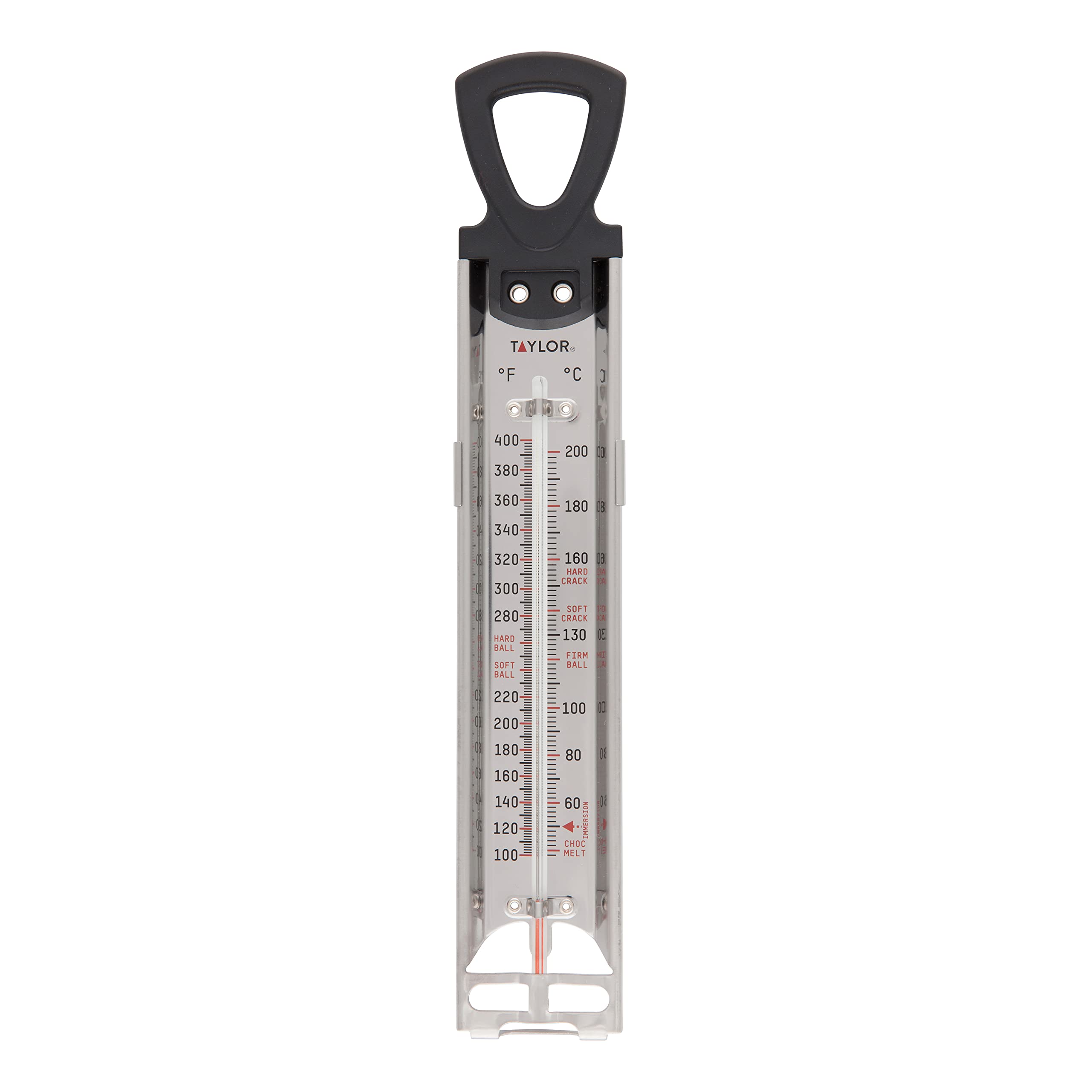
A durable, battery-free paddle thermometer with a large magnified face, adjustable pan clip, and markings for candy and frying temperatures.
Why I picked it: Solid stainless construction and a big dial that I can read easily without electronics.
Best for: Serious high-temp sugar work and deep-frying where I want a battery-free tool.
Classic, midrange analog choice for dependable long-term use.
Pros
- No batteries required
- Large magnified face
- Adjustable secure pan clip
- Heat-resistant insulated handle
Cons
- May need initial calibration
- Bulky compared with slim probes
My take
I keep the Taylor paddle in my candy kit for heavy-duty jobs like pulling hard-crack sugar or frying large batches. The big dial makes it easy to watch slow changes while I stir.
Because it’s analog, there’s nothing electronic to fail; after a quick calibration run in water I trusted it for several batches of caramel. The clip holds solidly and the stainless body wipes clean without fuss.
If you prefer a tool that just works every time without batteries, this is the thermometer I turn to.
4. TempPro TP510 Waterproof Digital Thermometer – Best for Large Pots
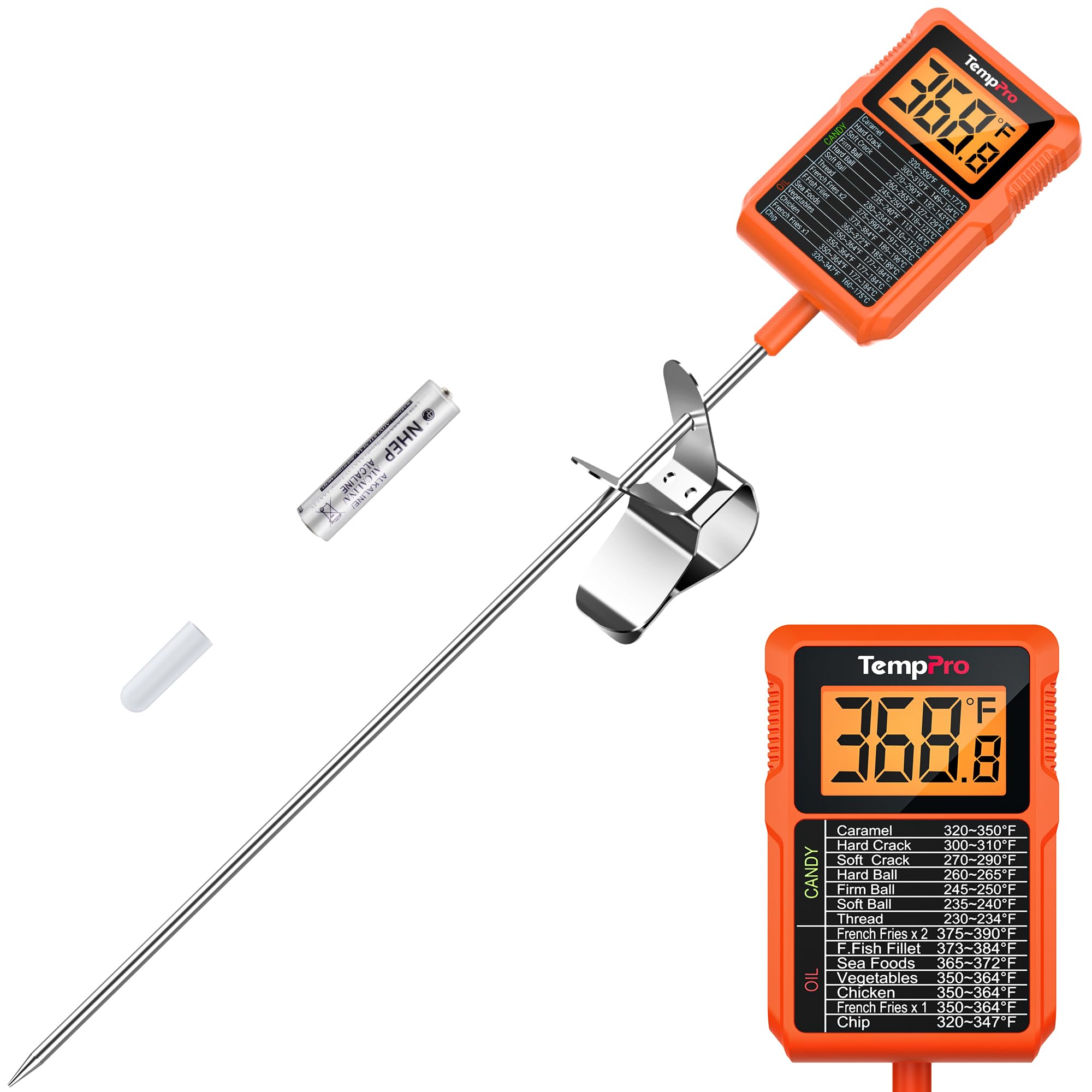
A waterproof digital thermometer with a 10" probe, backlit 90° rotating display, fast 1–3 second reads, and a printed temperature reference for candy stages.
Why I picked it: Long probe and waterproof housing that handle larger pots and heavy syrup with ease.
Best for: Large-batch jam, big pots of syrup, and deep-frying where extra probe length helps.
A slightly higher-cost digital aimed at batch cooks.
Pros
- 10" long probe for deeper pots
- IPX5 waterproof design
- Backlit 90° rotating display
- Fast 1–3 second readings
Cons
- 10" can be short for very large stockpots
- Requires battery power
My take
I reached for the TP510 when I made a large batch of jam; the 10" shaft was perfect for my 12-qt pot and kept the tip away from the bottom while I stirred.
The rotating backlit display made reading temps easy over steam, and the unit responded quickly to temperature swings in syrup. It rinses clean in seconds, which is a real time-saver.
On an extra-large 20-qt pot the shaft felt a little short, so I reserve this primarily for medium-to-large home batches rather than commercial kettles.
5. 9" Candy Thermometer with 2" Dial – Best Large Dial
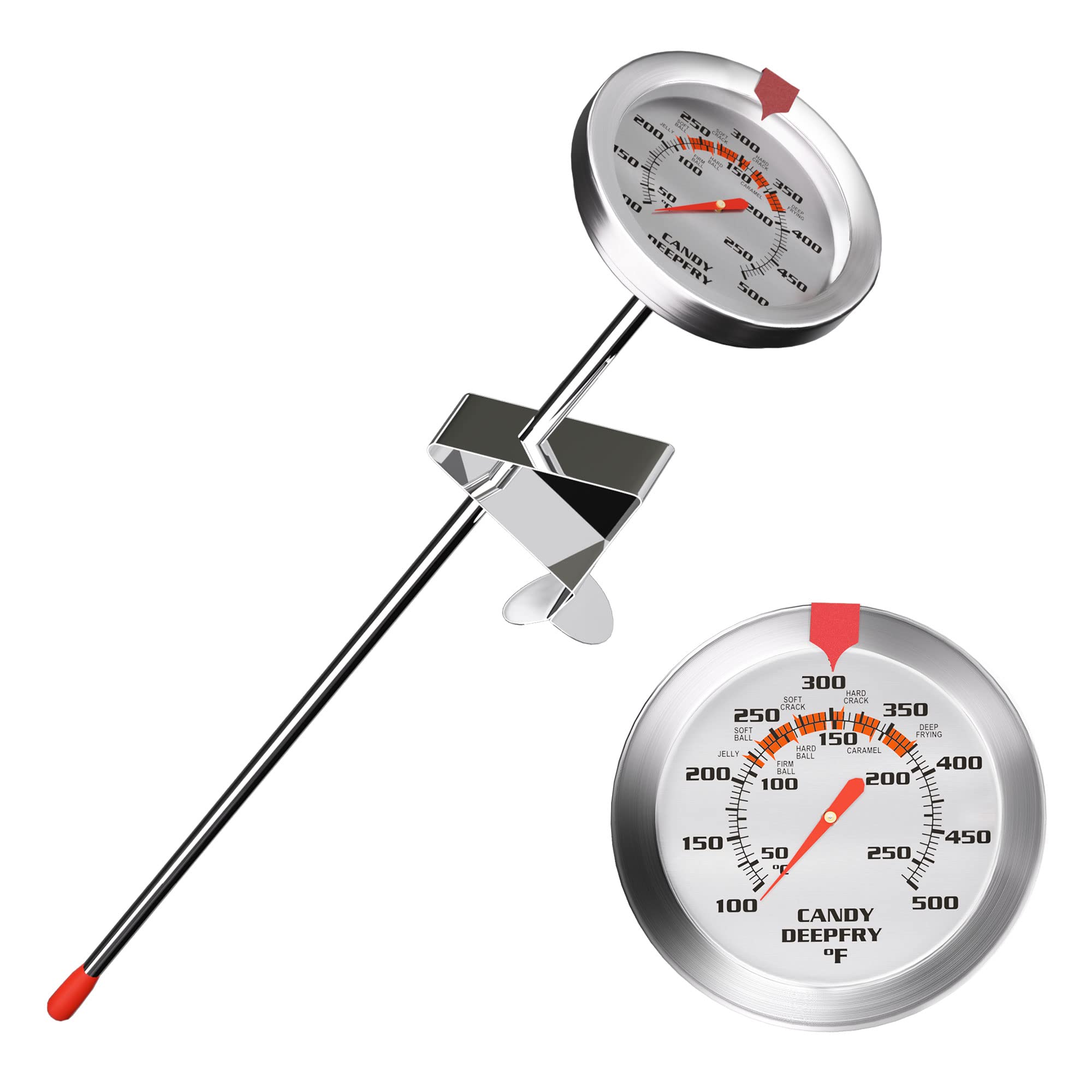
A heavy-duty 9" probe thermometer with a large 2" dial, glass lens, printed candy zones, adjustable marker, and an upgraded clamp for a secure fit.
Why I picked it: Large, easy-to-read dial and adjustable marker make monitoring a breeze.
Best for: Cooks who want an oversized face for quick glances while juggling pots.
An economical pick that prioritizes readability.
Pros
- Extra-large 2" dial
- Adjustable temperature marker
- Shatterproof tempered glass
- Secure upgraded pot clip
Cons
- Dial can lag on sudden changes
- Bulky size for small pots
My take
For turkey frying and deep batches of candy I like the big dial on this 9" thermometer — I can read it from across the stove without squinting.
The adjustable marker is handy for tracking a target temperature while I multi-task, and the tempered glass face cleaned up easily after syrup work.
I did notice the dial sometimes took a moment to catch up during fast temperature jumps, so I don’t use this when I need split-second readings.
6. CDN DTC450 Digital Candy Thermometer – Best for Precision Work
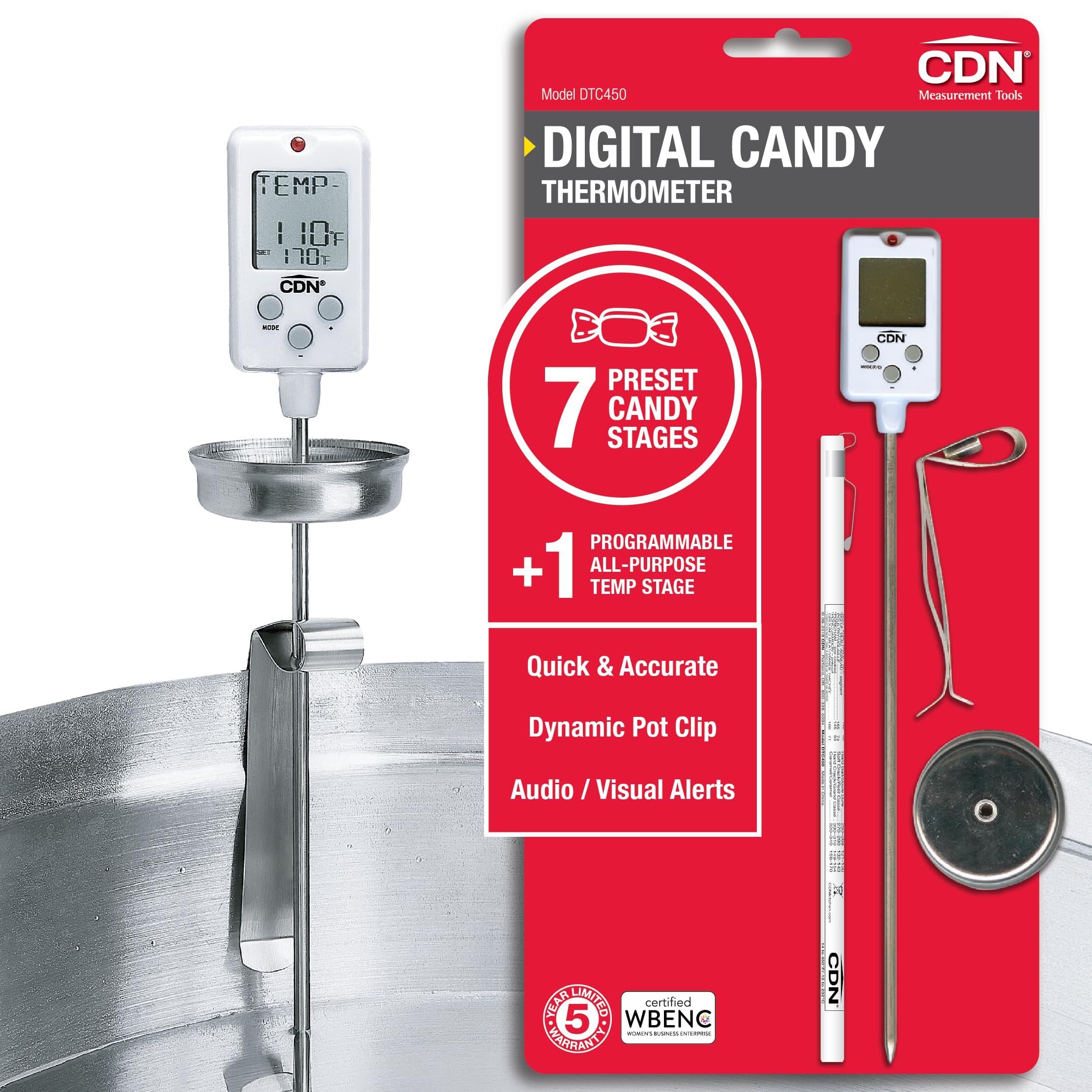
A professional-style digital thermometer with seven preset candy stages, a programmable stage, audio/visual alerts, and an adjustable 8.25" stem with pot clip.
Why I picked it: Preset candy stages and audible alerts let me set it and focus on other tasks.
Best for: Precise candy making where set-and-forget alerts and exact temps matter.
Premium choice for cooks who want built-in presets and alerts.
Pros
- Seven preset candy stages
- Audio and visual alerts
- Programmable extra stage
- ±1.5°F accuracy
Cons
- Display visibility drops at very high temps
- Not safe to leave inside an oven
My take
When I need to hit specific sugar stages I rely on the CDN DTC450. Programming a target and letting the audible alert notify me freed me up to stir and scrape without fear of missing a window.
The adjustable pot clip and 8.25" stem work well in most saucepans, and the thermometer has been reliable over months of confectionery projects.
I do avoid leaving it in an oven; the display can darken above certain temperatures, so I use it as an immersion monitor rather than an oven probe.
How I Choose Candy Thermometers
Digital vs. Analog
I pick digital when I need fast, repeatable readings and visible numbers; digital units are best for quick-response candy and frying work.
I prefer analog paddle thermometers when I want a battery-free, durable tool that tolerates heavy use and still gives me accurate readings after a simple calibration.
- Digital: faster response, backlight, calibration features.
- Analog: no batteries, simple, excellent for steady monitoring.
Probe Length and Pot Clips
Probe length determines how deep you can safely suspend the tip in syrup or oil. I always match probe length to pot depth—10" or longer for larger kettles.
A secure, adjustable pot clip is non-negotiable for hands-free work; it keeps the tip away from the bottom and stops the thermometer from sliding.
- Short probes: good for small saucepans.
- 10"+ probes: better for 8–12 qt pots and larger.
- Adjustable clips: allow accurate placement and stable reading.
Temperature Range, Accuracy, and Presets
Candy work requires a thermometer that covers the hard-crack range and is accurate within a couple degrees. I aim for devices rated to at least 400–450°F for most sugar work.
Presets and programmable stages are huge time-savers for hands-off monitoring—use them for soft-ball, hard-crack, and frying temps.
- Look for ±1–1.5°F accuracy for confectionery work.
- Presets: useful for repeatable candy stages.
- Wide temperature range: necessary for frying and candy.
Display, Response Time, and Waterproofing
A backlit, rotatable display makes life easier around steam and low light. I value thermometers that read in 1–3 seconds for tight sugar windows.
If you work with sticky syrups, choose a waterproof or splash-resistant unit so it survives fast rinses.
- Backlight and rotation: read temps from any angle.
- 1–3 second response: essential for fast candy stages.
- IPX5/IP65: rinse without worry after use.
Maintenance and Calibration
I rinse probe stems and wipe dials after each use to avoid sticky buildup. For analog thermometers I do a quick water test to confirm calibration before important batches.
Digital units with calibration or lock functions let me fine-tune and freeze readings for safer handling.
- Hand-wash or top-rack only if specified.
- Perform a water-ice calibration for accuracy checks.
- Use lock/read-hold features when handling hot pots.
Frequently Asked Questions
Can I use a meat thermometer for candy making?
Yes. I use instant-read meat thermometers for candy when they have the right temperature range and a long enough probe. Fast response and calibration are what matter most—just avoid units that aren’t rated for high sugar temps.
Where should I clip the thermometer in the pot?
I clip mine so the probe tip sits in the center of the liquid, suspended off the bottom. The edge temperature is usually cooler; center placement gives the most accurate reading for candy and frying.
How do I calibrate an analog candy thermometer?
I do a simple boiling-point or ice-water test. For boiling: compare to your local water boil temp and adjust if the unit allows. For ice: submerge stem in ice water and check for 32°F (0°C) as a quick accuracy check.
Can I leave a thermometer clipped inside while I cook?
I leave it clipped for stovetop syrup or frying, but I avoid leaving most digital displays inside the oven—some displays can dim or fail under continuous high heat.
Final Take
Temperature control is a small investment that pays off in every batch. For speed and repeatability I reach for a fast digital like the TempPro TP19H or the CDN DTC450 when I want presets and alerts.
If I’m doing heavy, high-heat batches or want a tool that won’t fail when batteries do, the Taylor paddle or Polder analog thermometers are the dependable choices I turn to.
Match probe length to pot size, pick a secure clip, and keep calibration in your routine—do that and your candy, jams, and fried foods will turn out the way you expect.
