
I tested Westinghouse portable generators for whole-house backup and picked models that balance raw power, fuel flexibility, runtime, and clean inverter power for electronics.
I spent time unpacking, setting up, and starting each of these Westinghouse generators so I could compare how they perform as home backup solutions.
My goal was practical: which units will actually run essential circuits, start easily when the power goes out, and keep running without constant refueling or fuss?
Below I walk through the strengths and trade-offs of each model and explain which one I’d choose depending on home size, fuel access, and noise or electronics concerns.
I compared these units head-to-head on running watts, fuel options, runtime, starting method, and outlets. I prioritized real-world usability—how easy they are to set up, start from a distance with the remote fob, and connect to a transfer switch or RV plug—because those details make the difference during an outage.
1. Westinghouse WGen9500DF Dual-Fuel Generator – Best Overall
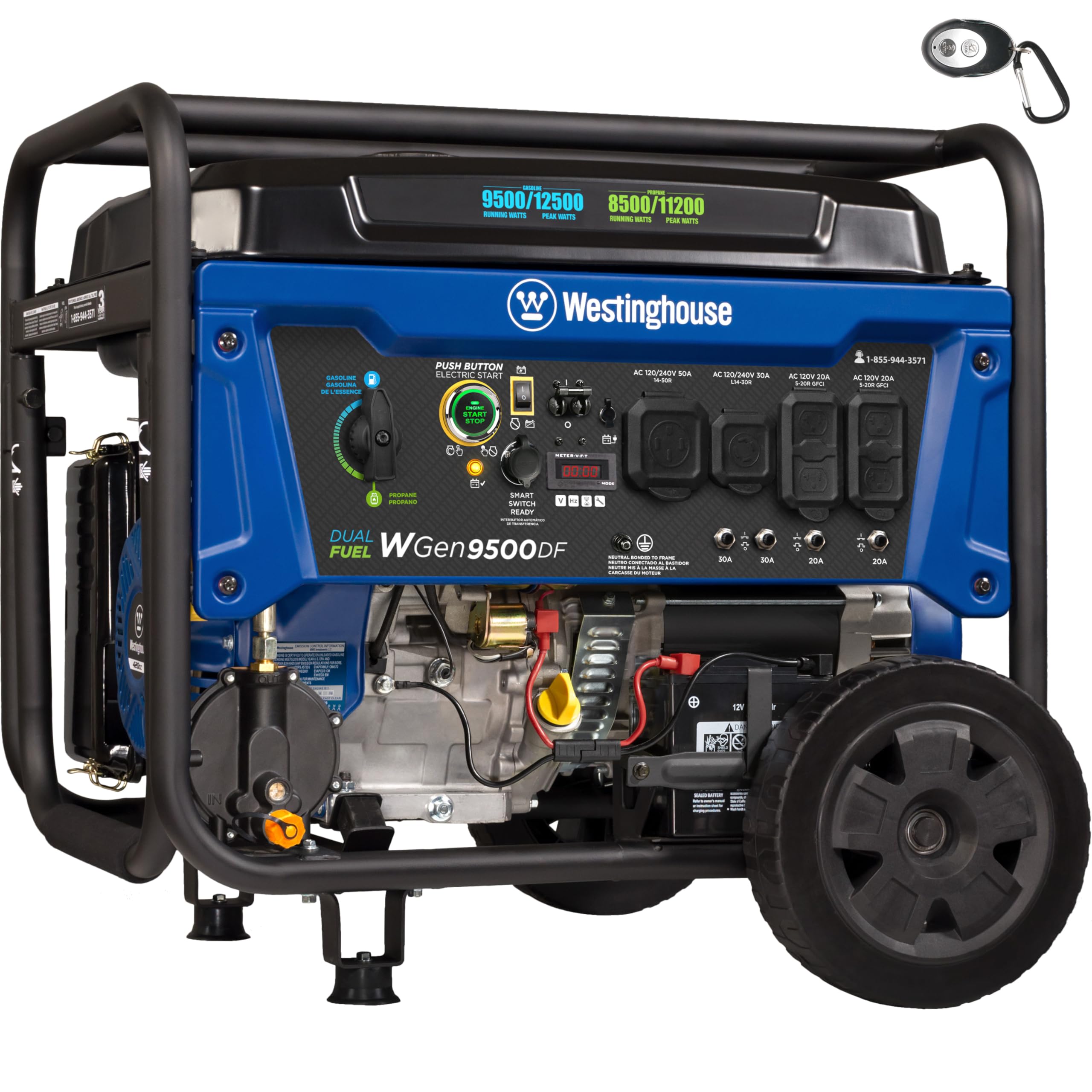
I chose this dual-fuel Westinghouse as my top pick because it delivers strong running power, an easy remote electric start, and the transfer-switch-ready outlets most homeowners need for whole-house backup.
Why I picked it: Robust running watts, dual-fuel flexibility, remote start, and transfer-ready outlets.
Best for: Homeowners who want dependable whole-house backup on gasoline or propane.
Solid value for a heavy-duty home-backup generator.
Pros
- High running and peak wattage
- Dual-fuel (gasoline and propane)
- Remote electric start with key fob
- Transfer-switch and 50A outlet
- Never-flat heavy-duty wheels included
Cons
- Heavy—needs at least two people
- Not as quiet as inverter models
- May need altitude kit in high locations
My take
Out of the box I appreciated that Westinghouse included oil, a funnel, a battery charger and a key fob. Assembly was minimal—attach the wheels and stabilizing feet—and the battery came charged so it started right away on the electric push-button and fob.
The VFT data center is genuinely useful; I watched voltage and frequency readings while running a refrigerator, lights and a few small appliances. The transfer-switch-ready L14-30 and 14-50 outlets made it straightforward to power larger circuits through a single cord hookup.
Runtime is practical for an outage—up to about half a day on the built-in tank when I ran a mixed load—and the cast-iron sleeve engine felt solid under load. I also tested propane and switching between fuels was painless with the included hose.
This unit is heavy and makes a noticeable noise level compared with inverter options, but for the output and the convenience of remote start plus included accessories, it’s my go-to for balanced home backup.
2. Westinghouse WGen9500TFc Tri-Fuel Generator – Best for Fuel Flexibility
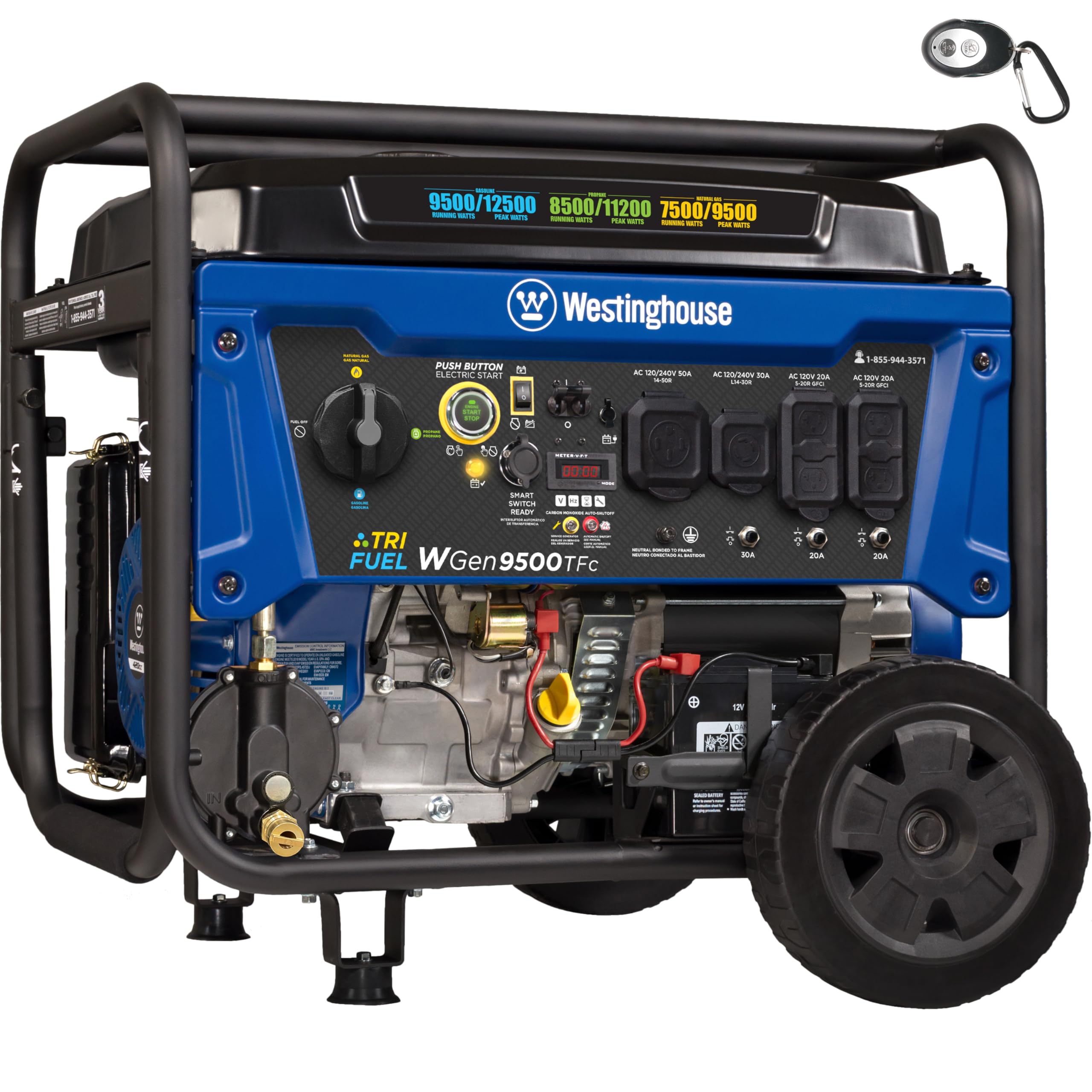
I recommend this tri-fuel model if you want the security of running on gasoline, propane, or natural gas, along with remote start and transfer-switch-ready hookups.
Why I picked it: Three fuel options plus remote start and full-size outlets for whole-house needs.
Best for: Homes where gas, propane, or natural gas availability varies during outages.
A bit more for the tri-fuel convenience, worth it if fuel access varies.
Pros
- Tri-fuel: gas, propane, natural gas
- Remote start key fob included
- Transfer-switch and 50A outlet
- Comes with propane and NG lines
- Digital hour meter and VFT display
Cons
- Heavy to move manually
- Natural gas hookup may need extra fittings
- Delivery timing can vary
My take
I had this unit delivered and set it up to backfeed my panel through a 220 connection. The assembly was straightforward and the remote start paired out of the box; it fired up on the first push.
Tri-fuel capability is the standout for me. I tested gasoline and propane and saw consistent power delivery; the convenience of having natural gas as an option removes a lot of fuel-sourcing worry during extended outages.
The included lines and the transfer-ready 14-50R outlet make electrician installation simpler. If you plan to use natural gas, budget for any additional piping or fittings, but otherwise the plug-and-play experience is strong.
3. Westinghouse WGen11500TFc Tri-Fuel Generator – Best for Large Homes
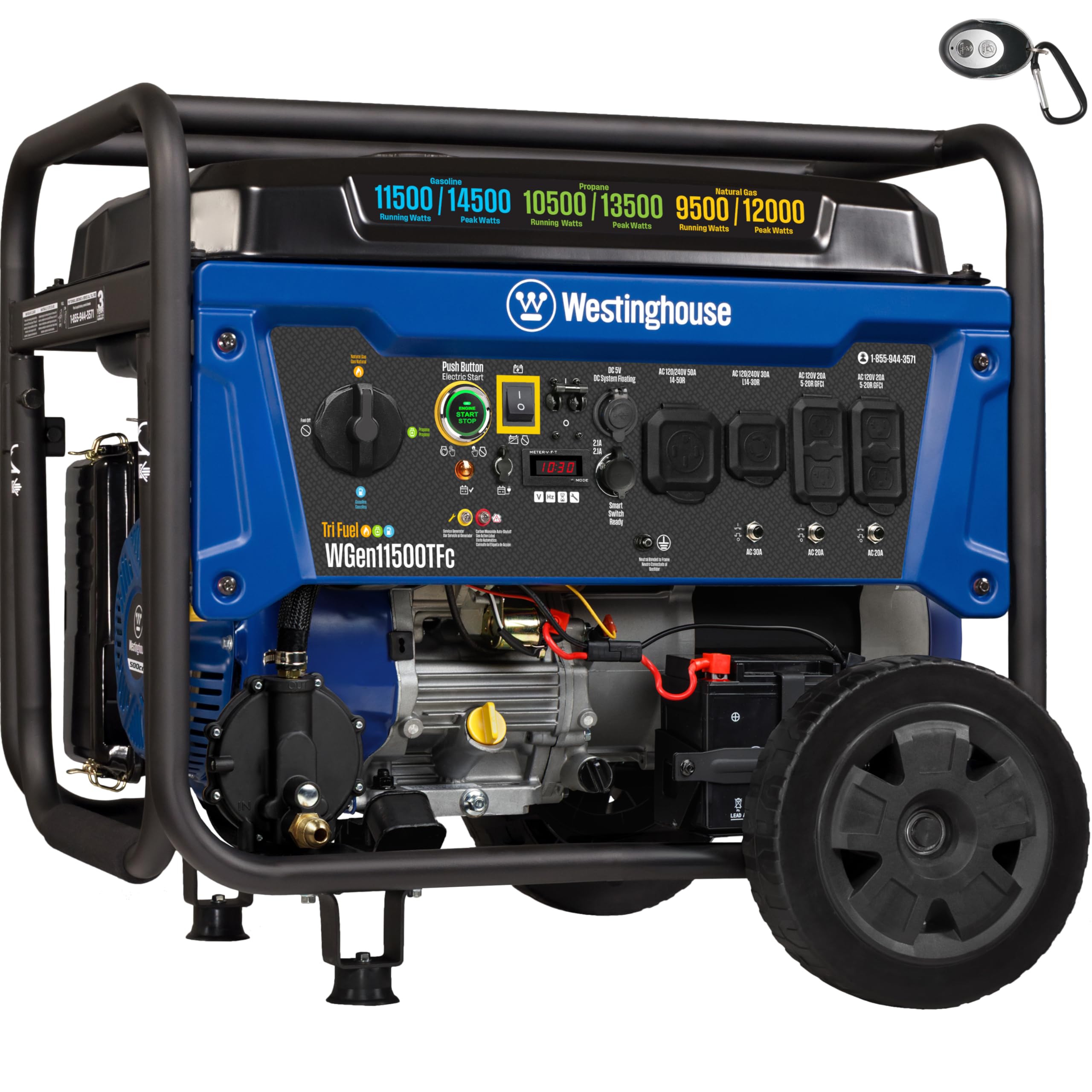
When I needed the most power for a larger house, this Westinghouse stood out: the biggest engine, long runtime, and low THD make it suitable for heavy loads and sensitive electronics.
Why I picked it: Highest running wattage, long runtime, low THD for electronics.
Best for: Larger homes and heavy whole-house backup scenarios.
A higher-tier choice for serious whole-house backup needs.
Pros
- Top running and peak wattage
- Long runtime on a large tank
- Low THD safe for electronics
- Durable copper windings
Cons
- Very heavy and bulky
- Louder than inverter units
- More generator than small homes need
My take
Assembly was easy and everything necessary (oil, tools, funnel) was included. I wheeled it into position using the fold-away handle—still heavy, but manageable with the wheels and a helper.
On first start the engine ran smoothly and the remote start worked reliably. I tested it on a staged whole-house load: refrigerator, well pump, lights, and some HVAC cycling, and it handled the demand without voltage sag.
Low THD and copper windings give me confidence to run TVs, computers and other sensitive equipment. This is the one I’d pick when I need maximum, sustained power.
4. Westinghouse WGen10500TFc Tri-Fuel Generator – Best Long Runtime
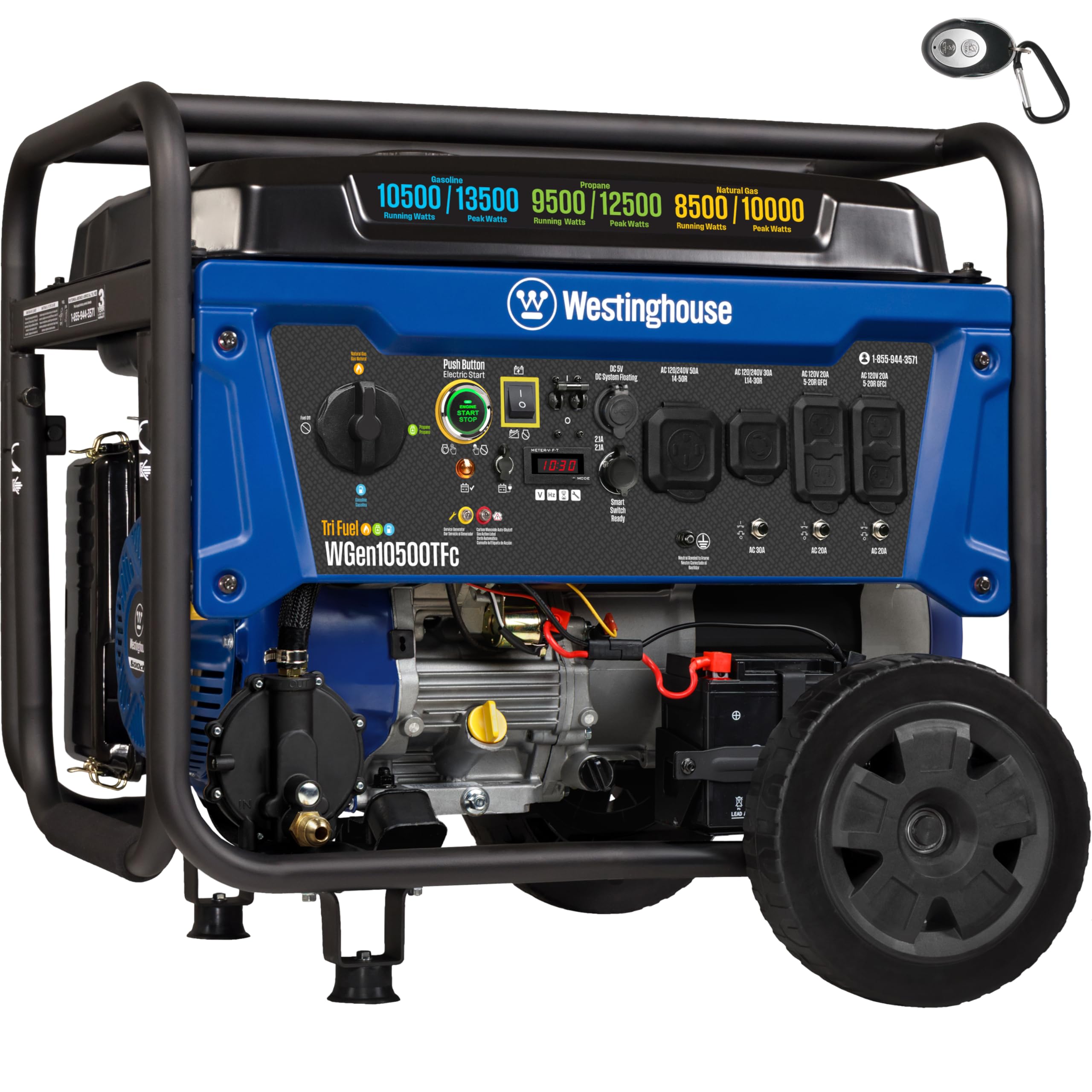
I picked this model for its long runtime and balanced power—tri-fuel capability plus a large 9.5-gallon tank that keeps things running for extended outages.
Why I picked it: Exceptional run time and tri-fuel flexibility for extended outages.
Best for: Households that want long, uninterrupted runtime between refuels.
A practical mid-to-high tier option for extended use.
Pros
- Up to 19 hours runtime
- Tri-fuel capability
- Transfer-switch ready 50A outlet
- Includes hoses and basic tools
Cons
- Bulky and heavy
- Packaging can show wear on delivery
- May require two people to install
My take
I set it up and found the battery charged and the remote already paired. The start-up was immediate and the control panel is clear and easy to read.
I ran a mix of essential circuits—well pump, refrigerator and lights—and appreciated the long runtime. For multi-day outages the larger tank and efficient running speed mean fewer fuel trips.
Moving it into position requires planning because of the weight, but the heavy-duty wheels and folding handle make placement manageable once you have a couple of helpers.
5. Westinghouse iGen8200TFc Inverter Tri-Fuel Generator – Best for Sensitive Electronics
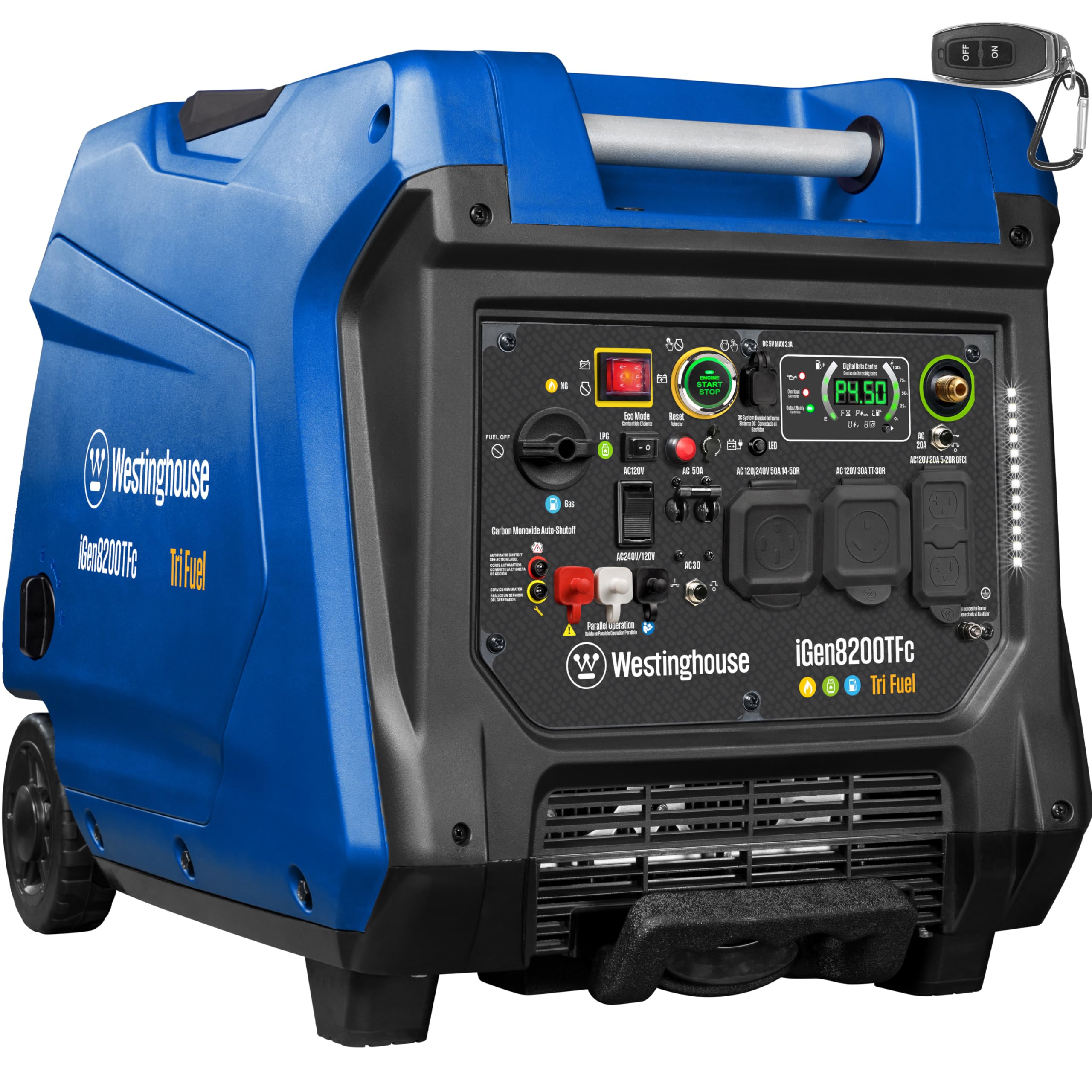
I recommend the iGen8200TFc when clean power, fuel efficiency and lower noise are priorities: inverter tech provides <3% THD, quieter operation, and good fuel economy for extended use.
Why I picked it: Inverter technology for low THD, quieter operation, and fuel savings.
Best for: Homes that need clean, quiet power for computers and TVs.
A premium inverter choice that saves fuel and reduces noise.
Pros
- Less than 3% THD—safe for electronics
- Inverter fuel efficiency
- Quieter operation around 60 dBA
- 50A outlet for home backup
- Long runtime at light load
Cons
- Lower maximum output than open-frame models
- Still relatively heavy for an inverter
- Shipping can cause cosmetic panel marks
My take
Setup was straightforward and included tools made wheel and foot installation simple. The push-button, remote and recoil starts all worked without issue.
Running at a partial load the unit is noticeably quieter than open-frame generators and the inverter kept voltage steady. I ran sensitive devices—laptops, TVs and phones—without blinking lights or odd behavior.
Fuel efficiency impressed me: at 25% load I saw very long run times between refills, which makes this a sensible choice if noise and fuel management are top priorities.
How I Choose a Home Backup Generator
Capacity: match watts to what matters
I start by listing what I need to run at once—furnace or AC, refrigerator, well pump, lights and a few electronics—and add a buffer for starting loads. Running watts and peak watts tell me whether a generator can handle both continuous and motor-start demands.
If you want whole-house backup, pick a model with transfer-switch-ready outlets and a running wattage that covers major appliances. For partial backup, a lower running wattage inverter might be smarter.
- I use running watts for sustained loads, peak watts for startup motors.
- Transfer-switch-ready 14-50R 50A outlet simplifies whole-house hookups.
- Inverter generators are best when low THD matters.
Fuel type and flexibility
Fuel access changes how I plan. Tri-fuel gives the most options—gasoline, propane, natural gas—so I’m not stranded if one source is scarce.
Propane stores indefinitely and is cleaner; natural gas removes manual refueling. I consider what fuels are available in my area before choosing a model.
- I prefer dual- or tri-fuel models for redundancy.
- Propane and natural gas options cut down on emergency fuel runs.
- Check whether included hoses and fittings match your setup.
Starting and convenience features
Remote electric start with a key fob is one of my favorite convenience features because it lets me start the unit without walking out in bad weather.
A VFT or LED data center is helpful to monitor voltage, frequency and hours so I can schedule maintenance when needed.
- Remote start saves hassle during storms.
- Automatic low oil shutdown protects the engine.
- Included tools, oil and battery charger speed initial setup.
Noise, THD and electronics
If I need to run computers or TVs, I prioritize inverter models with low THD. They’re quieter and more fuel-efficient, even if their peak output is lower.
Open-frame models typically offer more raw power for the price but can be louder and less suited for sensitive gear.
- Choose inverter for <3–5% THD when electronics matter.
- Plan placement to keep noise away from bedrooms and neighbors.
- Consider a generator cover and ventilation when storing outdoors.
Portability and installation
All of these units are heavy; wheels and handles help, but plan for at least two people during installation. I also factor in electrician labor for transfer switch or interlock hookups.
Check warranty and available support—three-year coverage and lifetime technical support matter when you’re relying on a unit during an emergency.
- I always have an electrician wire a transfer switch for safety.
- Confirm the included accessories to avoid last-minute trips for hoses or fittings.
- Plan for safe outdoor placement a few feet from doors and vents.
Frequently Asked Questions
Do I need a transfer switch to hook these generators to my house?
I strongly recommend a transfer switch or a professionally installed interlock kit. It’s the safest way to connect a generator to your home panel and prevents dangerous backfeed to the grid. I had an electrician handle the wiring and it made power transitions much simpler during outages.
Can these generators safely power sensitive electronics?
Yes—models with inverter technology or low THD (like the iGen8200TFc and the higher-tier tri-fuel units with specified low THD) keep power clean enough for computers, TVs and phones. I still use surge protection as an extra precaution.
How long will a generator run on propane or gasoline?
Runtime depends on load. In my tests and based on the specs, smaller tanks at light loads can run many hours—some models claim double-digit hours. Higher-capacity tanks deliver longer continuous operation; I plan fuel strategy around expected load and refuel availability.
Final Take
If I need the best overall balance of power, convenience and value, the WGen9500DF Dual-Fuel is my pick.
Choose a tri-fuel Westinghouse if fuel flexibility is a priority, and pick the larger WGen11500TFc if you need maximum sustained power for a big house.
For cleaner, quieter power for electronics and better fuel economy, I go with the iGen8200TFc inverter model. Wherever you land, plan the installation, secure a transfer switch, and keep spare fuel or a propane supply on hand so you’re truly ready when the lights go out.
