
I tested five popular baker's racks across materials, stability, and power features to find options that actually work in real kitchens — from compact butcher-block tops to racks with built-in outlets.
I live in a kitchen-first home and have tried multiple baker's racks to reclaim counter space, build a coffee bar, or add a microwave station. For this roundup I focused on build quality, assembly, shelf adjustability, and whether a unit includes a useful power strip.
Each pick reflects hands-on time: building the rack, loading appliances, and living with the piece for weeks. Below I explain what each rack does best and where I’d place it in my kitchen.
I compared these racks on materials (solid wood tops vs particleboard), stability (frame thickness, X-brace, anti-tip), and useful extras like power strips and removable shelves. If you want a natural wood top and tool-free assembly, go one direction; if you need integrated power or a coffee-bar setup, pick the models with built-in outlets.
1. Amazon Basics Baker’s Rack with Removable Wood Top – Best Overall
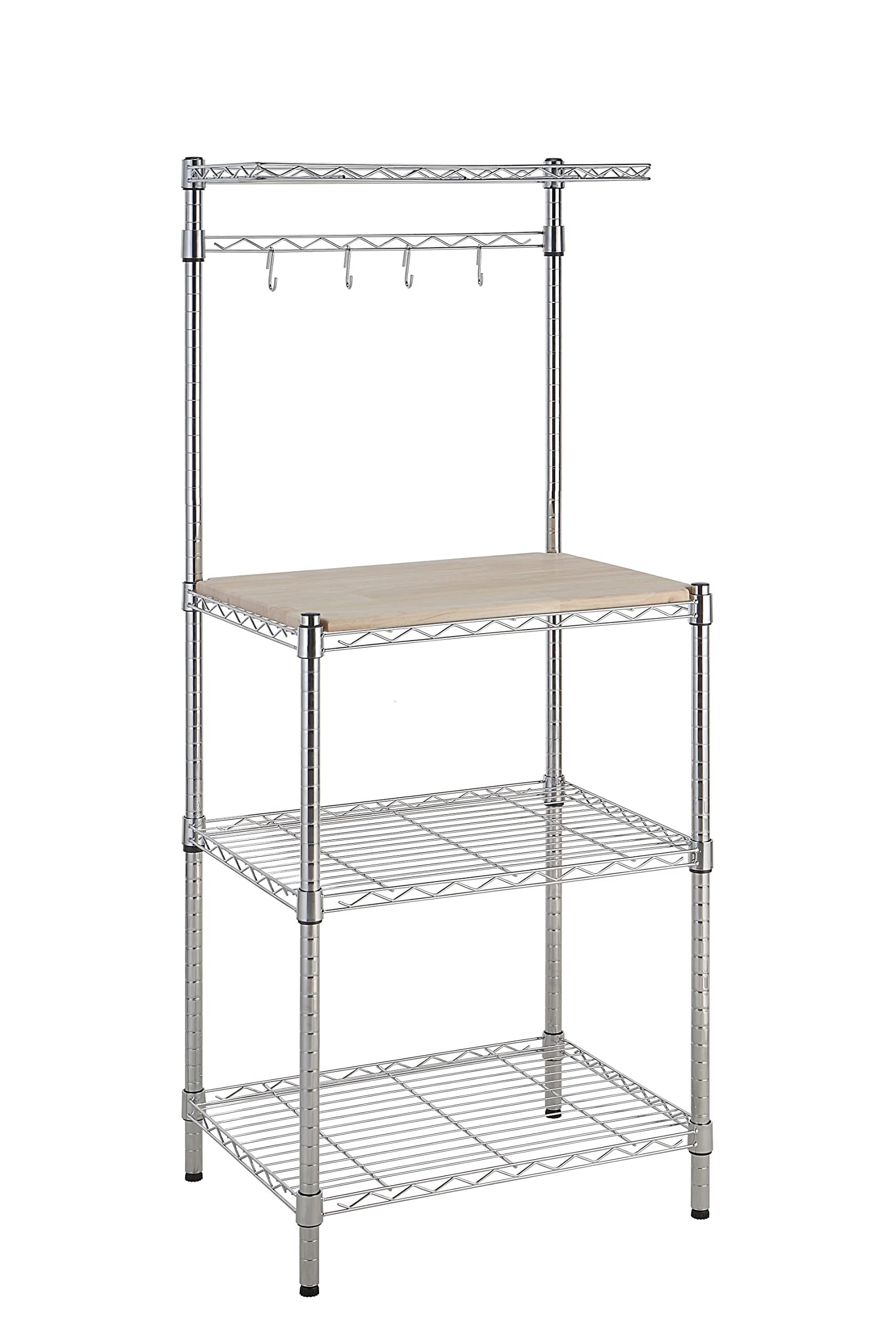
I recommend this when you want a no-fuss, sturdy chrome frame with a real wood countertop and easy, tool-free assembly.
Why I picked it: Real wood countertop, chrome frame, tool-free assembly, highly adjustable shelves.
Best for: Small kitchens that need a sturdy, low-odor wood top.
Affordable option for solid-feel hardware.
Pros
- Solid chrome-plated steel frame
- Removable 16mm real wood top
- Tool-free assembly in minutes
- Shelves adjust in 1-inch increments
Cons
- Instructions are diagrams only
- Limited finish options
My take
I assembled this rack in about ten minutes without tools and appreciated how lightweight yet surprisingly sturdy it felt once built.
The 16mm removable wood countertop is a highlight — it gives a genuine wood surface without the off-gassing I avoid with particleboard, so I used it as a prep surface and for my bread maker.
Shelves and the hanging bar adjust in one-inch steps, which let me tailor spacing for my mixer, toaster, and spice baskets. The included S-hooks are handy for mugs and utensils.
If you care about a clean, chrome look and a real wood top without a complicated build, this is the balance I kept reaching for.
2. VASAGLE Rustic Brown Baker’s Rack – Best Rustic Look
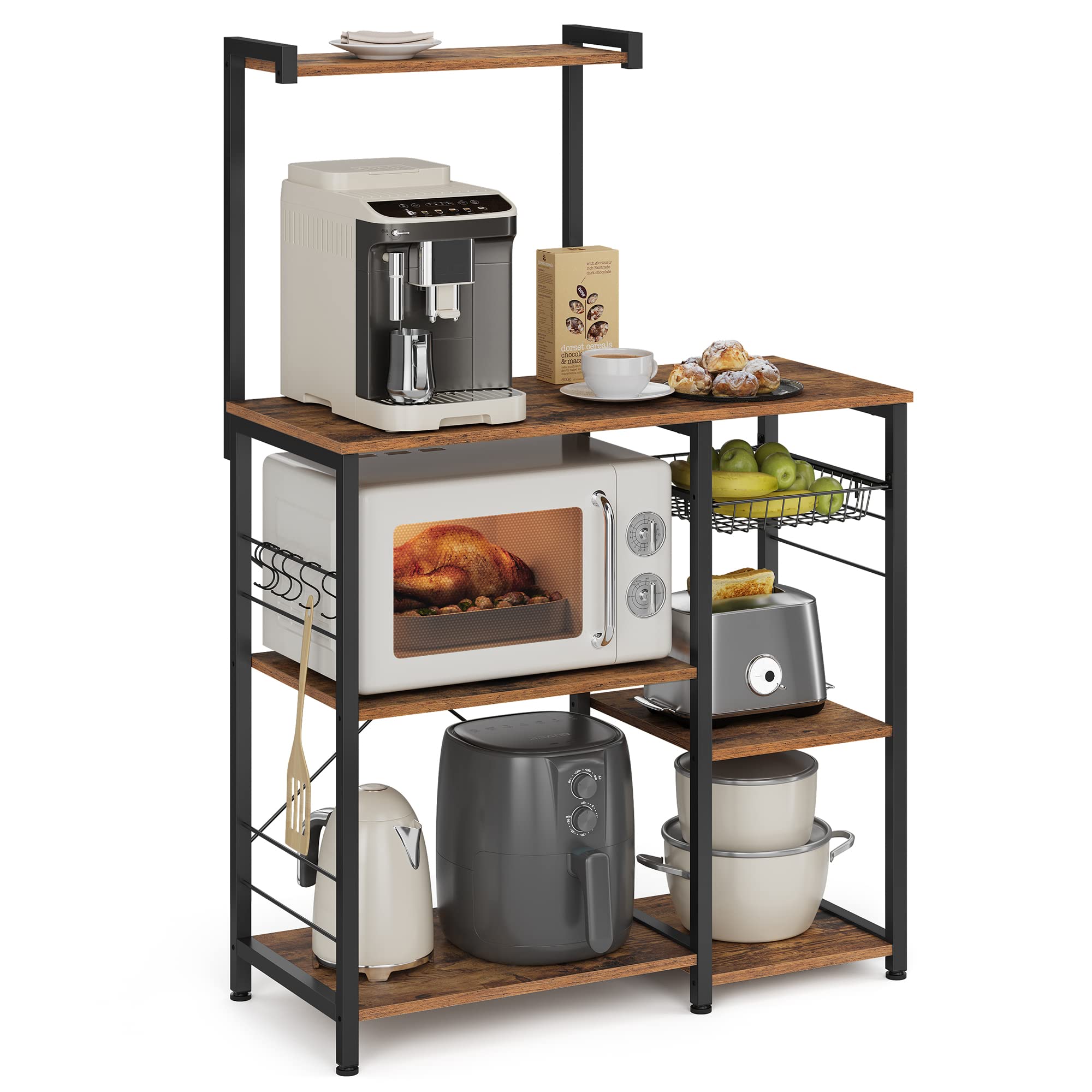
I pick this when style matters; the black frame with rustic brown shelves and an X-brace give a stable, decorative footprint for a coffee bar or pantry.
Why I picked it: Stylish rustic finish with solid frame, labeled parts, and anti-tip hardware.
Best for: Those who want a decorative coffee-bar or open-storage piece.
Moderately priced for look and function.
Pros
- Attractive rustic brown shelves
- X-brace adds visible stability
- Adjustable feet and anti-tip kit
- Labeled parts simplify assembly
Cons
- Particleboard shelves, not solid wood
- Upper-screw alignment can be fiddly
My take
This VASAGLE unit improved the look of my kitchen corner without feeling flimsy; the black frame and rustic shelves make a cohesive coffee-bar setup.
Assembly was straightforward thanks to labeled parts and clear diagrams. Once tightened, the X-brace and adjustable feet delivered a stable feel I trusted for small appliances and jars.
I swapped hooks and baskets around to fit utensils and spice jars; the rack handled the reconfiguration well. Keep in mind the shelves are particleboard, so I treated them as storage surfaces rather than heavy prep counters.
3. VASAGLE Baker’s Rack with Built-In Power Strip – Best with Power
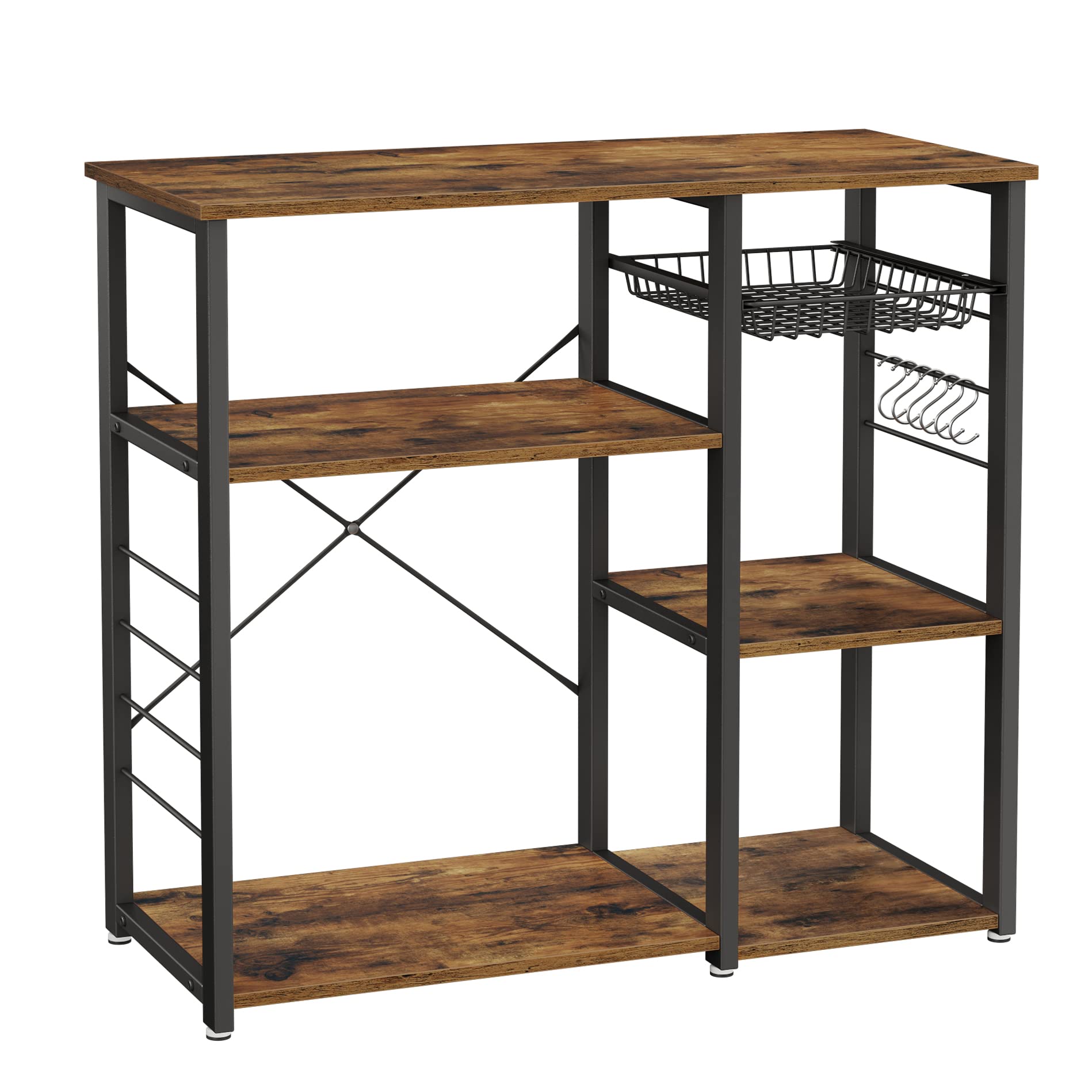
I recommend this if you want a dedicated coffee bar or appliance station — the integrated power strip keeps cords tidy and lets me plug in multiple devices safely.
Why I picked it: Integrated multi-outlet strip with safety features and adjustable shelves.
Best for: Coffee bars and appliance-heavy setups needing outlets.
Higher-priced but adds built-in power and safety features.
Pros
- Built-in power strip with multiple outlets
- Safety overload and leakage protection
- Adjustable shelves for various appliances
- Sturdy, long-term construction
Cons
- Particleboard shelves
- Heavier to move once loaded
My take
I’ve used this stand as a coffee bar and microwave station for years; the hidden cord routing and four AC outlets make daily use effortless and neater than a power strip on the counter.
The power strip includes overload and leakage protection plus an on-off switch, which gave me peace of mind when running a grinder, kettle, and espresso machine together.
Shelves are adjustable across several heights, so I fitted my microwave and left room for a toaster oven below. The frame felt very solid and even came with anchoring hardware for extra safety in a busy kitchen.
4. Whitmor Supreme Baker’s Rack with Cutting Board Top – Best Compact Cut-and-Prep
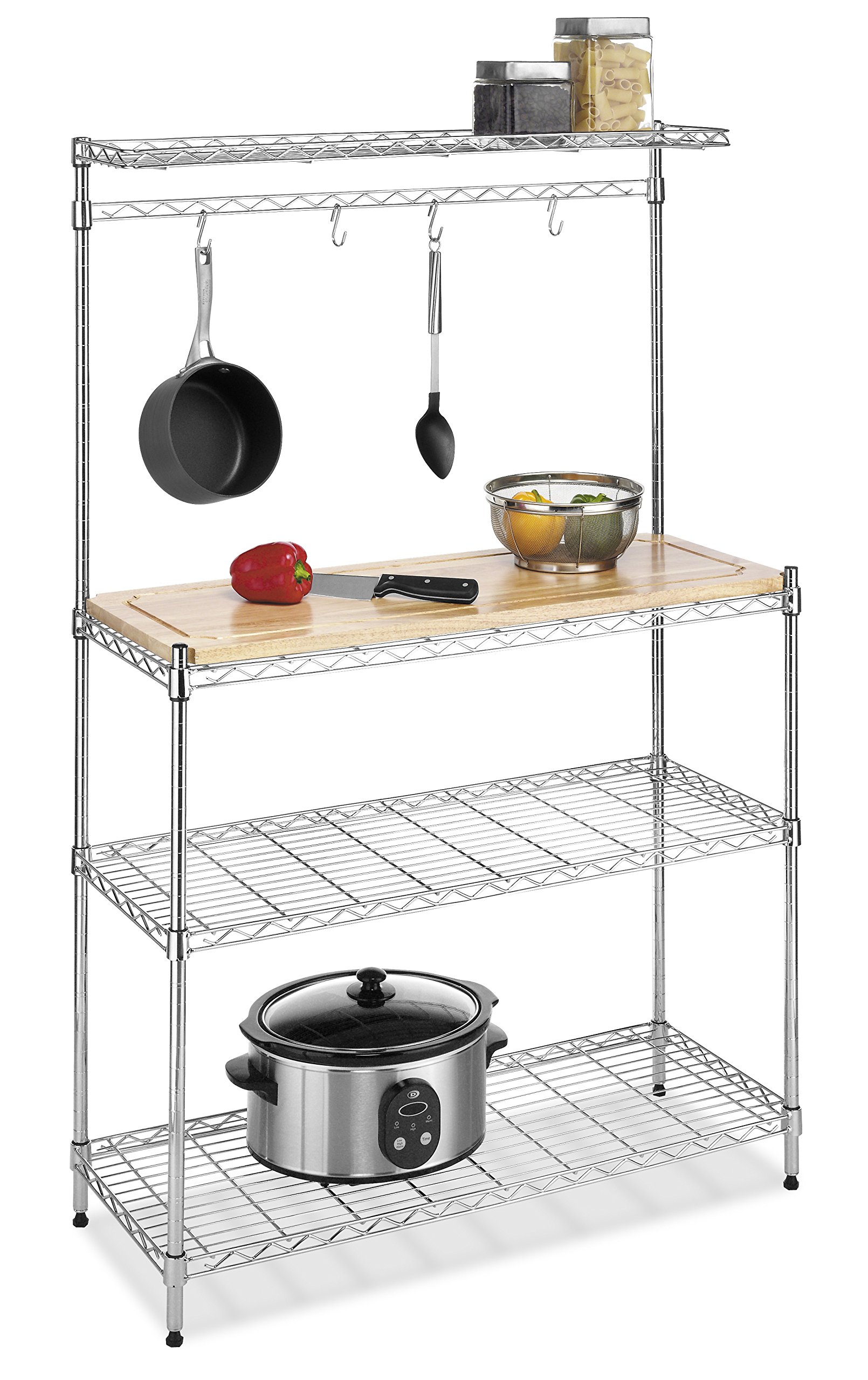
I recommend this when counter space is tight and you want a true butcher-block-style top that doubles as a cutting surface.
Why I picked it: Compact footprint with a removable cutting-board top and heavy-duty shelves.
Best for: Tight kitchens that need a small prep surface and storage.
Moderately priced for a butcher-block-style top.
Pros
- Removable wood cutting-board top
- Compact footprint for small kitchens
- Heavy-duty shelves hold cookware
- Tool-free assembly
Cons
- Only a few included hooks
- Narrow shelving width
My take
This is the rack I reach for when I need a small footprint that still functions as a prep surface — the removable wood top works well as a cutting board or platform for appliances.
Assembly took me less than half an hour with no extra tools, and the unit slid into a narrow space flush against the wall. The shelves held heavier items without sagging.
I did add a few extra hooks for pans and utensils, but otherwise it served as a compact, reliable workhorse in a tucked-away pantry area.
5. SUPERJARE Kitchen Baker’s Rack with Power Outlets – Best Value with Outlet
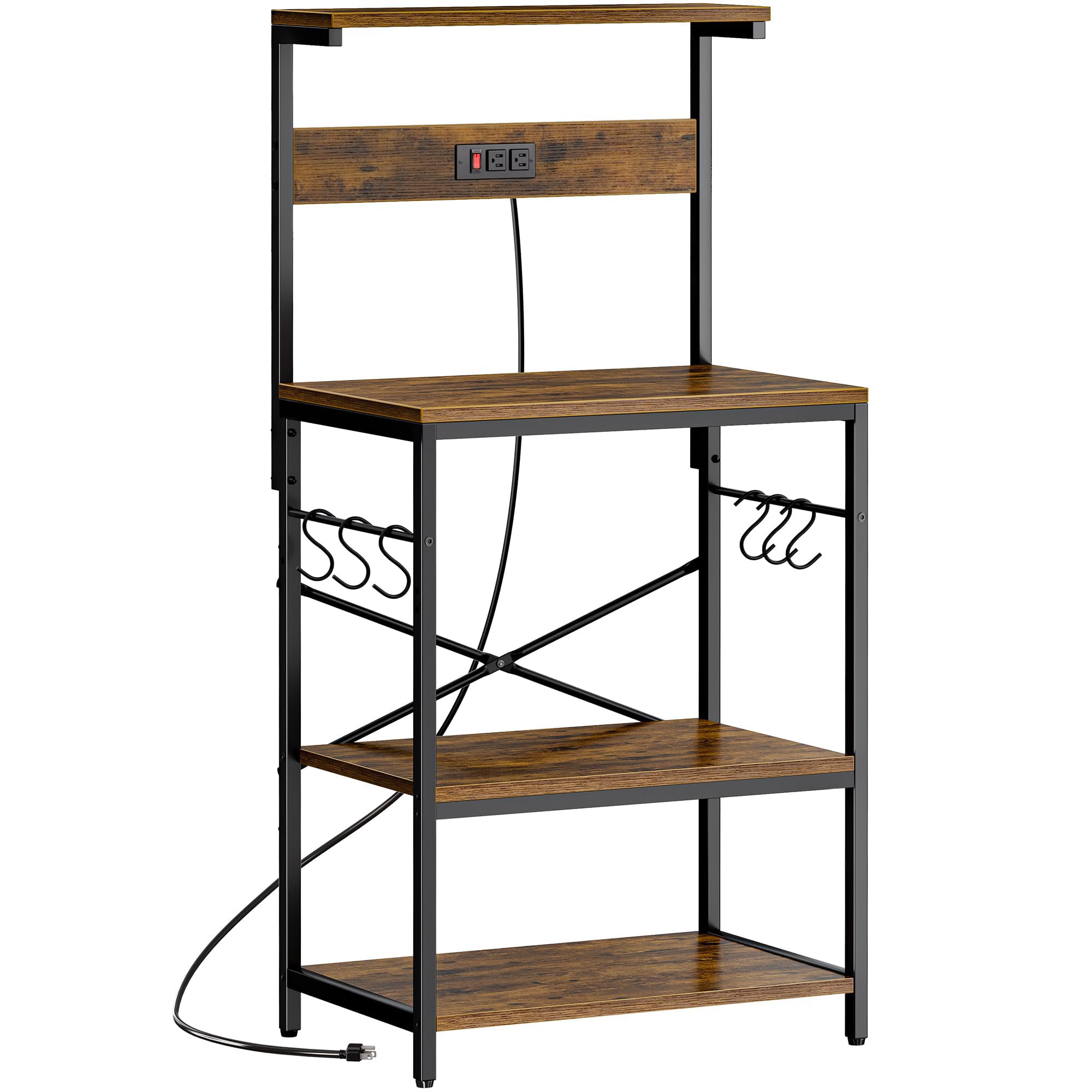
I recommend this when you want built-in outlets and flexible shelf options at a value — the removable shelf and two power outlets made it ideal for my coffee and microwave setup.
Why I picked it: Two built-in outlets, removable shelf for tall appliances, and six S-hooks.
Best for: Budget-conscious cooks needing integrated outlets.
Good value for an outlet-equipped rack.
Pros
- Two built-in power outlets with air switch
- Removable shelf for taller appliances
- Six S-shaped hooks included
- Labeled parts speed assembly
Cons
- Particleboard shelves
- Instructions rely heavily on pictures
My take
I used this rack as a tidy coffee corner with a toaster and air fryer; the two outlets and air switch meant I didn’t have to run an extra power strip across my counter.
The removable middle shelf allowed me to fit a taller appliance when needed, and the six S-hooks kept mugs and tools organized within reach.
Assembly required patience — I followed the advice to not tighten any fasteners until everything was aligned — but the finished unit felt sturdy and attractive for the price.
How I Choose a Baker’s Rack
Materials & Durability
I prioritize frame thickness and shelf material. Steel frames with X-braces or thicker tubes feel noticeably more rigid under load.
When I want a prep surface, I favor a real wood top over particleboard; wood resists off-gassing and stands up better to light chopping or hot appliances.
- Steel frames with X-brace for heavy use
- Real wood tops for prep and low odor
- Particleboard for budget-friendly storage
Size & Fit
Measure the wall or counter gap before buying. I always measure appliance widths and heights to ensure microwaves and air fryers will fit.
Depth matters more than you might expect; a shallower rack clears counters and traffic in tight kitchens.
- Measure appliance width and height first
- Choose shallower depth for narrow kitchens
- Confirm overall height for overhead cabinets
Shelving & Adjustability
I look for adjustable shelves so I can rearrange for mixers, microwaves, or storage baskets.
Removable or half shelves are useful when you need a tall opening for a mini-fridge or stand mixer.
- Adjustable shelves increase flexibility
- Removable shelves fit taller appliances
- Half-shelves add small-item storage
Integrated Power
When I’m building a coffee bar or appliance station, a built-in power strip changes everything — fewer cords, neater looks, and easier daily use.
Check outlet capacity and safety features; I prefer units with overload and leakage protection and an accessible on/off switch.
- Built-in outlets tidy cords
- Choose units with safety protections
- Confirm wattage and outlet count
Assembly & Stability
I test how things tighten and whether parts align before loading the rack. Labeled parts and clear diagrams speed setup.
Anti-tip hardware and adjustable feet are small additions I always anchor or use for uneven floors.
- Follow instructions; don’t fully tighten early
- Use anti-tip kit for safety
- Adjust feet for level placement
Frequently Asked Questions
Can a baker’s rack hold a microwave or toaster oven?
Yes — I regularly place microwaves and toaster ovens on racks labeled for appliance use. Measure the unit's shelf width, depth, and maximum shelf height, and check whether the shelf is rated or built from sturdier materials like thicker particleboard or solid wood.
Are the wood tops safe for food prep?
In my experience, real wood tops are fine for light prep and have less off-gassing than particleboard. I still recommend using a cutting board for heavy chopping to protect the surface and food safety.
Is an integrated power strip worth it?
I find integrated outlets invaluable for a coffee bar or appliance zone — they keep cords hidden and make daily use simpler. I look for built-in overload protection and an accessible on/off switch.
Do these racks need to be anchored to the wall?
I always use the included anti-tip kit or anchor the rack when it will hold heavy appliances or be in a household with kids or pets. Anchoring is a quick step that adds a lot of stability.
Final Take
I rely on different racks for different jobs: the Amazon Basics model for a wood-top prep area, VASAGLE options for style or built-in power, Whitmor for tight quarters with a cutting-top, and SUPERJARE when I need outlets on a budget.
Measure your space, decide if you need built-in power, and pick the material and footprint that match how you actually cook. I kept practicality and real-world use at the center of every pick, so any of these will serve well depending on your kitchen priorities.
