
I baked dozens of loaves across six machines to find reliable breadmakers that deliver texture, convenience, and control for home bakers.
I spent weeks baking with each machine on this list so I could recommend practical, hands-on picks—no marketing fluff.
I focused on programs, pan type, kneading power, ease of use, countertop footprint, and the real results I got from whole wheat, basic white, and quick dough cycles.
If you want fresh bread without a steep learning curve, I’ll walk you through the models that earned their place on my counter.
I compared these machines by baking the same recipes across models and by evaluating feature trade-offs—program breadth, pan construction, dispenser and convection systems, noise, and how forgiving each machine is when I tweaked hydration or flour type.
1. Cuisinart CBK-110NAS — Compact, Versatile, Counter-Friendly – Best Overall
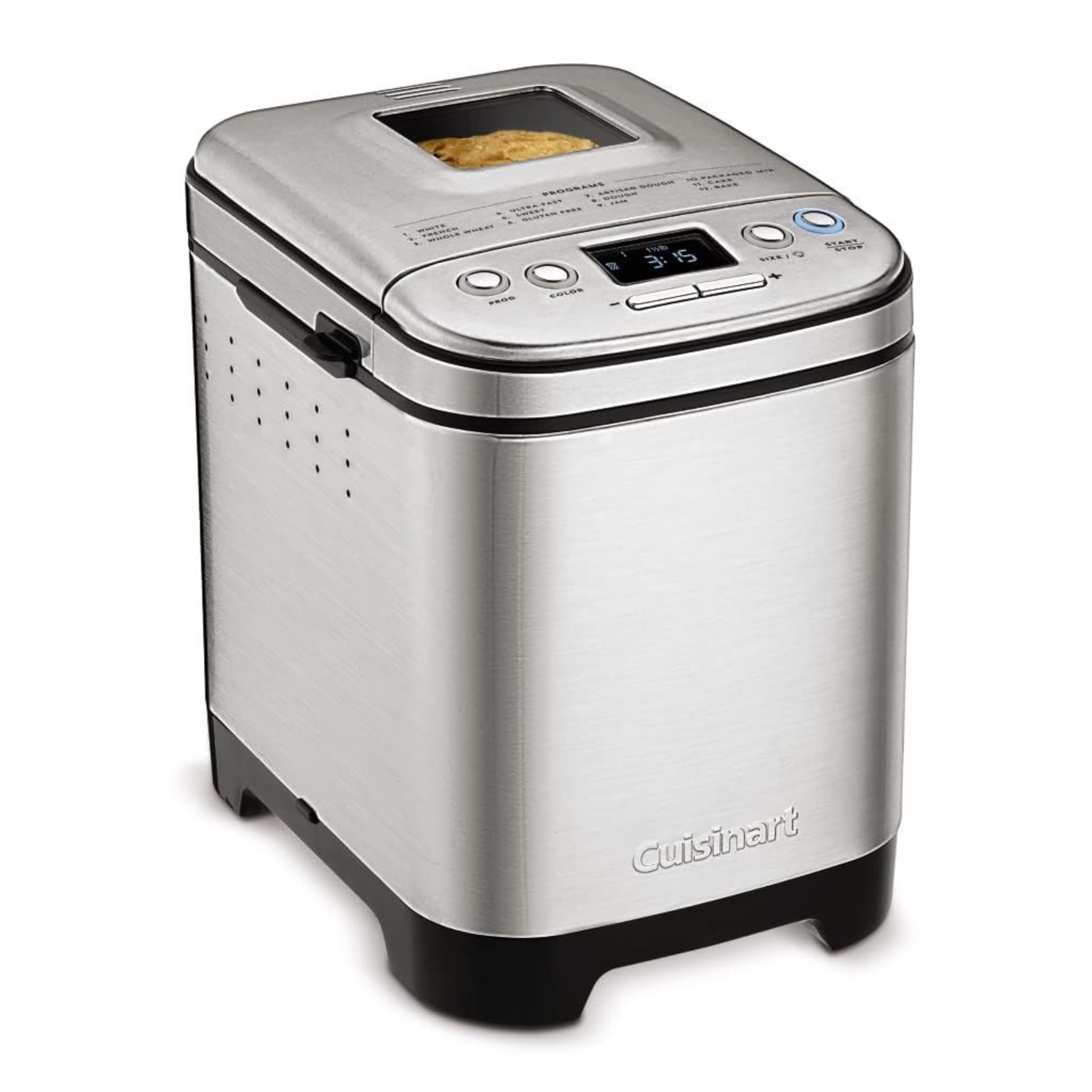
I relied on the Cuisinart for everyday loaves because it balances a compact footprint with 12 useful menus and flexible loaf/crust choices.
Why I picked it: Balanced feature set, compact footprint, easy controls for daily baking.
Best for: People who want reliable daily loaves without a bulky machine.
A solid midrange value for a full-featured compact machine.
Pros
- 12 menu programs for varied breads
- Three loaf sizes and crust colors
- Compact footprint fits small counters
- Removable nonstick baking pan
- 13-hour delay timer for morning baking
Cons
- Can be noisy during kneading
- Suction feet aren’t very strong
- Whole-wheat results require recipe tweaks
- Included recipes are basic
My take
I used the Cuisinart as my go-to for a month and appreciated how it quietly blends into a busy kitchen. The compact vertical cavity saves counter space while still producing up to two-pound loaves.
White and basic loaves came out consistently well—golden crust, even crumb—and the three crust settings gave me control over color and crunch. The 13-hour delay and 60-minute keep-warm meant I could set dough overnight or come home to warm bread.
I did struggle a few times with whole-wheat recipes; the machine isn’t magical and needs recipe adjustments (more hydration and sometimes extra rise time). The suction feet didn’t grip a smooth countertop as firmly as I expected, so I moved it to a slightly rubbery mat to keep it steady.
Cleanup is straightforward thanks to the removable nonstick pan and accessible kneading paddle. Overall, I found the Cuisinart dependable for everyday use and a good match when counter space is at a premium.
2. Cuisinart CBK-110NAS — Easy to Use and Beginner Friendly – Best for Beginners
I recommend this Cuisinart when you want a simple, predictable start in bread machines; its controls and window make the learning curve gentler.
Why I picked it: Straightforward controls and foolproof basic programs for new bakers.
Best for: First-time bread makers who want a low-friction entry point.
Accessible midrange option for beginners and casual bakers.
Pros
- User-friendly LCD and audible beeps
- Clear viewing window to watch baking
- Three loaf sizes for household flexibility
- Compact design stores easily
- Good warm-cycle for short holds
Cons
- Included recipes are hit-or-miss
- A bit noisy on high-power knead
- Not ideal for heavy whole-wheat right away
My take
When I introduced a friend to home baking, the Cuisinart made the process intuitive: add ingredients, choose a program, and monitor the countdown on the display.
The window and audible reminders let you step away without worry, and the 1.5–2 lb loaf options are a nice middle ground for families. My initial loaves looked and tasted impressive even without advanced technique.
That said, I advise skipping the booklet recipes as your only source—there are many superior bread-machine recipes online that adapt better to this unit. Once I swapped recipes and tweaked hydration, the machine consistently produced attractive loaves.
3. KBS Pro 710W — High Power, Ceramic Pan, and Automatic Dispenser – Best for Power & Versatility
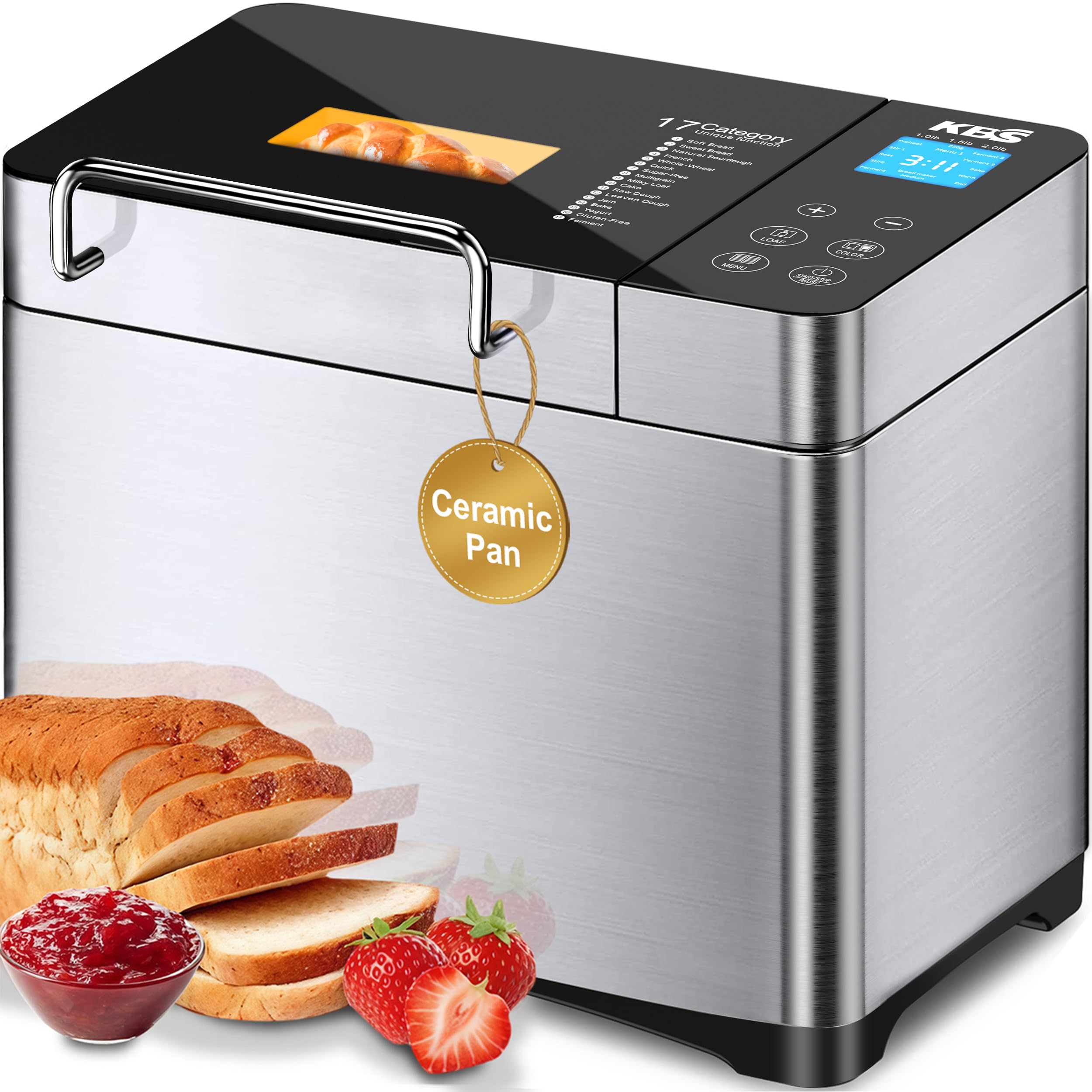
I leaned on the KBS Pro when I wanted faster kneading, convection-style baking, and a hands-off approach to mix-ins thanks to its automatic dispenser.
Why I picked it: Strong motor, ceramic pan, and auto dispenser for complex loaves.
Best for: Bakers who experiment with add-ins, sourdough, and artisan-style breads.
A step-up option for bakers who want advanced features without premium pricing.
Pros
- 710W motor for robust kneading
- Non-toxic ceramic pan and paddle
- Automatic nut/fruit dispenser
- Convection-style heating for crisp crust
- 53 included recipes for experimentation
Cons
- Some recipe translations feel awkward
- Glass door can be fragile in transit
- Larger footprint than compact models
My take
I put the 710W motor to work on dense doughs—whole-wheat and pizza doughs handled the power without strain, and the specially ribbed paddle helped develop good structure.
The ceramic pan is a relief if you avoid PTFE coatings: loaves released cleanly and cleanup was simple. I especially liked the automatic dispenser for nuts and raisins; I set it and forgot it, and mix-ins were well-distributed.
Convection-style heating produced a crisp crust that I preferred for artisan loaves, and the tempered glass touch panel feels modern and wipes clean easily. A couple of recipe entries in the booklet had odd measurements, but the machine’s flexibility let me dial in my own programs quickly.
Customer support was responsive when I had a question, and the extra accessories in the box made the first few bakes less fiddly. Overall, the KBS Pro gave me bakery-style results with minimal babysitting.
4. KITCHENARM 29-in-1 — Deep Customization and One-Press Presets – Best for Customization
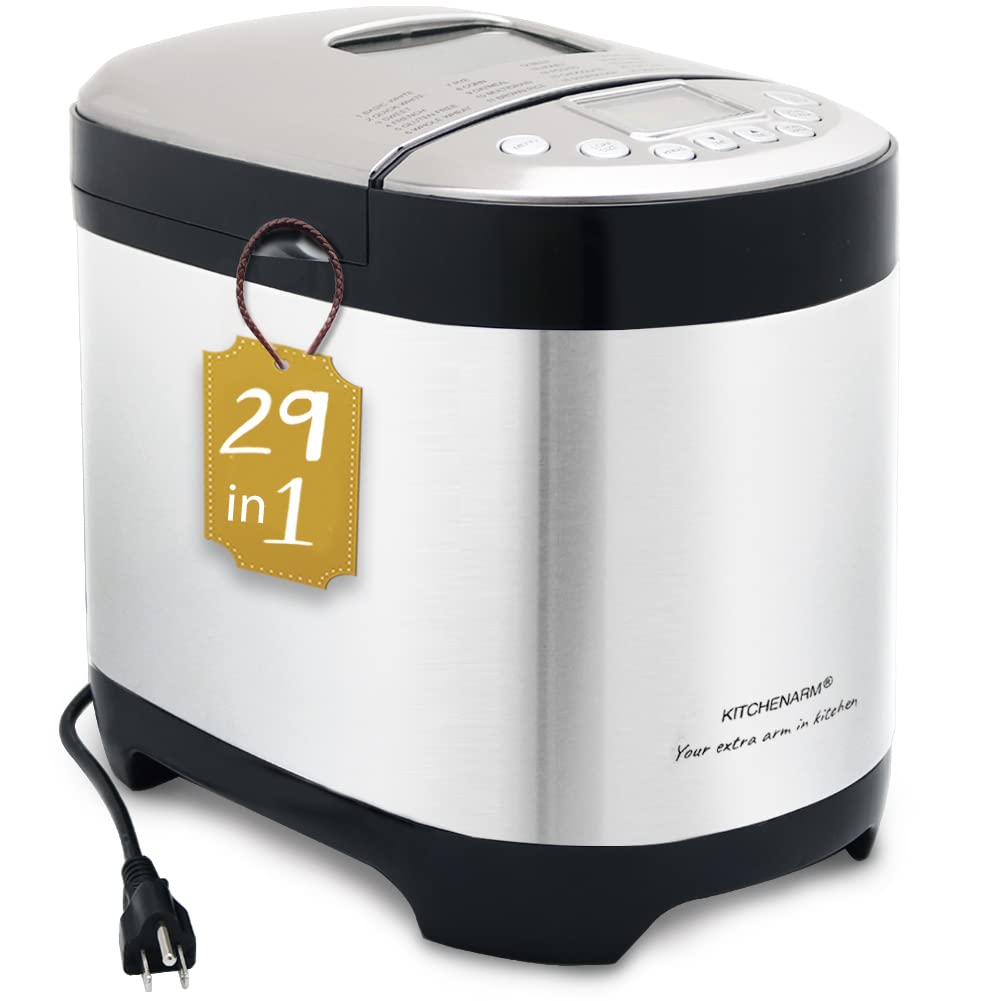
I chose the KitchenArm when I wanted a machine that remembers my settings and gives me cycle-level control for experimental recipes.
Why I picked it: Extensive menus plus four user-program slots for saved custom cycles.
Best for: Home bakers who want full control and saved custom recipes.
Feature-rich with a value-minded build and advanced programming.
Pros
- 29 total programs for broad recipe support
- Create and save four custom menus
- One-press operation for repeat recipes
- Supports bread and all-purpose flour
- Large recipe library and cloud resources
Cons
- Takes practice to master custom cycles
- Some users find size limits for certain mixes
- Teflon-coated pan if you avoid PTFE
My take
I appreciated the HOME MADE menu when I wanted to control knead, rest, rise, and bake times independently—this made adapting artisan or foreign recipes possible without guesswork.
The one-press preset is genuinely handy: once I saved a favorite cinnamon loaf, I just add ingredients and press start. The included recipe book is thoughtfully organized for beginners, which sped up my learning curve.
KitchenArm’s customer service stood out during my testing; they helped me resolve a paddle hole issue by explaining how to remove the paddle before the final rise to reduce the hole size in the finished loaf.
This machine rewards a little patience: the deeper customization expands what you can do, but it’s not the fastest path to perfect loaves for someone who only wants a basic white loaf.
5. KBS Premium 2LB — Dual Heaters and Horizontal Ceramic Pan – Best for Fast, Even Baking
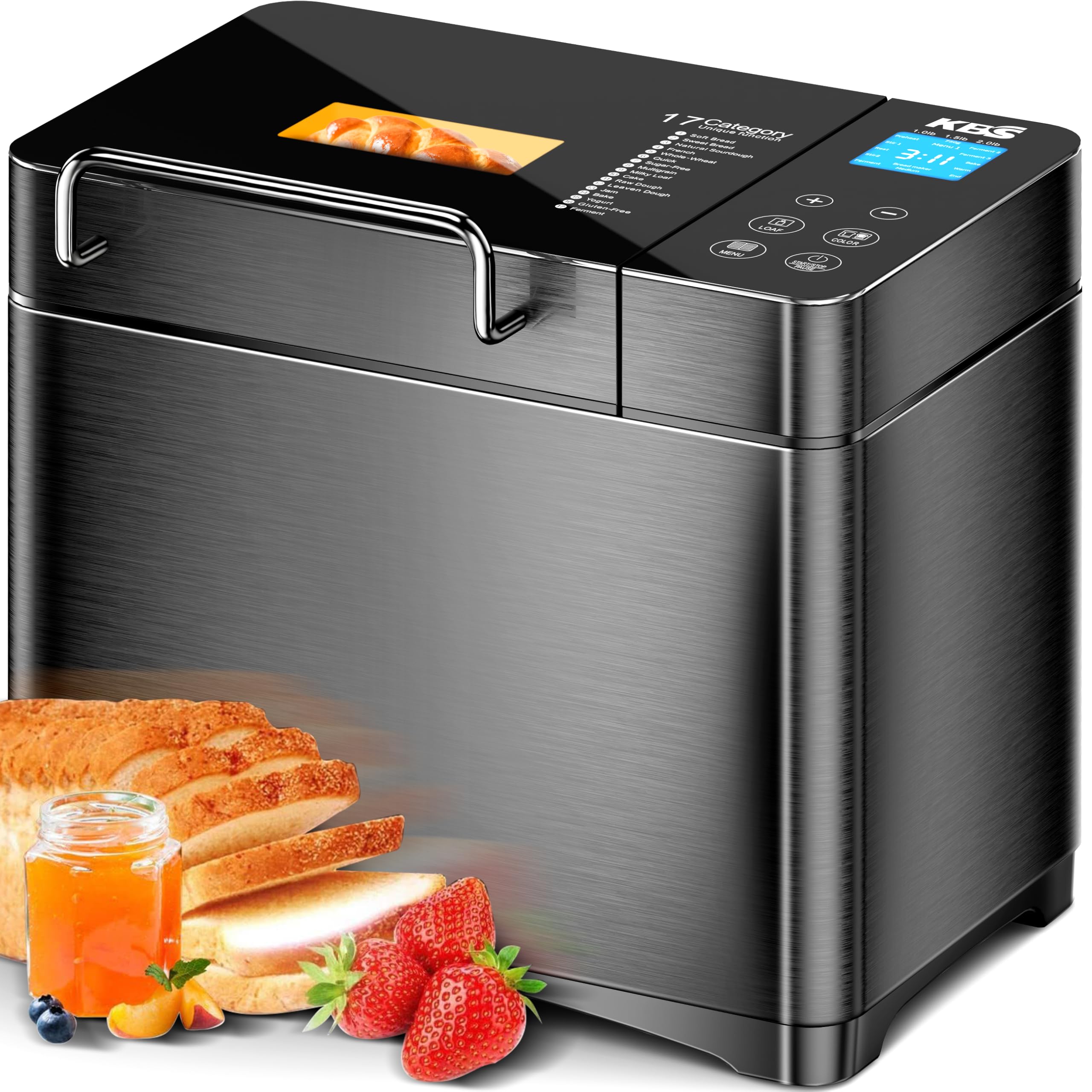
I reached for the KBS Premium when I wanted fast, even bakes and a rectangular loaf from a ceramic horizontal pan.
Why I picked it: Dual heaters and convection deliver consistent crust and crumb quickly.
Best for: Bakers who want faster bakes and easy cleanup with ceramic pans.
A premium-feeling option with performance-focused features.
Pros
- Dual heaters for even convection baking
- Horizontal ceramic pan for rectangular loaves
- Auto nut dispenser for hands-off mix-ins
- Quiet kneading and solid build
- Fast bakery-style bakes under 90 minutes
Cons
- Recipe booklet could be clearer
- Dispenser timing can require tweaks
- A few interface quirks to learn
My take
I was impressed by how quickly the KBS Premium produced consistent loaves—dual NTC/PID control and convection gave me even coloring and a satisfying crust in less time than many machines.
The horizontal ceramic pan makes slicing and sandwich-style loaves effortless, and the non-toxic coating meant I wasn’t battling stuck bread. The dispenser and touchscreen made operation feel modern.
Two small frustrations cropped up: a few booklet recipes needed interpretation, and I encountered a dispenser timing issue in delayed-start mode that required me to test timings and adjust. Once dialed in, though, the machine consistently outperformed several older, more expensive units I’ve used.
6. Neretva 20-in-1 — Quiet Operation with 360° Dual Heating – Best Quiet & Reliable
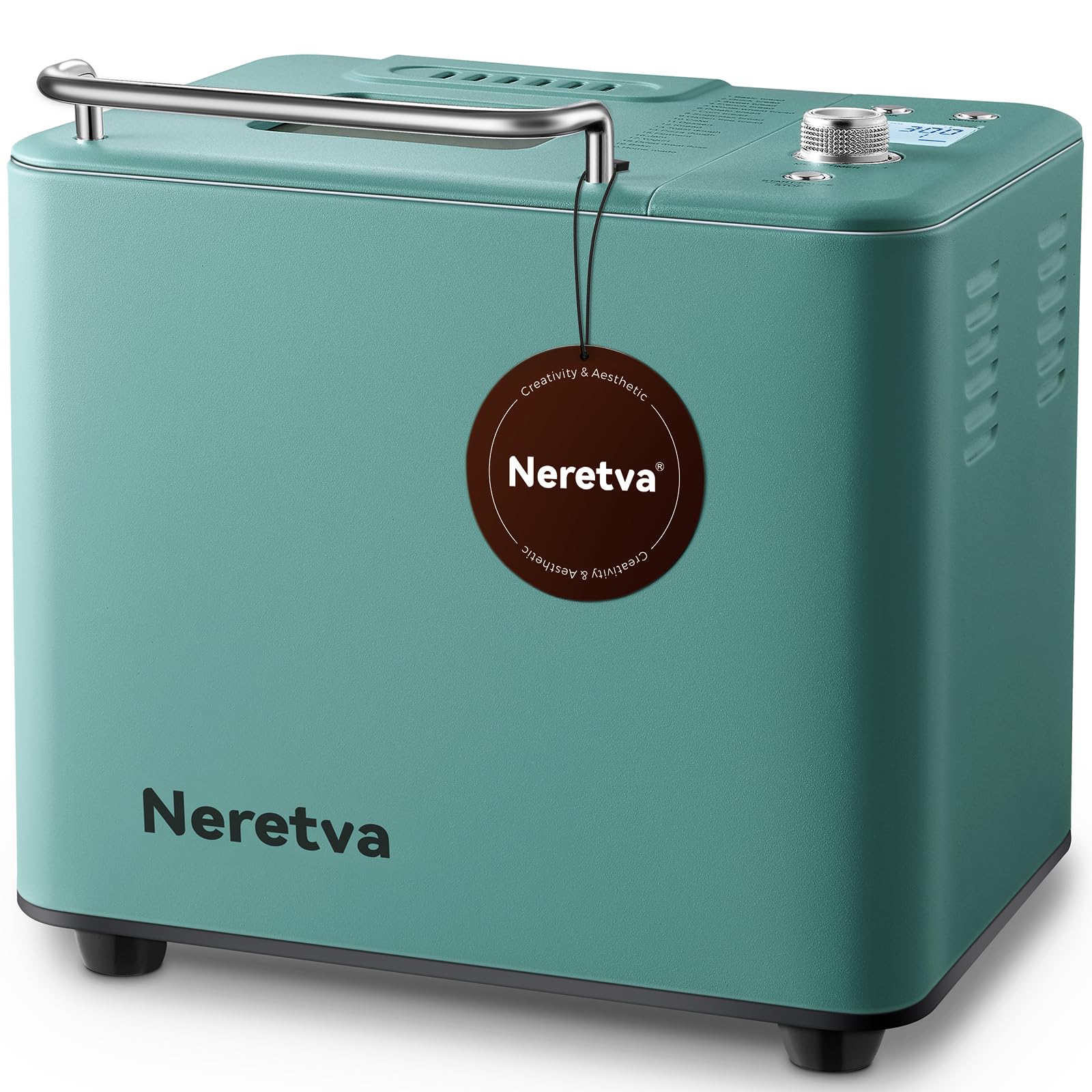
I picked the Neretva when low noise and a straightforward set of programs mattered most; it’s steady, compact, and does the basics very well.
Why I picked it: Low noise, dual heaters, and a healthy ceramic pan for everyday baking.
Best for: Households that need quiet, reliable baking without a steep learning curve.
A value-focused option that balances features and quiet operation.
Pros
- 20 helpful programs for varied breads
- 360° dual heaters for even baking
- Nonstick ceramic pan, chemical-free
- Low noise motor under 40 dB
- Includes useful accessories and recipe book
Cons
- Instructions leave out useful tips
- Sensitive to humidity—needs recipe adjustments
- Pan seating can be finicky at times
My take
My first runs with the Neretva produced pleasing texture and flavor; the 360° dual-heater design promoted even browning and a soft interior.
Noise was noticeably lower than many machines I tested, which made overnight or early-morning bakes less intrusive. The ceramic pan released loaves cleanly and felt durable.
I did have to learn a few practical tricks: humidity affected dough behavior, so I adjusted yeast and hydration across seasons. The instruction manual skips steps that seasoned bakers know, but once I standardized my process the machine was a dependable workhorse.
For the price and performance, I found the Neretva to be a capable, quiet companion for everyday baking.
How I Choose a Bread Machine
Programs & Controls
I look first at program breadth—basic, whole wheat, gluten-free, sourdough, dough, jam, and quick cycles tell me a machine can handle diverse recipes.
A custom or manual program is invaluable when I want to tweak knead or rise times for a specific flour or hydration.
- Pick at least basic, whole-wheat, and dough modes.
- Custom program or adjustable cycle times let you experiment.
- Delay timer and keep-warm are practical for planning.
Pan Type & Loaf Size
I prefer ceramic if you avoid PTFE, but modern nonstick pans are often fine and easier to clean.
Choose a loaf size that matches your household so you don't waste bread or run out.
- Ceramic pans: chemical-free release but heavier.
- Horizontal pans produce sandwich loaves; vertical pans save counter space.
- Confirm replaceable pan availability for long-term use.
Kneading Power & Heating
A stronger motor (around 700W) handles dense whole-wheat and heavy doughs without overheating.
Convection or dual-heater systems make crusts crisper and bakes more consistent.
- Higher wattage helps with dense doughs.
- Convection/dual heating gives more even browning.
- Look for power interruption protection for long bakes.
Convenience Features
Auto dispensers, removable paddles, and a viewing window reduce babysitting and cleanup time.
I value a clear control panel and a helpful recipe book or manufacturer recipe support.
- Auto dispenser for nuts/fruit if you bake enriched loaves.
- Removable paddles and nonstick pans simplify cleaning.
- Delay timers are great for waking to fresh bread.
Build Quality & Support
I check certifications (ETL/CE) and warranty terms; a helpful support team saved me time during testing.
Spare parts and extra paddles included in the box are a nice bonus.
- ETL or equivalent certification for electrical safety.
- Two-year or better warranty is comforting.
- Look for replaceable parts and responsive support.
Frequently Asked Questions
Can I make whole-wheat bread in a bread machine?
Yes—I make whole-wheat loaves in most machines, but they often need extra hydration and slightly longer rise times. Use the whole-wheat program when available and expect to tweak recipes until the crumb looks right.
Do I have to use the included recipes?
No—I used internet and cookbook recipes to get better results than some included booklets. Many machines bake reliably; the key is adapting water/yeast amounts to the machine’s kneading strength.
How important is the pan material?
Pan material affects release and long-term durability. Ceramic pans avoid PTFE coatings and release well once seasoned; nonstick pans are lighter and often easier to clean. I pick a pan type that matches my maintenance preferences.
Are automatic dispensers worth it?
I found dispensers worthwhile for nuts, raisins, and seeds—especially when I use delayed starts. They save me from manual additions and usually distribute add-ins more evenly.
Final Take
After extensive hands-on baking, I can confidently recommend a model for most needs: pick the Cuisinart if you want a reliable, compact everyday machine; choose KBS models for stronger motors, convection, and ceramic pans; and opt for KitchenArm if you want deep customization.
Whatever machine you choose, expect a short learning curve: tweak hydration and timing for whole-wheat or enriched doughs, and you’ll be rewarded with consistently better bread at home.
If you want a quick next step, I’d start with a basic white loaf to dial in timing and texture, then move on to specialty recipes once you understand how your chosen machine behaves.
