
I tested four wall-mounted and countertop can crushers so you can choose the right one for everyday recycling, heavy use, or fast pneumatic crushing.
I use can crushers to keep recycling compact and my trash cans from overflowing. Over months of testing I put four popular crushers through real use — mounting them, crushing dozens of cans, and checking durability and ease of operation.
In this roundup I explain which crushers work best for everyday kitchen use, bulk garage duty, effortless auto-drop operation, and the fastest pneumatic crushing setups. I focused on build quality, mounting, how consistently cans compress, and any maintenance or equipment they require.
If you want a simple, low-effort option for daily use choose a basic wall-mounted steel crusher. For repeated bulk crushing I prefer a thicker-steel model with a rubber-lined base and long handle. If hands-off drop and safety matter, the pivot-style 12oz crusher is the smoothest. For speed and volume, the pneumatic cylinder unit is in a different class—but it needs a compressor and higher airflow.
1. McKay 16oz Metal Wall-Mounted Can Crusher – Best Value
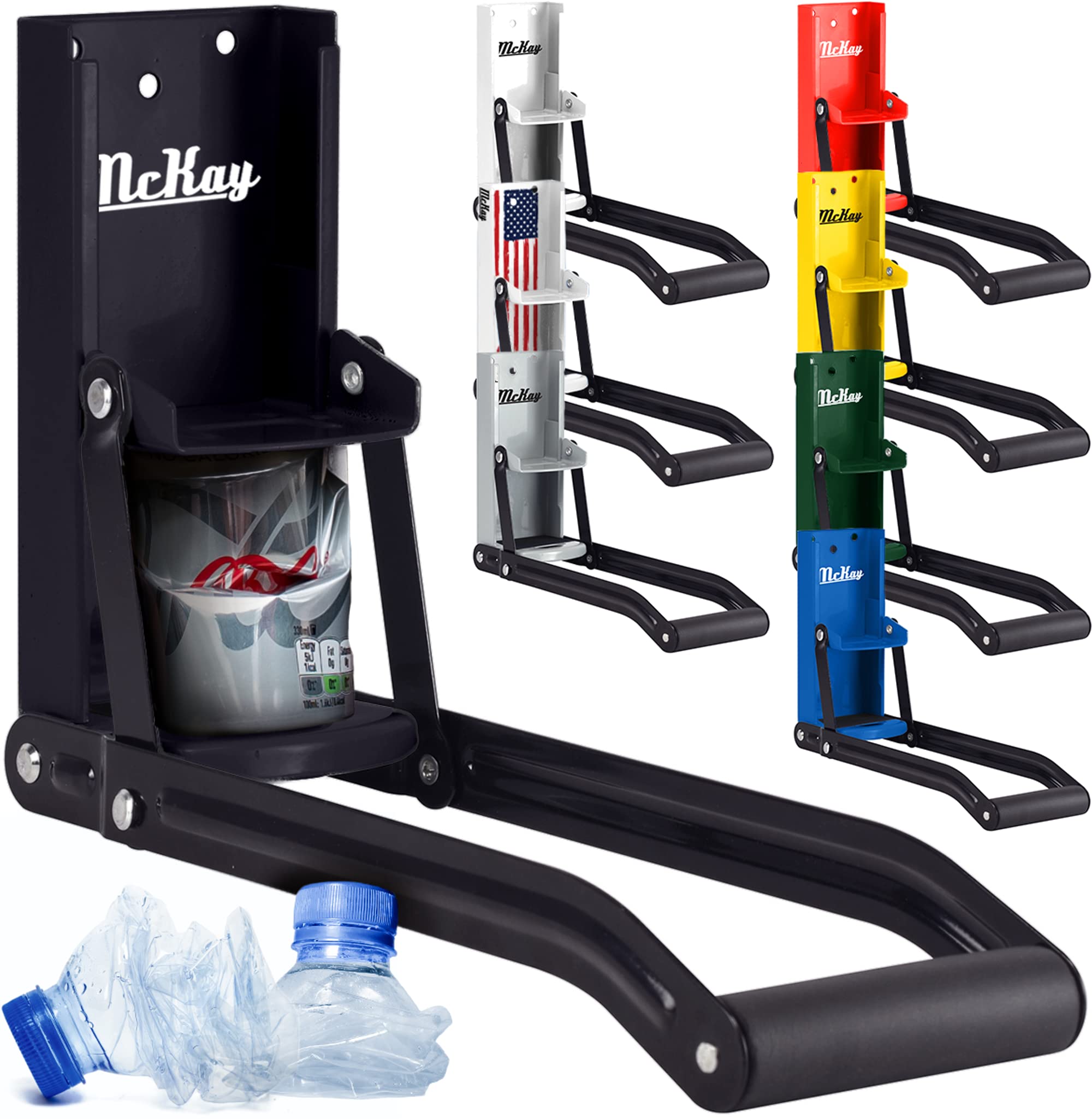
Simple, steel-built wall crusher that compresses 12–16oz cans and includes a bottle opener.
Why I picked it: I picked it for sturdy steel construction, simple two-part operation, and everyday reliability.
Best for: Everyday home use where ease and durability matter.
Affordable choice with solid materials and basic features.
Pros
- Sturdy all-steel construction
- Crushes 12–16oz cans reliably
- Easy two-part operation
- Built-in bottle opener
- Mounts almost anywhere
Cons
- Can develop play after heavy long-term use
- Occasional misfires reported
- Basic finish, not fancy
My take
I’ve used the McKay wall-mounted crusher at more than one address and appreciated how straightforward it is to install and operate. The steel frame and large cushion-grip handle make crushing cans effortless, and it handles both 16oz and 12oz sizes without fuss.
What I liked most was the simplicity: only two moving parts and a satisfying, compact result—cans compress to a fraction of their original volume so recycling takes up far less space. The included hardware made mounting quick, though I usually use stronger anchors if I’m mounting to drywall.
In long-term use I found it dependable, but I also encountered examples where a unit developed play after heavy use and a crushed can occasionally popped out. Because of that I recommend secure mounting and standing to one side when operating. Overall, this is a workhorse option if you want a basic, effective crusher that lasts.
2. HomeBuddy 12–16oz Wall-Mounted Can Crusher – Best for Bulk Crushing
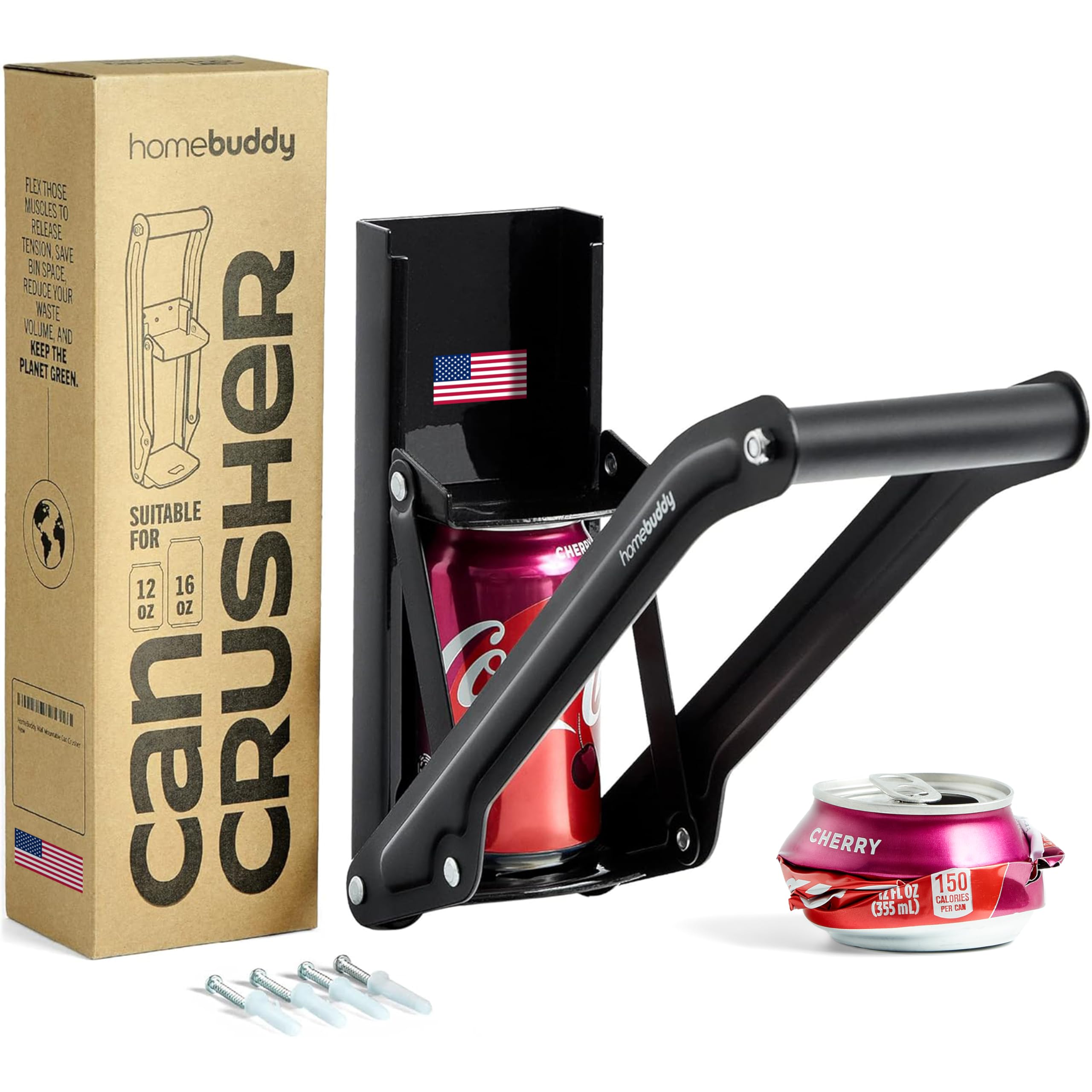
Reinforced steel crusher with a rubber-lined base and long handle for repeated crushing.
Why I picked it: I chose it for its reinforced build and rubber base that prevents cans from popping out during heavy use.
Best for: Garages, workshops, or anyone crushing many cans at once.
A mid-range, durable option that balances strength and comfort.
Pros
- Thick sheet-steel frame
- Rubber-lined base prevents popping
- Long wide handle for leverage
- Mounts securely to walls
- Handles 12–16oz cans
Cons
- Hinges may need periodic oiling
- Requires good anchors for heavy use
- Not fully silent in operation
My take
I installed the HomeBuddy in my garage because I wanted a crusher that could stand up to repeated use. The thicker sheet steel and reinforced rivets give it a confidence-inspiring feel, and the longer, wider handle makes quick work of bulk crushing without tiring my arm.
The rubber-lined base is a practical detail — I rarely had a can slip or pop back out during operation. It’s easy to mount above a trash can and crush several cans in succession; just be ready to oil the pivot occasionally if you want the smoothest action over time.
I also found the instructions sparse on some drill details, so I used a 1/4" bit for anchors based on what worked for me. For anyone who needs a durable, no-nonsense crusher for steady throughput, this is a strong choice.
3. Dial Industries 12oz Wall-Mounted Can Crusher – Best for Easy, Safe Use
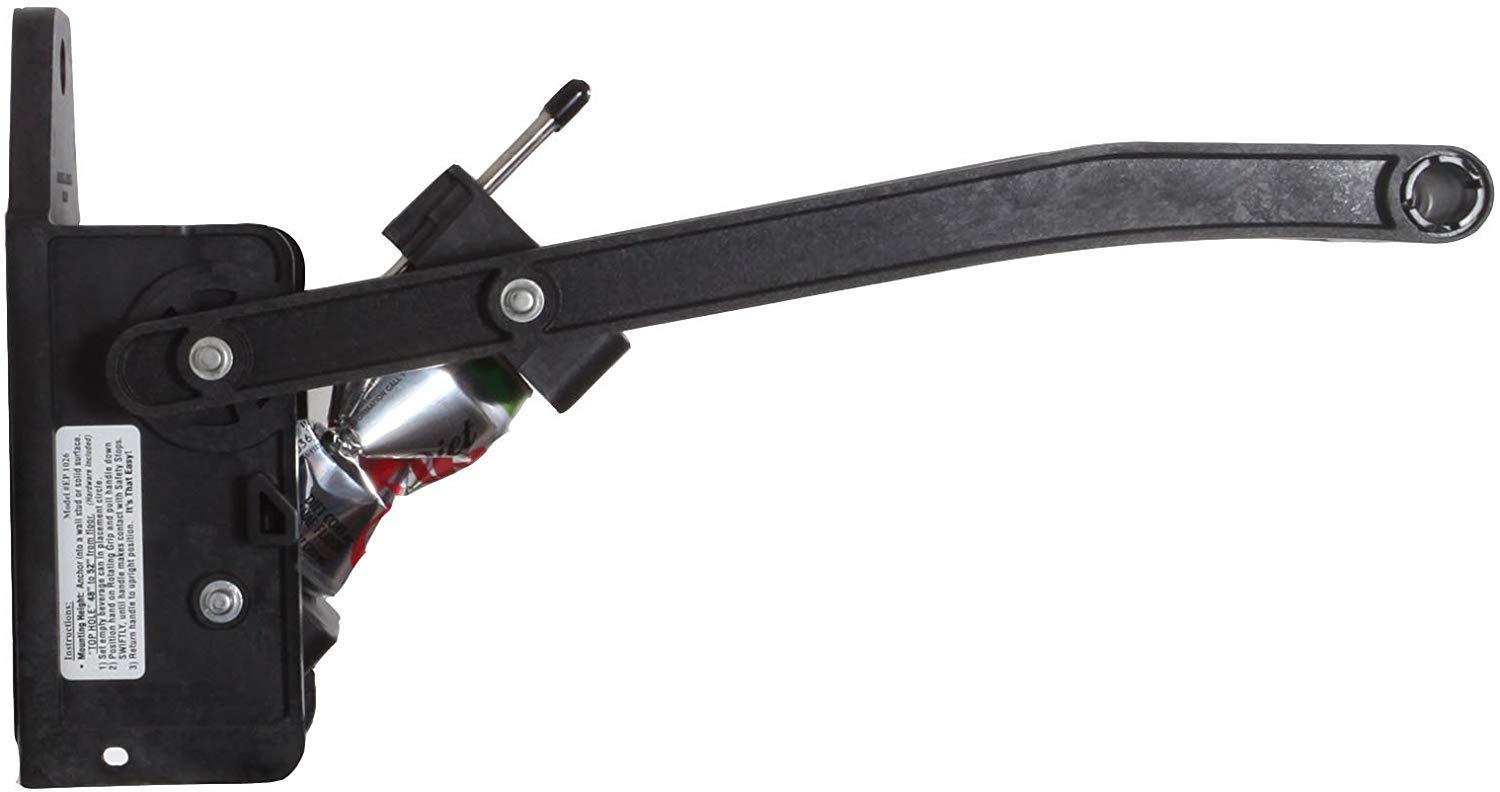
Patented pivot design that makes crushing easier, with auto-dispense and safety features.
Why I picked it: I valued the rotating grip, automatic can drop, and safety stops that reduce pinching risk.
Best for: Families and kitchens where auto-drop and kid safety matter.
A slightly higher-end, user-friendly option built for consistent operation.
Pros
- Patented pivot reduces effort
- Auto-dispenses crushed cans
- Rotating ergonomic grip
- Child safety stops
- Durable construction
Cons
- Made for 12oz cans only
- Plastic parts may not suit extreme heavy use
- Requires a bin underneath
My take
I installed the Dial Industries crusher in a semi-finished garage and immediately noticed how easy it is to use. The pivoting mechanism dramatically reduces the effort required compared with straight-lever crushers, and crushed cans simply fall into my bin without me touching sharp edges.
The rotating hand grip is comfortable and the safety stops give me confidence when kids want to help. It’s designed for 12oz cans, so I don’t use it for taller 16oz varieties, but for standard soda and beer cans it turns multiple bags of cans into a much smaller bundle.
This unit feels well engineered and has stood up to daily use in my household. If you want the simplest, safest experience and an automatic drop into a receptacle, this is my top pick.
4. Pneumatic Air Cylinder Can Crusher (Countertop) – Best for Fast Crushing
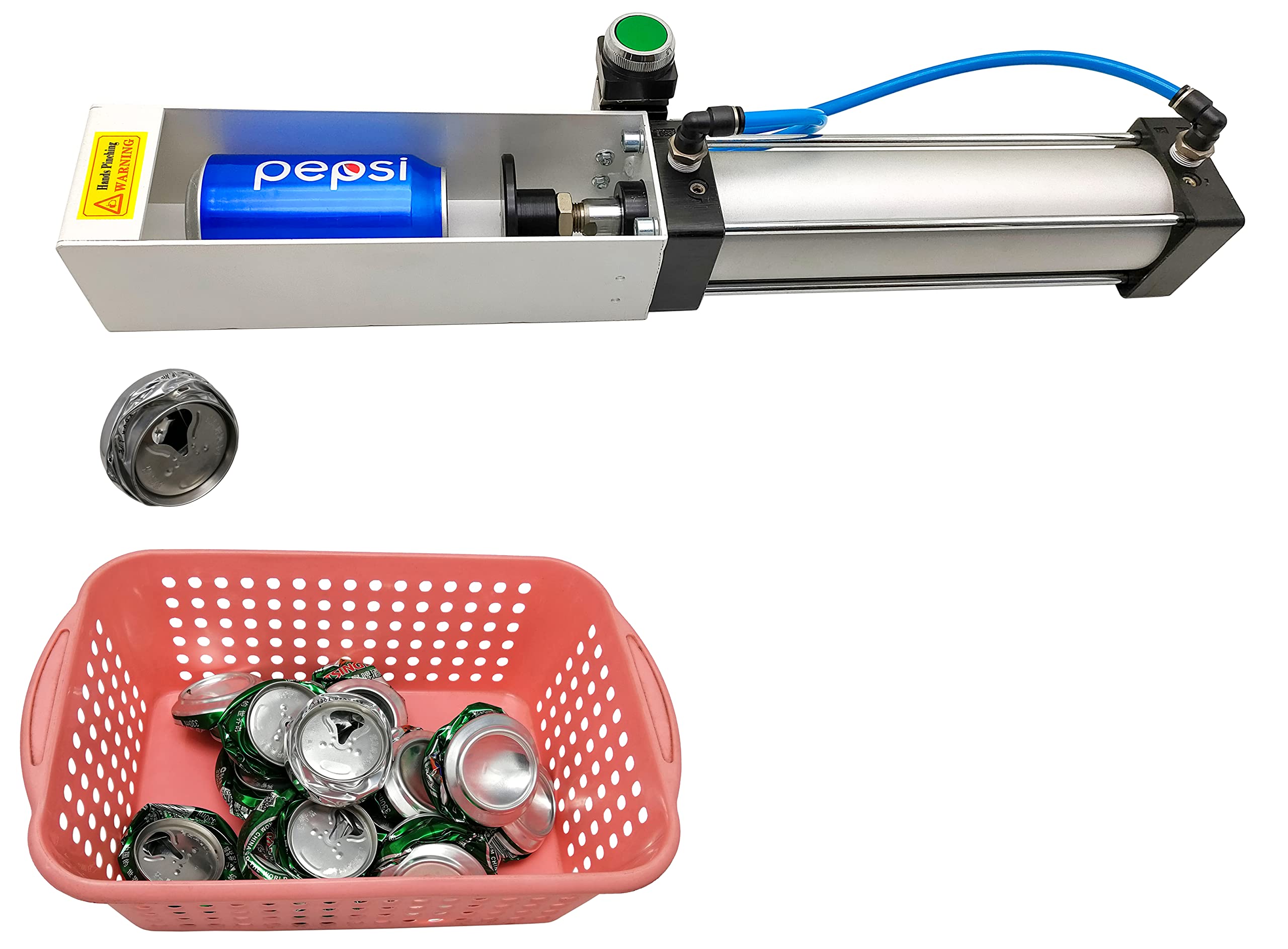
Air-driven crusher that smashes cans at the push of a button — fast and consistent for high volume.
Why I picked it: I chose it for speed and uniform crushing when processing very large volumes of cans.
Best for: Workshops, small businesses, or anyone with an air compressor and high throughput needs.
Higher upfront complexity but excellent for saving space quickly.
Pros
- Push-button pneumatic operation
- All-steel frame and piston
- Consistent, powerful crushing
- Adjustable for many can sizes
- Safer with mechanical valve
Cons
- Requires an air compressor and adequate CFM
- Uses significant air during long runs
- Needs basic pneumatic familiarity to install
My take
Once I hooked the pneumatic crusher to a compressor, crushing cans became a one-button task — incredibly fast and consistent. It chews through a full trash container of cans and reduces that volume down to a single bag in minutes.
Assembly was straightforward if you know a few basics about pneumatic fittings; I paid attention to wrench placement to avoid damaging fittings and followed the included instructions. The unit works well at around 80–100 PSI but benefited from a compressor with higher CFM when I ran many cans in a row.
If you want industrial-style speed and have the compressor capacity, this is the most efficient option I’ve used. Just plan for installation space, air plumbing, and the fact that it consumes a fair amount of compressed air during heavy runs.
How I pick a can crusher
Mounting and placement
I always decide first where the crusher will live — kitchen, garage, or countertop — because mounting type and anchor strength matter. Wall-mounted units need good anchors if installed on drywall; if I expect heavy use I mount into studs or use heavy-duty anchors.
Countertop pneumatic units require a stable surface and room for an air hose and compressor nearby, so I plan layout before buying.
- Mount above a trash or recycling bin for auto-drop convenience
- Use stronger anchors for high-traffic areas
- Allow clearance so the handle can swing freely
Can size and capacity
I check whether a crusher handles standard 12oz cans only or both 12oz and 16oz. If you drink tall 16oz cans, choose a model that explicitly supports them.
Think about throughput: a thicker-steel crusher with a long handle feels better for bulk work, while a pivot-style 12oz crusher is easiest for daily household use.
- 12oz-only units are often easier to operate
- 12–16oz compatibility adds flexibility
- For large volumes, prioritize handle leverage or pneumatic power
Materials and durability
I prefer models with thick steel frames or reinforced rivets for longevity. Plastic-bodied pivot crushers can still be very durable, but check construction details and safety stops.
For heavy, repeated use, rubber-lined bases and reinforced handles reduce slipping and wear.
- All-steel frames for heavy-duty use
- Rubber-lined bases prevent can bounce
- Reinforced rivets resist wear over time
Safety and maintenance
I look for safety stops, auto-dispense features, and designs that keep my hands away from crushed can edges. Rotating grips and child-safety features make a big difference for family use.
Maintenance is simple: oil pivots occasionally and check mounting hardware. Pneumatic units need proper fittings and an adequate compressor.
- Auto-drop reduces contact with sharp cans
- Oil pivots periodically for smooth operation
- Verify compressor PSI and CFM before buying pneumatic units
Frequently Asked Questions
Will these crushers handle both 12oz and 16oz cans?
I make sure to check the product spec: some models like the McKay and HomeBuddy explicitly handle 12–16oz cans, while the Dial Industries unit is designed for 12oz only. If you drink tall or specialty cans, choose a model that lists 16oz compatibility.
Can I mount a crusher on drywall?
I mount these on drywall using the included anchors for light-duty use, but for repeated heavy crushing I secure the unit to studs or use heavy-duty anchors to avoid wobble or premature wear.
Do pneumatic crushers need a special compressor?
I use a compressor with sufficient PSI and good CFM — the pneumatic crusher runs best around 80–100 PSI and benefits from higher continuous CFM for long runs. A small portable compressor can work for occasional use, but heavy throughput needs a more capable machine.
How do I collect crushed cans safely?
I place a bin directly under wall-mounted units so crushed cans fall in; for pivot-style crushers that auto-dispense, a simple waste basket works. Always keep hands clear and let crushed cans fall before resetting the handle.
Final Take
I found a clear split: simple steel wall crushers deliver excellent everyday value; reinforced models with rubber-lined bases are my pick for bulk garage duty; pivot-style 12oz units are the easiest and safest for families; and pneumatic crushers excel when speed and volume matter.
Decide whether you need convenience, durability, or throughput, and pick the crusher that matches where and how often you’ll be using it. I keep at least one of these in my recycling setup and it’s made hauling and storing cans much less of a chore.
