
I tested a range of propane heaters for garages, workshops, and patios — from pocket-sized Buddies to high-BTU tank-top units — and picked the models that actually deliver heat, safety features, and easy setup.
I’ve spent time heating everything from canvas tents and camper vans to two-car garages, and I know how different needs call for very different heaters.
In this roundup I cover compact portable models for spot heating, tank-top and dual-head heaters for workshop work, vent-free options for whole-room warmth, and heavy-duty patio units for outdoor comfort.
I focused on heat output, safety systems (ODS and tip-over shutoffs), fuel options, and real-world usability so you can match a heater to your garage, shop, or outdoor space.
If you need mobility and short-run convenience pick a Buddy-style unit; if you need wholesale garage heat choose a tank-top or vent-free unit; for outdoor entertaining the tall patio heaters give wide-area coverage.
1. Mr. Heater Portable Buddy 9,000 BTU – Best Portable Buddy
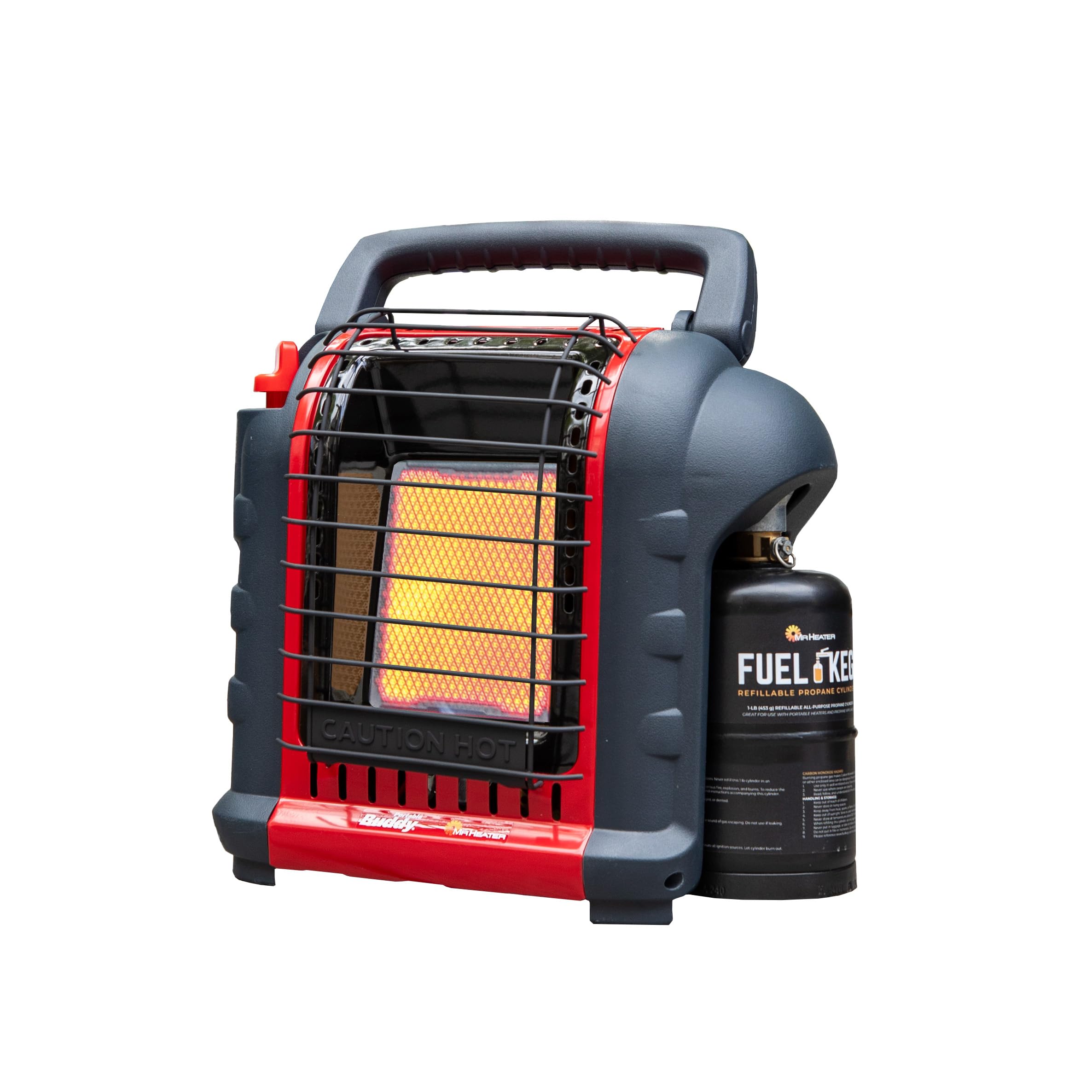
Small, rugged radiant heater that I carry for tents, campers, and quick garage tasks.
Why I picked it: Compact, quick to set up, and surprisingly warm for its size.
Best for: Spot heating in tents, small garages, and camping setups.
Affordable and economical to run on disposable or refillable cylinders.
Pros
- Lightweight and highly portable
- Two heat settings for flexibility
- Built-in ODS and tip-over shutoff
Cons
- Radiant heat is directional
- Shorter run time on 1-lb cylinders
My take
I keep a Portable Buddy in my camping gear and in the workshop for quick spot heat. Its radiant burner feels like a small sun — you notice warmth instantly when you stand in front of it, which is perfect for working at a bench or warming a tent entrance.
Setup is literally minutes: screw on a 1-lb cylinder or use the Buddy hose to attach a larger tank. On a 1-lb bottle I get the run times the listing suggests, and on a 20-lb tank this little unit will run for many hours depending on the setting.
Safety features matter in confined spaces; I’ve tested the tip-over shutoff and it works reliably, and the oxygen depletion sensor gives me confidence when I use the unit in semi-enclosed spaces with a cracked vent.
What I watch for is placement — because it’s infrared, heat is strongest where it’s pointed. For warming a person or a small work area it’s ideal; to raise overall room temperature you’ll need a larger unit or supplementary airflow.
2. Mr. Heater Big Buddy 18,000 BTU – Best for Bigger Garages
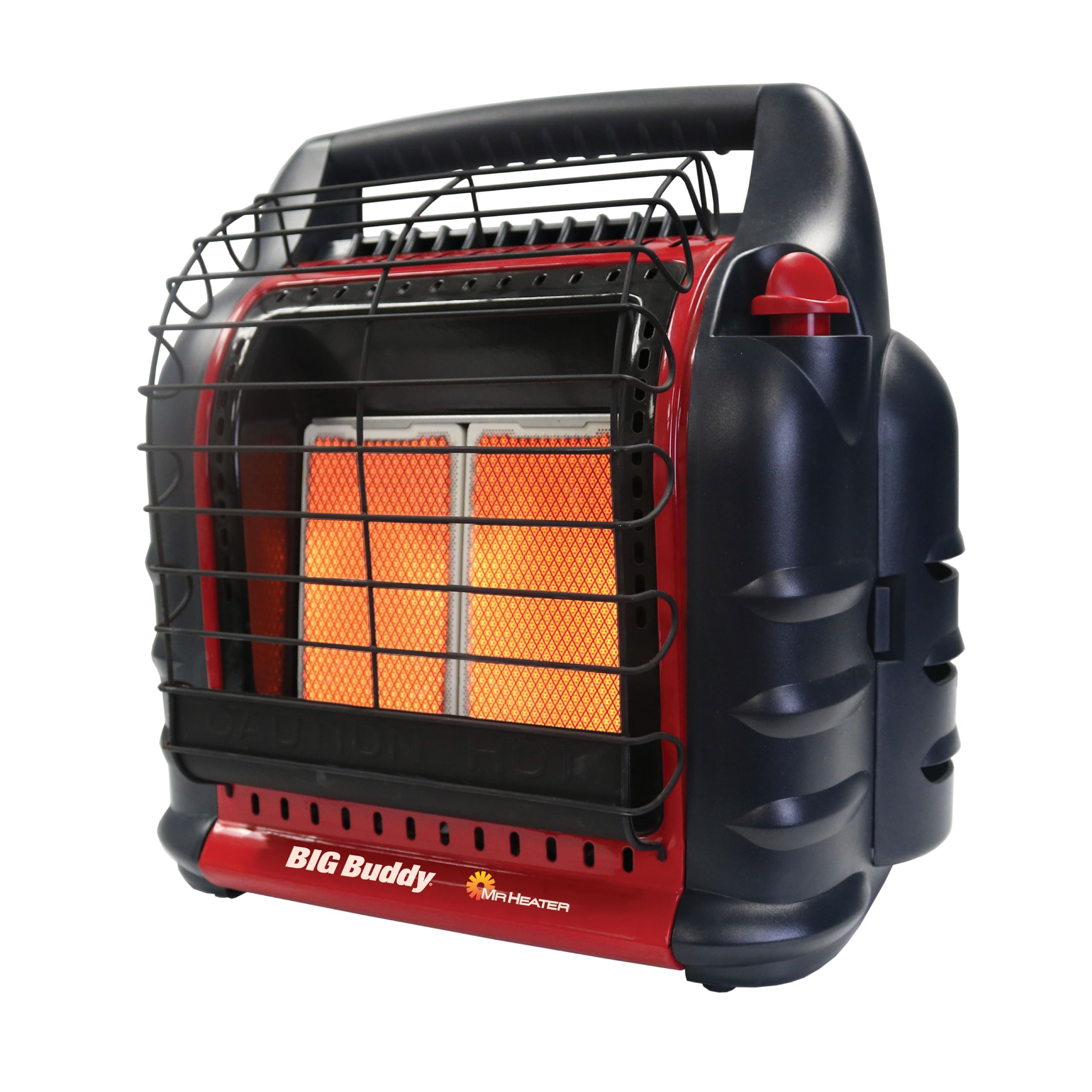
A step up in BTU for larger garages and workshop spaces that still stays portable.
Why I picked it: Higher output and multiple heat settings without losing portability.
Best for: Medium to large garages, workshops, and bigger tents.
Mid-range option that balances portability and raw heat.
Pros
- Up to three heat settings
- Can connect to 20-lb tanks
- Covers larger square footage
Cons
- Heat concentrates near the unit
- May need a fan for even distribution
My take
When I needed more heat than a Buddy could deliver, the Big Buddy made the difference. It cranks out a lot more infrared warmth and will quickly take the edge off a cold garage.
I like the swivel regulators and the ability to run two 1-lb cylinders or hook the unit to a 20-lb tank with the optional hose. That flexibility means I can run it on disposables for a weekend or on a full tank for longer stretches.
Because the output is strong, I sometimes combine it with a small circulation fan to move heat away from the unit and down to where I’m working. Without that fan most of the radiant heat stays close to the heater.
The built-in Life Safety System — oxygen depletion sensor, thermal shut-down, and tip-over protection — is reassuring for indoor or semi-enclosed use, which is why I’m comfortable running this in my detached garage when I ventilate it slightly.
3. Mr. Heater Tank-Top 45,000 BTU – Best High-BTU Tank-Top
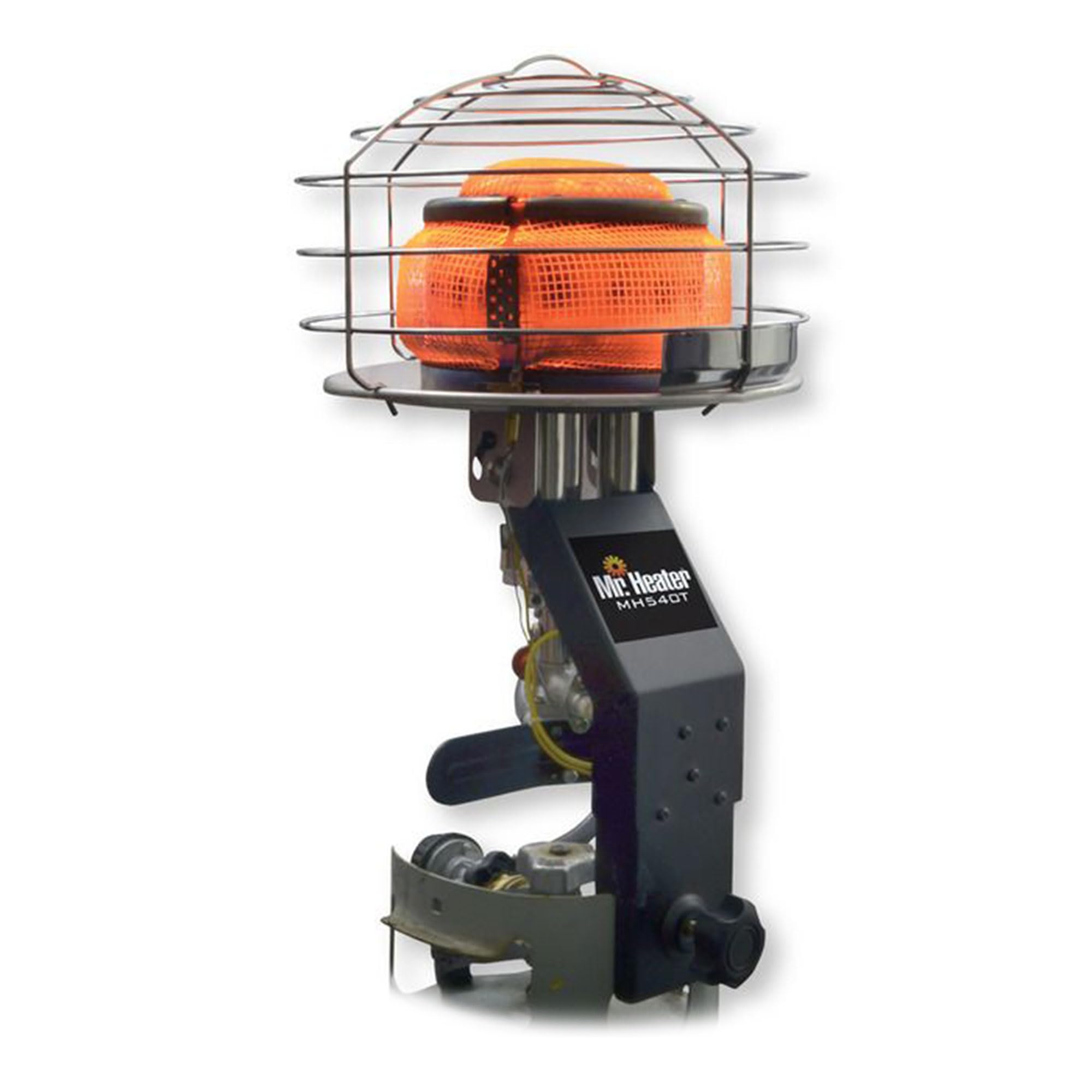
A heavy-hitting tank-top radiant heater that I use when the garage needs serious heat fast.
Why I picked it: Massive output from a compact tank-mounted form factor.
Best for: Uninsulated or large garages and job-site heating.
Strong value for heavy-duty, short-term heating needs.
Pros
- Very high BTU output
- Multi-directional bracket
- Mounts directly to 20-lb tank
Cons
- Outdoor-use rated only
- Initial lighting takes a moment
My take
For my coldest shop days I mount this tank-top unit to a 20-lb cylinder and let it run — it heats a two-car garage to comfortable working temps far faster than a small torpedo heater.
The 360-degree burner head and swivel bracket let me aim heat where I want it, and the three-position regulator is useful for dialing output to the job at hand.
The first light-up needs patience to get the mantle glowing, but after that ignition is quick. I’ve left the unit running under my welding table and it fits into tight shop layouts without hogging floor space.
Keep in mind this model is for outdoor use only, so I use it in my ventilated garage or outside on the driveway and never in tightly sealed indoor living areas.
4. Mr. Heater Big Buddy PRO 18,000 BTU – Best for Pro/Workshop Use
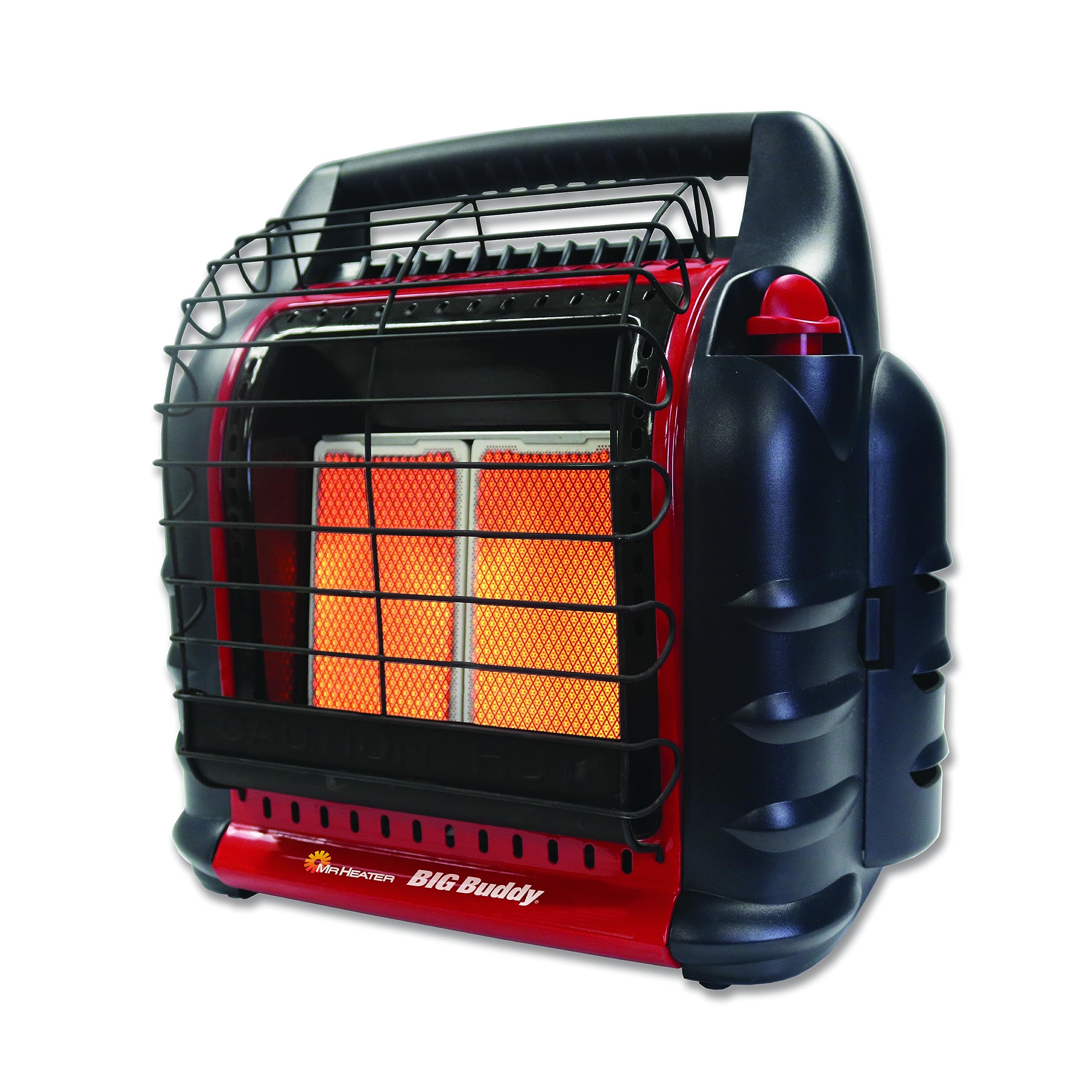
A professional-grade Big Buddy with fan-enhanced heating for more even distribution.
Why I picked it: Blends radiant and convection heat for larger indoor spaces.
Best for: Workshops, job sites, and emergency indoor heating (with ventilation).
A higher-end portable option with pro features.
Pros
- Radiant plus fan-driven convection
- Three heat levels for control
- Good for up to ~450 sq ft
Cons
- Some models shipped without fan
- Fan models are heavier
My take
I use the PRO in my workshop when I need even, steady warmth rather than a single hot spot. The integrated fan mixes radiant and convection heat so the whole space comes up to temperature more predictably.
It’s easy to light and the low/medium/high knob gives straightforward control. I’ve connected mine to a 20-lb tank for long stretches and appreciated the runtime and power.
A note from my hands-on time: some batches of this model have the fan removed due to supply changes, so if the fan matters to you verify the listing before you buy. When the fan is present it noticeably improves heat spread.
The PRO series feels built for tougher use, and I’ve relied on it during power outages as a dependable emergency heat source when I ventilate the area appropriately.
5. Mr. Heater 30,000 BTU Vent-Free Blue Flame – Best Vent-Free Whole-Room
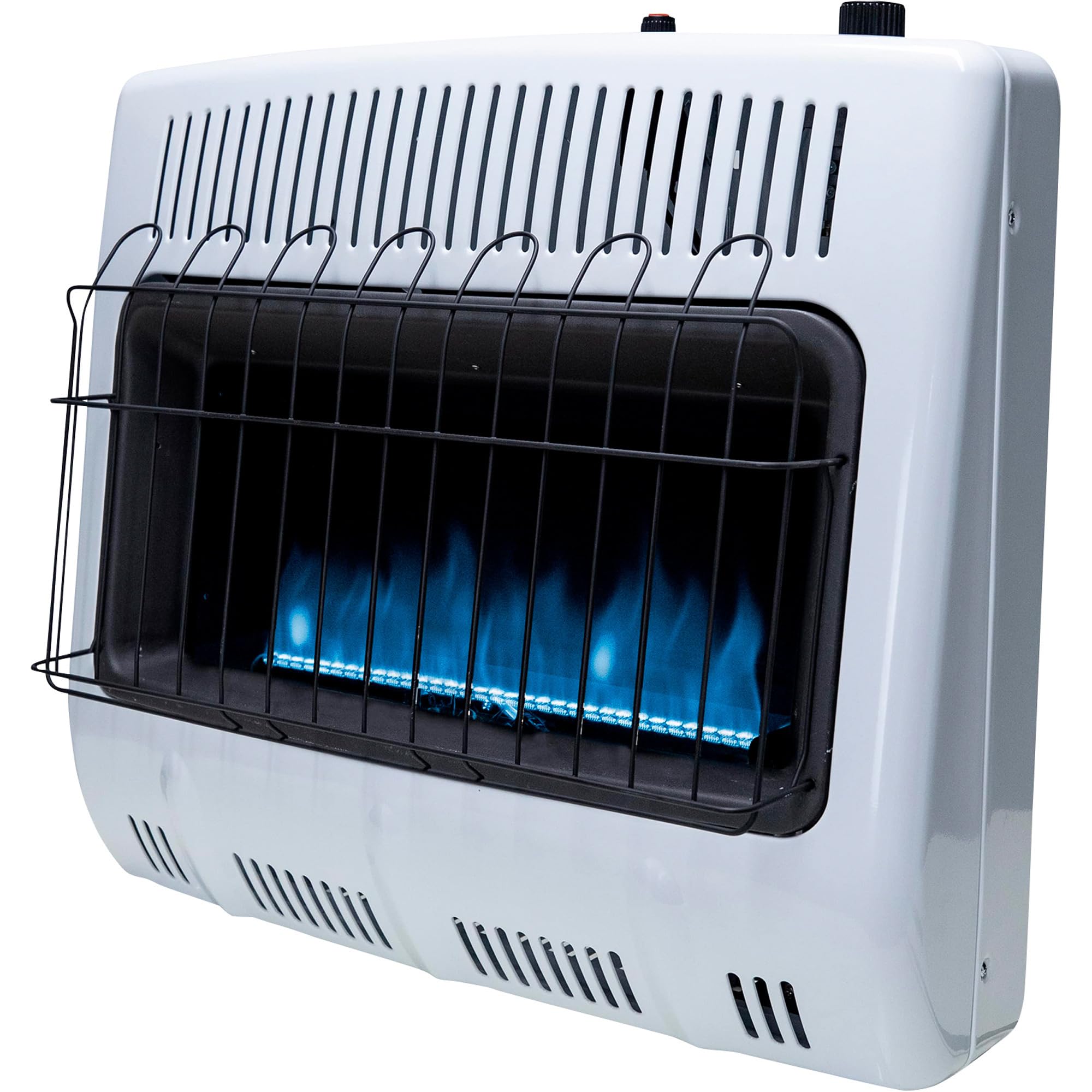
A vent-free blue flame heater I’ve used to heat larger rooms where wall mounting is possible.
Why I picked it: Convection-style vent-free heating that spreads warmth through the air.
Best for: Mounted heating for large rooms or workshops with proper clearance.
Higher upfront cost but replaces larger fixed systems for whole-room warmth.
Pros
- Convection spreads heat widely
- Built-in thermostat for control
- No electrical connection required
Cons
- Vent-free requires careful placement
- Optional blower may have limited reach
My take
I installed the vent-free Blue Flame unit in a woodworking shop and was impressed by how it warmed the air throughout the space rather than just a single spot.
The included thermostat and piezo ignition simplify daily use; the unit brought my workspace up several degrees in a few hours and kept it steady.
I experimented with the optional blower but found it best to pair the heater with a separate circulation fan placed slightly above the unit to distribute heat farther across the room.
Because it’s vent-free, I pay close attention to clearances and to the oxygen depletion sensor — I treat ventilation as part of the installation and operation routine.
6. EAST OAK 50,000 BTU Patio Heater – Best Outdoor Patio Heater
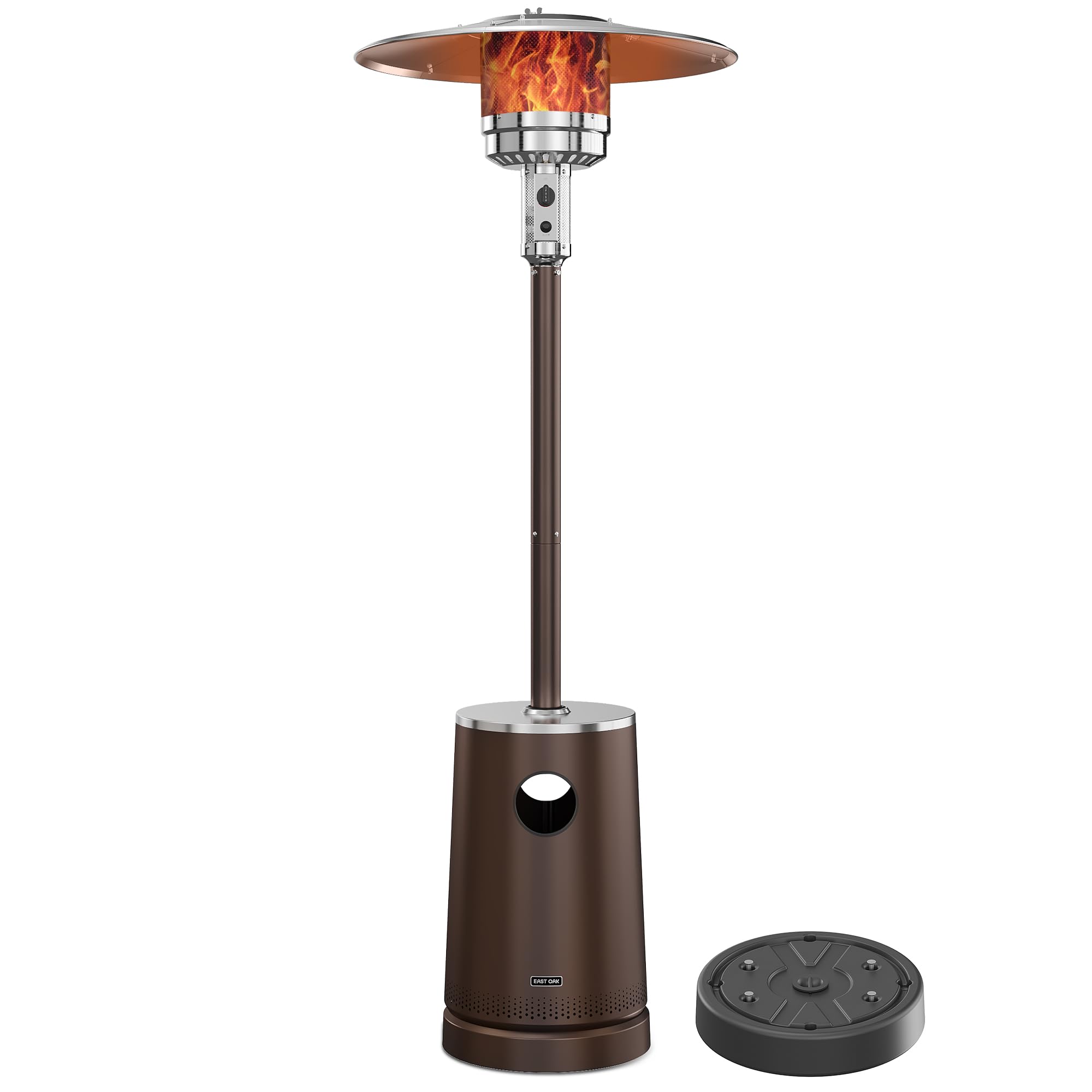
A tall patio heater that I use for outdoor gatherings where wide-area radiant and convective warmth is needed.
Why I picked it: High BTU output, heavy base, and table-top design for social patios.
Best for: Patios, decks, and commercial outdoor seating.
Value-focused option for high-output outdoor heating.
Pros
- Very high heat coverage
- Sturdy base with optional ballast
- One-touch ignition
Cons
- Outdoor use only
- Paint may fade in strong sun over years
My take
For outdoor entertaining I prefer the tall patio heater because it throws warmth over a broad area; the East Oak unit reached friends and family gathered around our patio table quickly.
Assembly was straightforward and the built-in tabletop is genuinely useful for drinks and small items. The wheels make repositioning easy when I want to change coverage.
I appreciate the tilt and flame-out safety systems — they give peace of mind when the unit is left running on a cool evening. Over a few seasons I did see minor fading on the painted cover when left in strong sun, but performance stayed solid.
If you want powerful, wide-area outdoor heat without a permanent installation, this is one of the best-feeling options I’ve used.
7. Mr. Heater MH9BX Portable Buddy + 10-ft Hose – Best Approved Portable + Hose
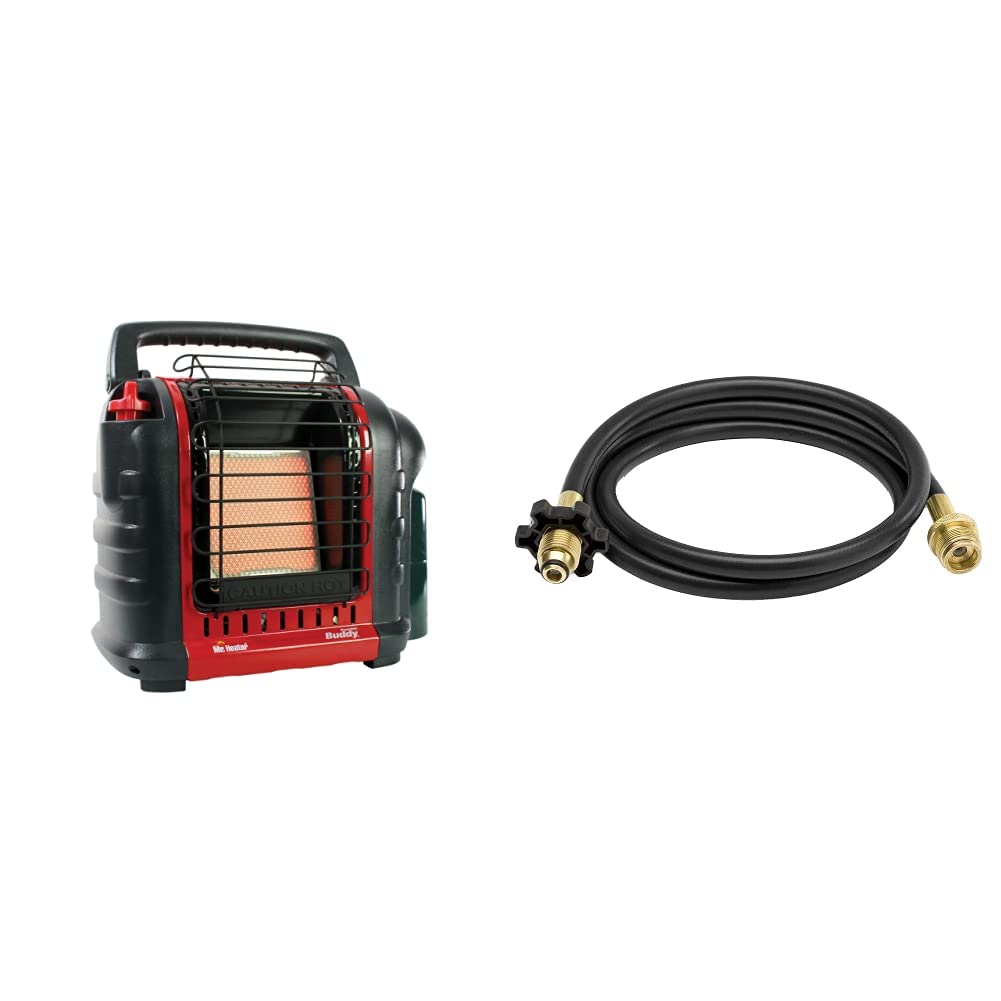
A compliant Buddy bundle that I use when regulations require an approved unit plus a hose for longer tank placement.
Why I picked it: Massachusetts/Canada approvals and a handy 10-foot hose included.
Best for: Users who need an approved portable heater with extended tank reach.
A slightly premium Buddy package for regulatory compliance and flexibility.
Pros
- Regulatory approvals for restricted areas
- Included 10-ft hose for larger tanks
- Compact and portable
Cons
- Same directional heat as other Buddies
- Limited room-wide heating
My take
I like this bundle when I need a Buddy-sized heater but also must meet specific state or provincial approvals. The MH9BX behaves like the classic Portable Buddy but gives me the paperwork and compliance peace of mind.
The included 10-foot hose is one of the best practical additions — I can place the 20-lb tank well away from my tent or garage door and still enjoy hours of heat without swapping cylinders.
In everyday use the unit warms a small tent or a workbench area quickly and the fold-down handle makes it easy to store in a vehicle or cabinet.
If you need approval-compliant equipment and extended fuel placement, this package removes the extra shopping step and just works.
8. Mr. Heater MH30T Double Tank-Top – Best Budget Tank-Top
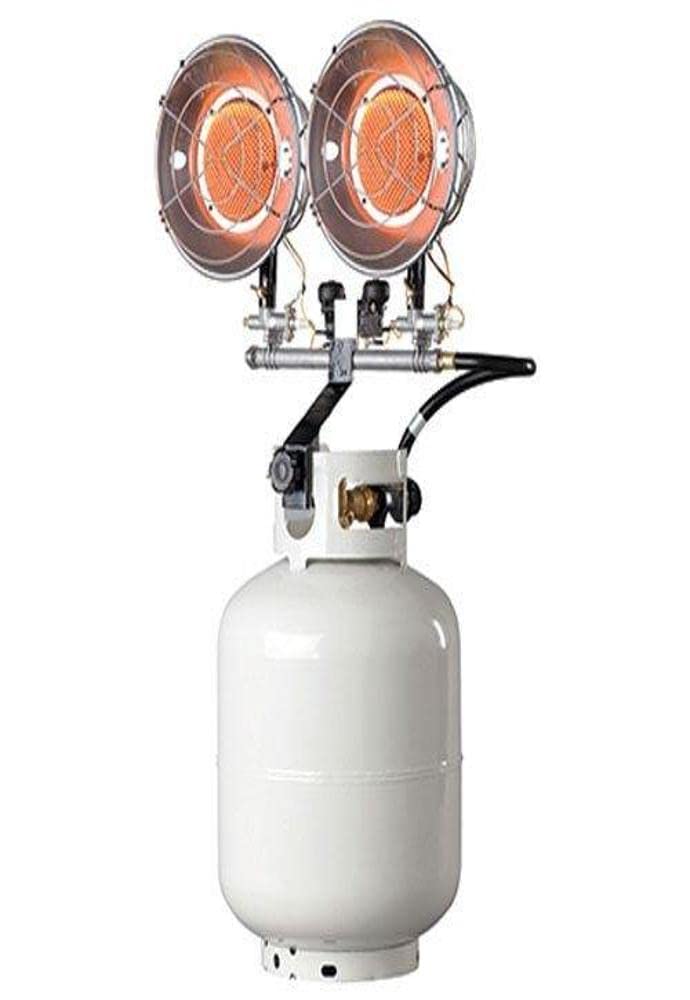
A simple, economical double-head tank-top heater I use for jobs and outdoor tasks.
Why I picked it: Two heads for directional coverage at a budget-friendly price.
Best for: Outdoor jobsites, tailgating, and garage spillover heating.
Great budget choice for high output without a big investment.
Pros
- Dual heads for broader coverage
- Made in the USA
- Quiet, efficient radiant heat
Cons
- May need matches or a torch to light
- Not rated for indoor use
My take
I bought the double tank-top when I needed raw, economical heat for outdoor jobs and tailgates; the two heads give better directional coverage than a single-head unit.
It’s straightforward to mount on a standard cylinder and the push-button igniter works consistently after the initial lighting. For some first lights I’ve used a torch to get everything glowing, after which ignition is quick.
This heater is a no-frills performer: robust, quiet, and designed to deliver heat without taking up floor space. I wouldn’t use it inside a sealed living area, but it’s ideal for open garages and outdoor work.
How I Choose a Propane Heater for a Garage or Workshop
Match BTU to Space and Use
I start by estimating the square footage and insulation level of the garage. Small insulated spaces get by with 4,000–9,000 BTU Buddy units; larger or uninsulated garages usually need 18,000 BTU or more.
For quick spot heat at a bench I choose a portable radiant unit; to raise overall room air temperature I favor vent-free or tank-top heaters with higher BTU output and circulation.
- Up to ~225 sq ft — Portable Buddy-style radiant units
- ~225–450 sq ft — Big Buddy or PRO models
- 450+ sq ft or heavy-duty tasks — Tank-top 30k–45k+ BTU units
Indoor vs. Outdoor Use and Ventilation
I always check the manufacturer’s indoor/outdoor rating. Buddy and Big Buddy models are approved for indoor use with proper ventilation and their oxygen depletion sensors, while tank-top job-site heads are often outdoor-rated only.
Vent-free blue flame heaters heat air efficiently but require placement and clearance planning — I treat ventilation as part of safe operation.
- Use ODS-equipped units in semi-enclosed spaces with a small vent open
- Keep outdoor-only tank-top heaters outside or in well-ventilated garages
- Follow clearance and mounting instructions carefully
Fuel Connections and Runtime
I prefer models that can run on 1-lb disposable cylinders for portability and also accept a 20-lb tank via a hose for longer runtimes. That flexibility keeps me from constantly changing bottles.
If runtime matters to you, plan for a 20-lb tank hookup or refillable cylinder setup.
- Use the Buddy hose to connect to 20-lb tanks for extended operation
- Expect shorter runs on 1-lb cylinders; a 20-lb tank extends usable hours dramatically
Safety Features I Don’t Ignore
I prioritize oxygen depletion sensors (ODS), tip-over shutoffs, and thermal shut-down systems. These are not optional in my book when I run heaters in enclosed or semi-enclosed garages.
For outdoor patio heaters I look for tilt protection and flame-out systems to prevent accidental gas flow.
- ODS for indoor or semi-enclosed use
- Tip-over shutoff for portable units
- Flame-out and tilt protection for tall patio heaters
Distribution and Accessories
Radiant heaters warm objects and people directly, so I add fans when I need even room temperature. For the Big Buddy PRO I value the integrated fan; for other models I use a small circulation fan.
Useful accessories include tank hoses, refillable cylinders, and optional blowers for vent-free models.
- Add a fan to redistribute radiant heat
- Hoses let you place tanks farther from occupied areas
- Consider optional blowers for vent-free units
Frequently Asked Questions
Can I safely use a propane heater in my garage?
Yes — if the unit is rated for indoor or semi-enclosed use and you follow ventilation and clearance guidelines. I always leave a small vent open, run ODS-equipped models, and avoid sealed living spaces when operating vent-free or indoor-allowed heaters.
How do I connect a Buddy heater to a 20-lb propane tank?
I use the Buddy series hose assembly (10 feet is common) to connect the Buddy-style regulator to a 20-lb tank. That setup lets me keep the tank safely away from the immediate work area and extend runtime.
Do vent-free heaters need electricity?
Most vent-free blue flame units don’t require household electricity — many use a battery-powered ignition and a built-in thermostat. I pair them with a small circulation fan if I want wider distribution, and that fan may need power.
How long will a 20-lb tank run a heater?
Runtime depends on BTU setting and the heater. From my experience, small Buddies can run for many hours on a 20-lb tank at low settings, while high-BTU tank-top and patio units consume fuel much faster. Using a 20-lb tank with an appropriate hose gives the best balance of portability and long runtime.
Final Take
Over the years I’ve learned there’s no one-size-fits-all propane heater — pick a Buddy for portability, a Big Buddy or PRO for workshop balance, a tank-top for raw output, and a patio tower for outdoor gatherings.
Consider ventilation, safety features, and whether you want to use disposable cylinders or a 20-lb tank. With those priorities set, you’ll end up with a heater that keeps your garage or patio comfortable and safe.
If you’re unsure which to buy first, I recommend starting with a Buddy if you want flexibility, or the tank-top option if you need to heat a large, uninsulated garage quickly.
