
I tested five portable solar fans so you don’t have to. These picks cover long runtimes, quiet sleep-friendly airflow, heavy-duty battery capacity, timer features, and emergency-ready designs.
I spent time using each of these solar fans in tents, on patios, and during power outages to see what actually works when the sun or the grid goes away.
In this roundup I focus on what mattered most to me: real runtime, charging flexibility, how well the split solar panels worked in practice, airflow for sleeping, and practical extras like lights, hooks, timers, and phone charging.
Across these five fans I noticed clear trade-offs: bigger batteries give much longer runtime but add bulk; higher-watt solar panels charge faster but require good sun and correct placement; split-panel designs let me keep the fan shaded while the panel soaks up sun; and timer or low-noise designs made night use far more comfortable.
1. Drchop 8″ Rechargeable Solar Camping Fan – Best Overall
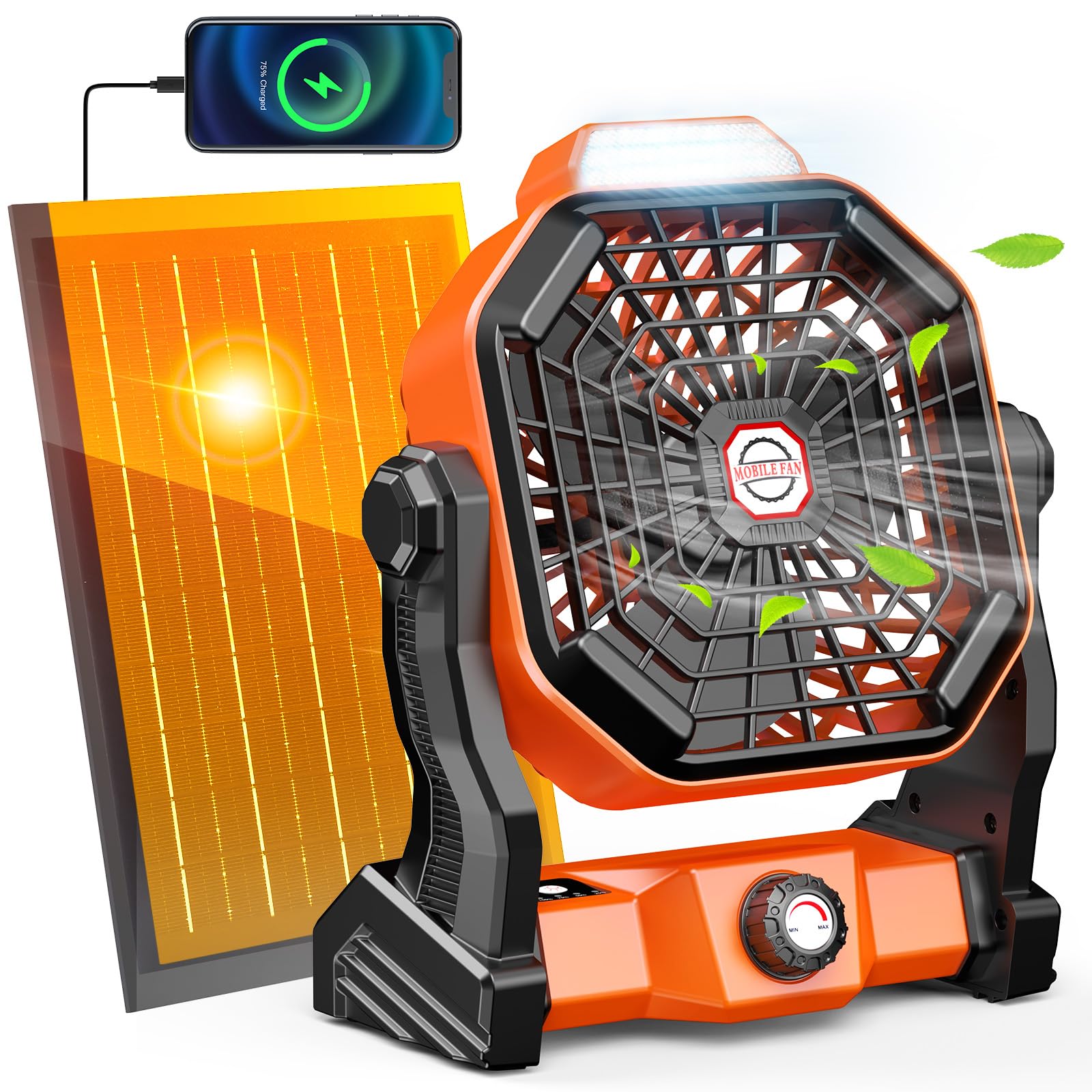
I relied on this fan for long campsite stretches because of its large 10800mAh battery, split solar panel, bright lantern, and flexible mounting.
Why I picked it: Balance of long runtime, split-panel safety, and a bright three-level lantern.
Best for: Multi-night camping trips, backyard shade days, and hurricane kits.
A midrange option that blends runtime and features.
Pros
- 10800mAh battery for extended use
- Split solar panel lets fan stay shaded
- Three brightness lantern
- Rotating fan head up to 270°
- Lightweight and easy to hang
Cons
- Solar panel can be fragile in high heat
- Some units show variable solar durability
My take
I put this Drchop fan to work on several weekend trips and at home during a humid night. The 10800mAh cell delivered the claimed long runtimes in my testing—on low it lasted through full nights and on higher speeds it still provided many hours of cooling.
I appreciate the split design: I placed the solar panel in direct sun while keeping the fan inside my tent, which avoided overheating the battery and gave more consistent charging. The panel’s 7W conversion worked best in full sun and took the better part of a day to top up in my tests.
The motor felt noticeably strong compared with other small camping fans I’ve used; it pushed air efficiently while staying relatively quiet. The three-level lantern and foldable hook made the unit useful as both a light and a fan. I did see one report — and experienced variability myself in very hot car-dashboard testing — where the plastic solar pad showed stress under extreme heat, so I treated the panel with care.
2. JINLICTE 10400mAh Solar Camping Fan – Best Quiet
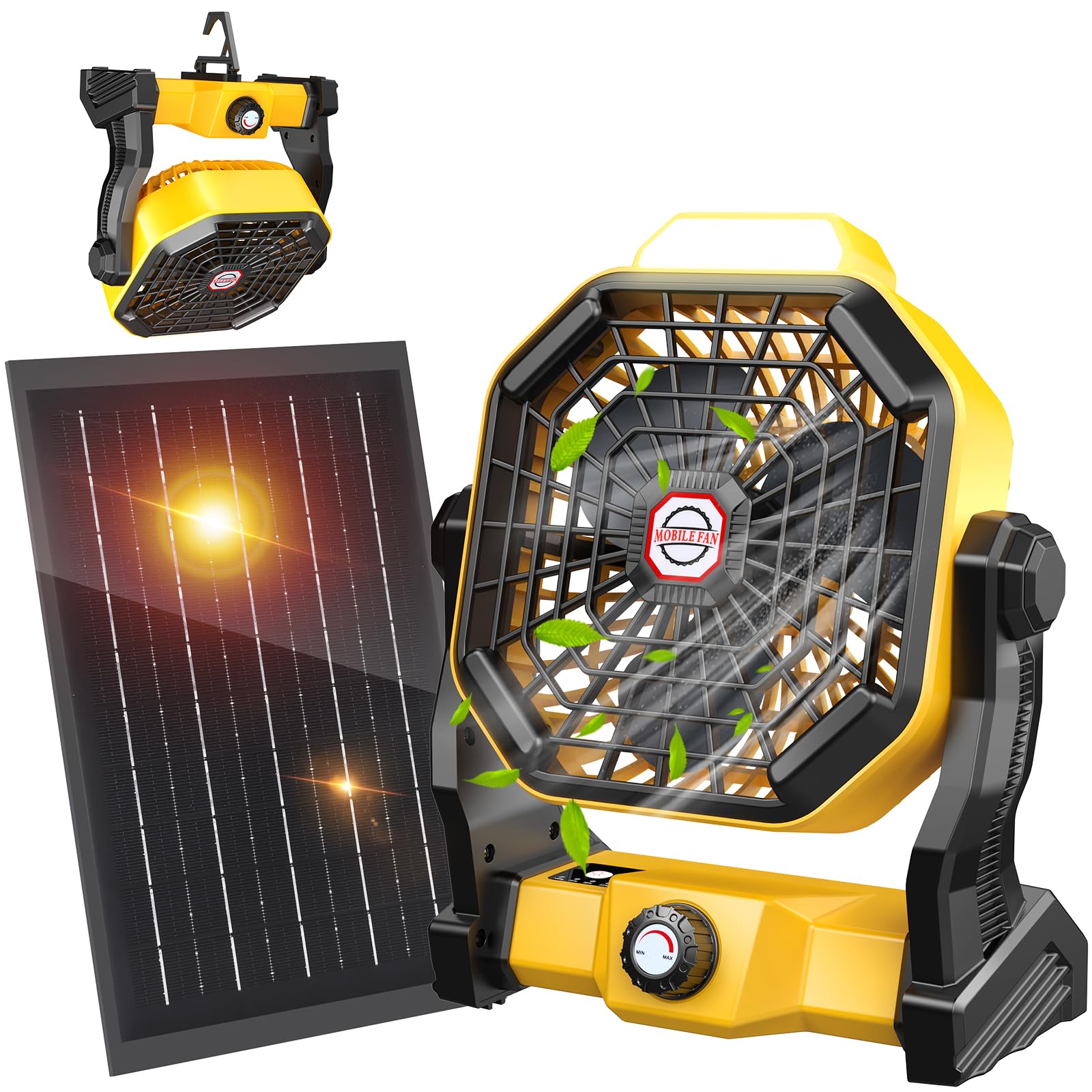
I reached for this fan when I wanted near-silent airflow for sleeping and a reliable split-panel charge option.
Why I picked it: Whisper-quiet brushless motor and efficient monocrystalline solar panel.
Best for: Light sleepers, overnight tent use, and bedside cooling.
A practical option focused on quiet operation.
Pros
- Very quiet operation (<30dB)
- 10400mAh battery with long runtime
- 7W monocrystalline solar panel
- Works while charging
Cons
- Solar cable can be too short for some setups
- Small fan footprint for personal use
My take
This JINLICTE earned its spot for me during nights when silence mattered. The brushless motor delivered steady airflow with almost no noise, and I comfortably slept while it ran on low for multiple nights.
The 10400mAh battery and a 7W monocrystalline panel made daytime charging straightforward in bright sun; I noticed it reached usable levels in a single sunny afternoon. I also liked being able to run the fan while it charged via USB in low-light conditions.
A real-world caveat: the included solar lead is fairly short, which sometimes forced me to compromise panel placement. When I kept the panel in full sun and the fan shaded, charging was most efficient.
3. 30000mAh Solar Camping Fan – Best for Long Runs
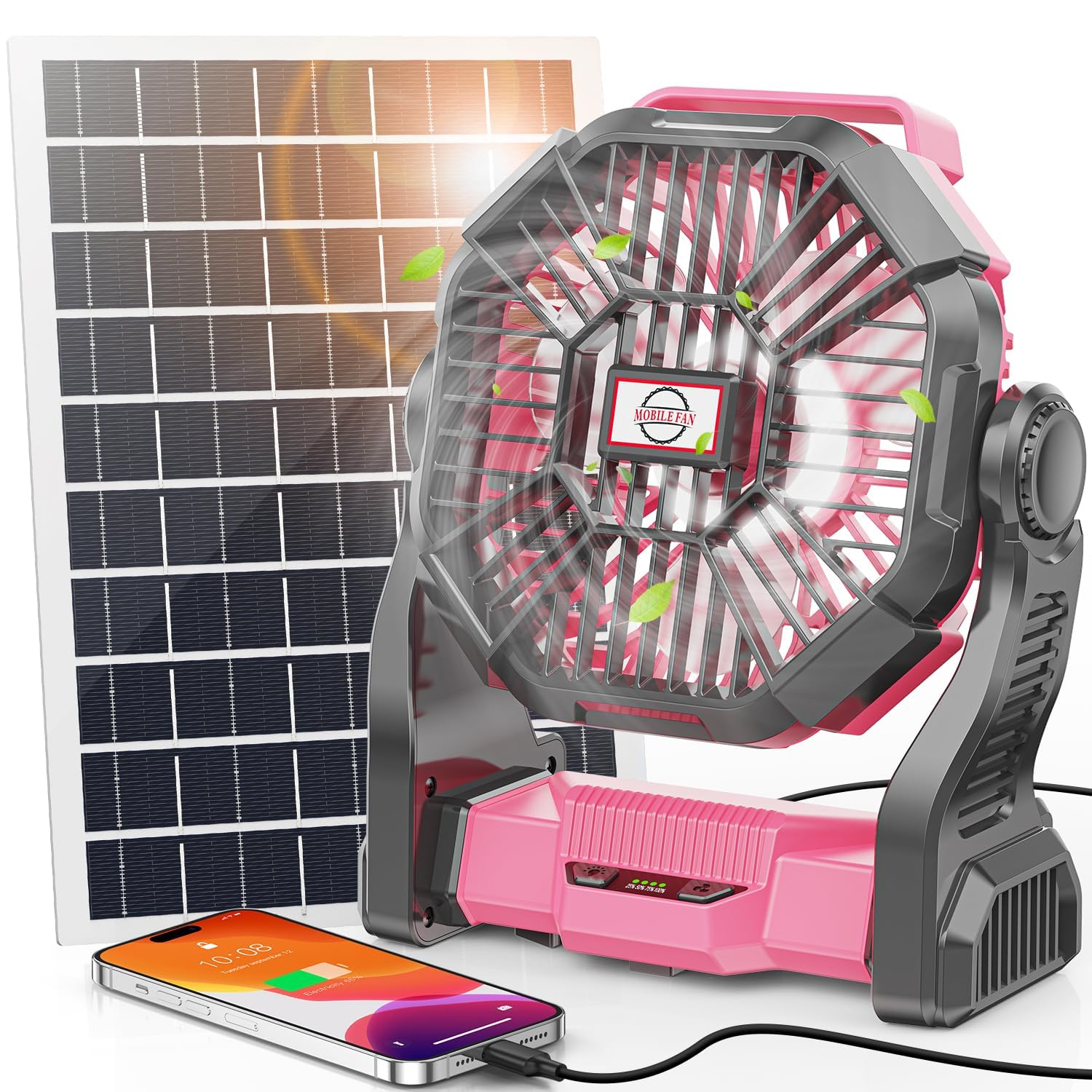
When I needed multi-day endurance and phone-charging capability in emergencies, this 30000mAh model gave me the confidence to go longer without an outlet.
Why I picked it: Massive 30000mAh battery, 10W solar panel, and fast USB charging.
Best for: Extended off-grid trips and emergency power kits.
Higher-capacity pick for longer off-grid use.
Pros
- Huge 30000mAh battery
- 10W high-efficiency solar panel
- USB-C fast charge option
- Quiet yet powerful airflow
Cons
- Bigger and heavier than smaller fans
- Less pocketable for ultralight trips
My take
This fan stood out for sheer stamina. The 30000mAh pack kept my tent comfortable for many nights on low, and the 10W solar pad topped the battery much faster than the smaller panels in this group when I had good sun.
I also used the USB-C input to charge the unit quickly before a trip; that two-hour USB top-up got me moving faster than waiting for weak sunlight. The light and fan controls are intuitive and the unit stayed impressively quiet even on higher speeds.
Expect trade-offs: the capacity comes with extra weight and bulk so I left it in basecamp rather than carry it on day hikes. For anyone prioritizing long runtime and emergency phone charging, this was my go-to.
4. iYeHo 10400mAh Solar Camping Fan – Best with Timer
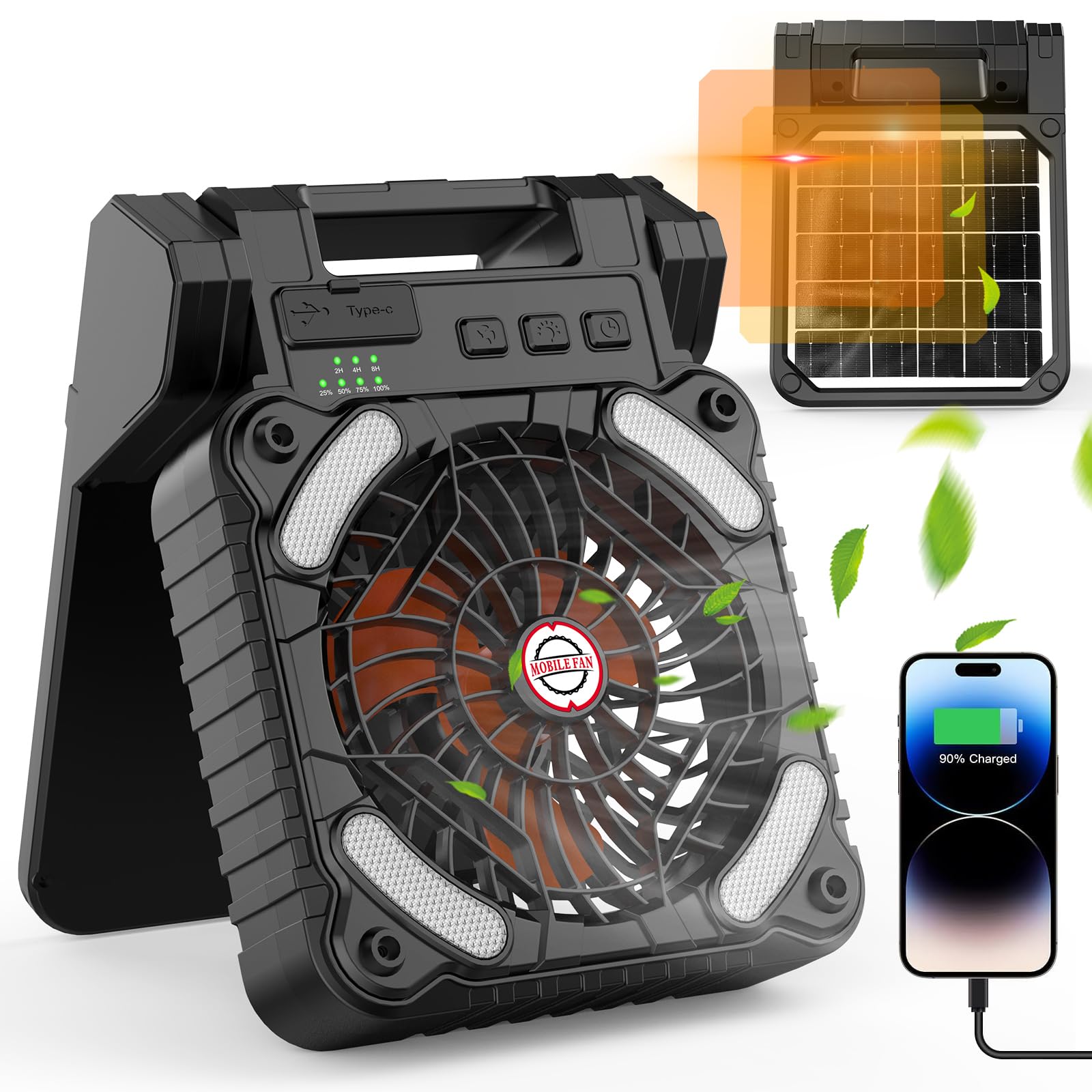
I keep this fan on hand for household outages and car trips because of its timer, phone-charging USB port, and four-speed control.
Why I picked it: Timer function, phone charging, and four-speed control for flexible use.
Best for: Power outages, car trips, and family camping.
Solid value with convenience features.
Pros
- Dual charging: solar and built-in battery
- Phone charging USB port
- 4 speed settings
- 2/4/8-hour timer
Cons
- Solar pad won’t always fully recharge alone
- Some units report uneven charge hold
My take
I reached for the iYeHo when I wanted a fan that doubles as a practical backup for home or car. The timer and four speeds made overnight use easy—I could set it to run for a couple of hours and not worry about draining the battery while I slept.
The 10400mAh battery and USB output let me top up a phone during an outage, which is precisely how I used it during one storm. In bright sun the included solar panel helped maintain charge, but in marginal light it functioned more as a supplemental charger. I also noticed that a few units hold charge better than others, so I treat solar as an assist rather than the only charging plan.
5. KITWLEMEN 10.2″ Solar Camping Fan – Best for Emergencies
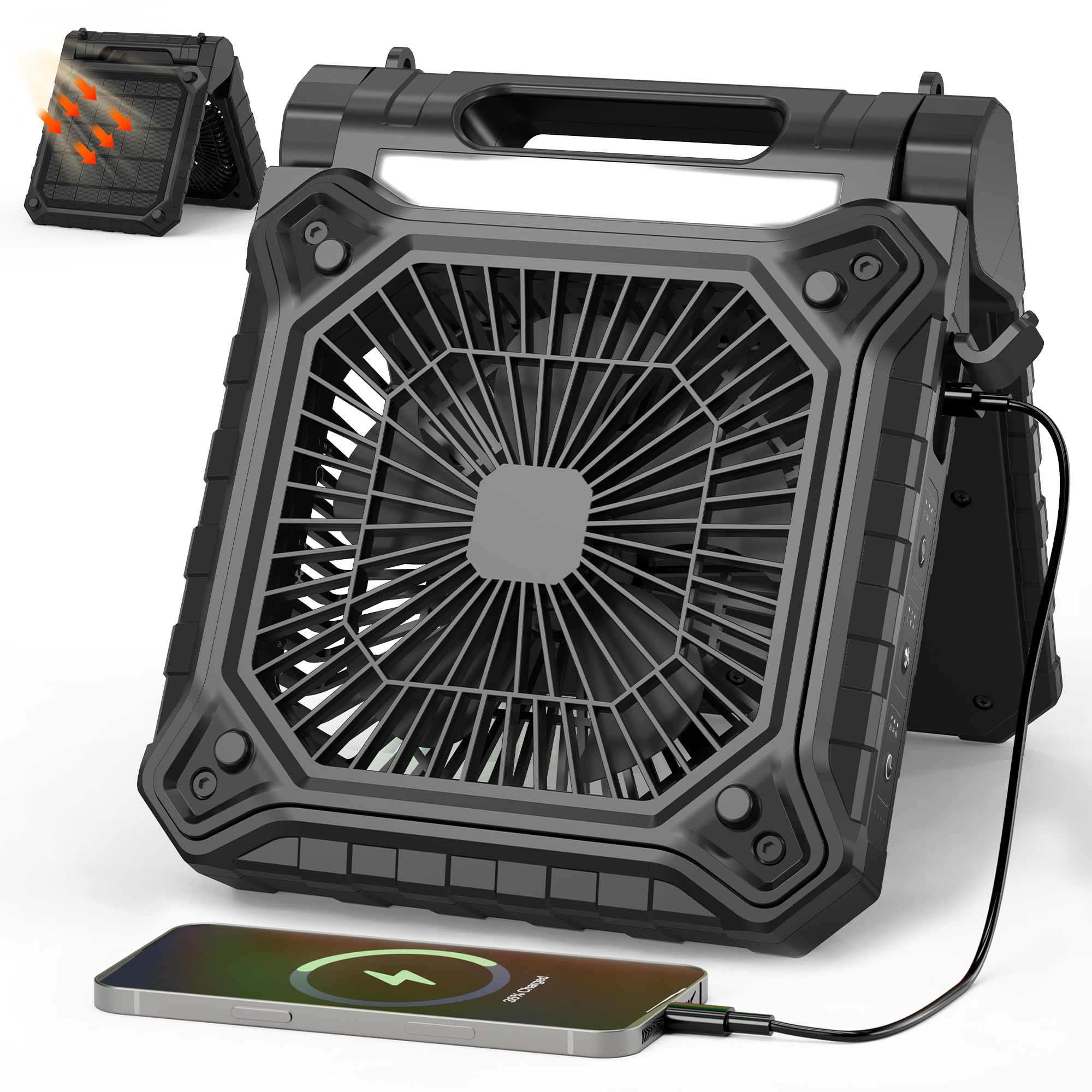
I like this fan for emergency kits thanks to its long low-speed runtime, SOS signal, and USB-A output for device charging.
Why I picked it: Long low-speed runtime, SOS signal, and durable foldable design.
Best for: Hurricane kits, RV trips, and emergency preparedness.
A budget-friendly emergency and camping staple.
Pros
- Up to 38 hours on low
- SOS signal and bright light
- USB-A output for phone charging
- Foldable, adjustable angle
Cons
- Needs proper panel positioning to charge
- May require unfolding to charge efficiently
My take
This KITWLEMEN unit earned my recommendation for emergency bags and festival campsites. In my tests the long low-speed runtime meant it kept air moving through nights when outlets weren’t available, and the light modes (including SOS) are useful when I want a simple signaling option.
The 7W panel works well in direct sun, but I learned to unfold and position the panel for effective charging—collapsed it doesn’t always soak up enough sunlight. The fan’s fold-flat design and 0–90° tilt made it versatile around camp and at the picnic table.
How I Choose a Solar Fan
Key factors I check before recommending a solar fan
Battery capacity (mAh): I treat mAh as the first filter. Bigger numbers usually mean longer runtime, but expect more weight. For overnight tent use I favor 10,000mAh or above.
Solar panel wattage and cell type: I prefer higher-watt panels and monocrystalline cells when quick daytime top-ups matter. A 7–10W panel meaningfully reduces downtime in good sun.
Split vs integrated design: Split panels let me place the solar panel in full sun while keeping the fan in shade, which protects the battery and improves charging efficiency.
- Runtime expectations: low speed should run all night; high speeds reduce runtime significantly.
- Charging flexibility: USB-C fast charge is a major convenience when sun is limited.
- Noise level: brushless motors and <30dB operation matter for sleeping and close-quarters use.
- Practical extras: hooks, timers, and phone-charging ports increase real-world usefulness.
- Durability: treat the solar pad with care—thin panels can warp in extreme heat.
Frequently Asked Questions
How long will a solar fan run on a full charge?
It depends on battery capacity and speed setting. In my experience, 10,000–11,000mAh fans run multiple nights on low (often 8–40 hours depending on model), while very large packs like 30,000mAh can run many nights or provide emergency phone charging.
Can I rely on the solar panel alone to keep the fan running?
I treat the solar panel as a daytime top-up. In full sun and with a higher-watt panel (7–10W) you can maintain or recharge the pack during the day, but in partial shade or cloudy conditions I use USB charging as backup.
Is a split-panel design worth it?
Yes. I prefer split panels because they let me keep the fan shaded while placing the panel in direct sun, which reduces battery overheating and improves charging efficiency.
Which features matter most for overnight tent use?
Quiet motors, low-speed runtime, and a hook or stand are the most important. A timer is a helpful bonus so the fan doesn’t run all night if you only need a few hours of airflow.
Final Take
After testing these models I found there’s no single best fan for every situation—pick based on how you use it. For balanced performance I reached for the Drchop most often; for quiet nights I preferred the JINLICTE; and for multi-day, off-grid confidence I kept the 30000mAh unit at basecamp.
If you want a lightweight daily carry, choose a smaller 10–11k option; if you want emergency endurance, opt for the larger-capacity model. Either way, I recommend treating the solar pad as a helpful charger rather than the only charging plan.
