
I tested analog, single-outlet, and Wi‑Fi timers so you can pick the right water timer for containers, lawns, or full irrigation systems. I focus on ease of use, leak resistance, scheduling flexibility, and smart weather
I spent hands‑on time with a range of water timers — from no‑frills dial units to 8‑zone Wi‑Fi controllers — to find dependable options for different yards and budgets.
In this roundup I explain which timers made sense for simple drip lines, hose‑end sprinklers, and whole‑house in‑ground systems, and why I used each one in specific setups.
My testing focused on setup, leak behavior, scheduling flexibility, battery behavior, and any smart features that actually saved me time and water.
If you want simple, go with an analog or single‑outlet electronic timer; for remote control and smart adjustments pick a Wi‑Fi controller. Brass inlets and metal couplings reduce leaks, while app features deliver real convenience for multi‑zone needs.
1. RAINPOINT Sprinkler Timer – Best Value
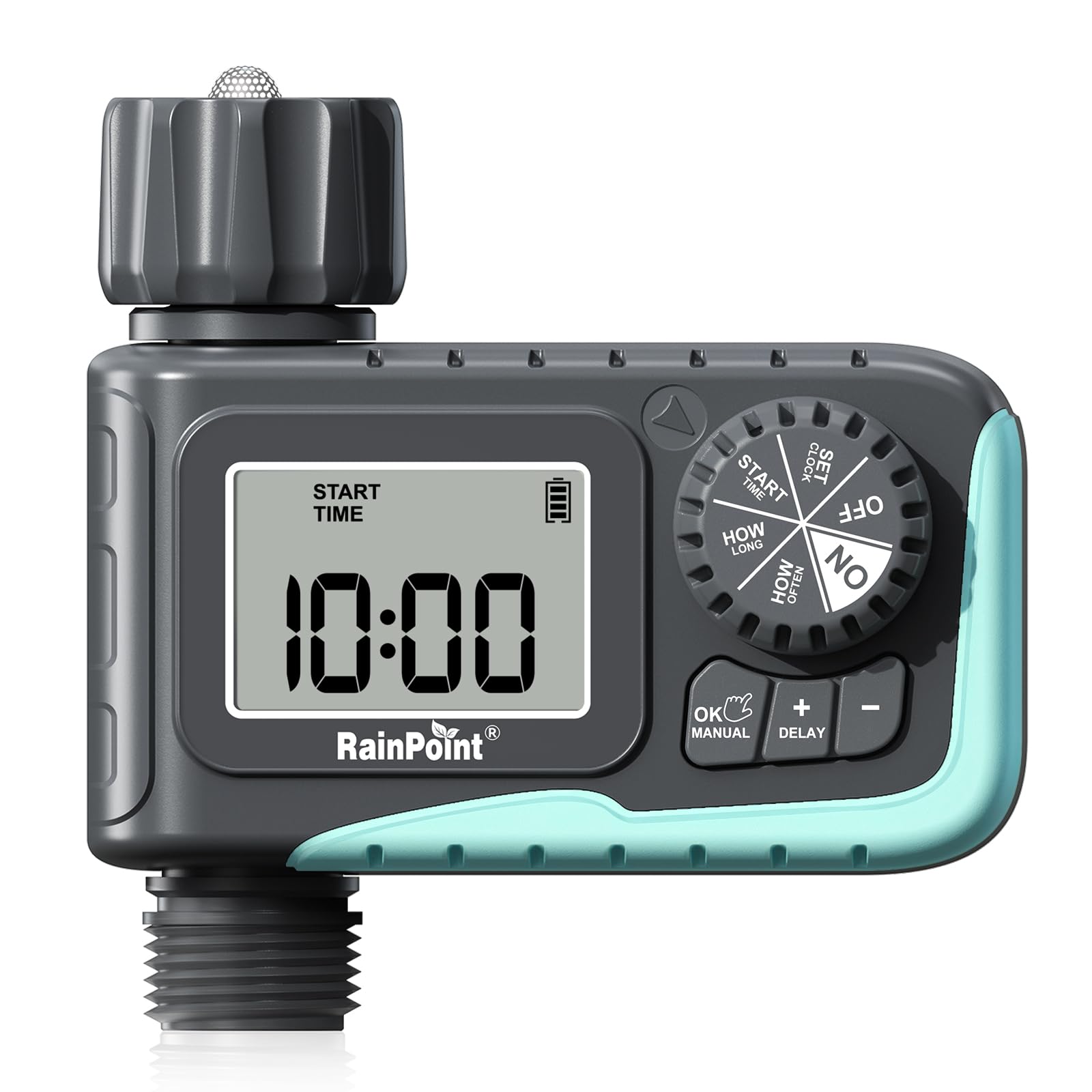
An affordable, programmable hose timer with a clear LCD, rain delay, and manual override that handles small to medium gardens.
Why I picked it: Flexible scheduling plus rain delay and a readable display at a low cost.
Best for: Small to medium gardens and homeowners who want simple automation.
Affordable, budget‑friendly choice.
Pros
- Flexible start times and durations
- Rain delay pauses schedules quickly
- Large, easy-to-read LCD
Cons
- Plastic fittings feel light
- Instructions could be clearer
My take
I installed this unit on an outdoor spigot to run a soaker hose for a young orange tree. Setup took minutes and the big LCD made programming fast.
I appreciated the range of start times, water durations and the 24/48/72‑hour rain delay. When I needed an extra soak I used the manual bypass without disturbing the main schedule.
A few initial firings had a tiny drip at the threaded connections, but wrapping the joints solved that. The body is light plastic, so I treat it gently during winter storage.
2. RAINPOINT Sprinkler Timer – Best for Easy Setup
Same programmable core as the value pick, but I highlight how fast it goes from box to watering duty.
Why I picked it: Extremely easy installation and straightforward operation.
Best for: New grass seed, temporary setups, and anyone who dislikes fiddly programming.
Very affordable and simple to operate.
Pros
- Plug‑and‑play installation
- Good battery life indicator
- Useful manual watering option
Cons
- Plastic housing not heavy‑duty
- Interrupting a run can pause daily sequence
My take
In another part of my yard I used the same model to keep new grass seed consistently moist. It was simple to attach and start.
The package included a small amount of silicone/Teflon tape that helped me seal the threaded connections. After that I had no continuous leaks.
One quirk I noticed: if I interrupted a scheduled run for a mechanical test, it occasionally suspended the rest of that day's sequence. It didn't break anything, but it caught my attention.
3. Gardena Universal Water Timer – Best Built
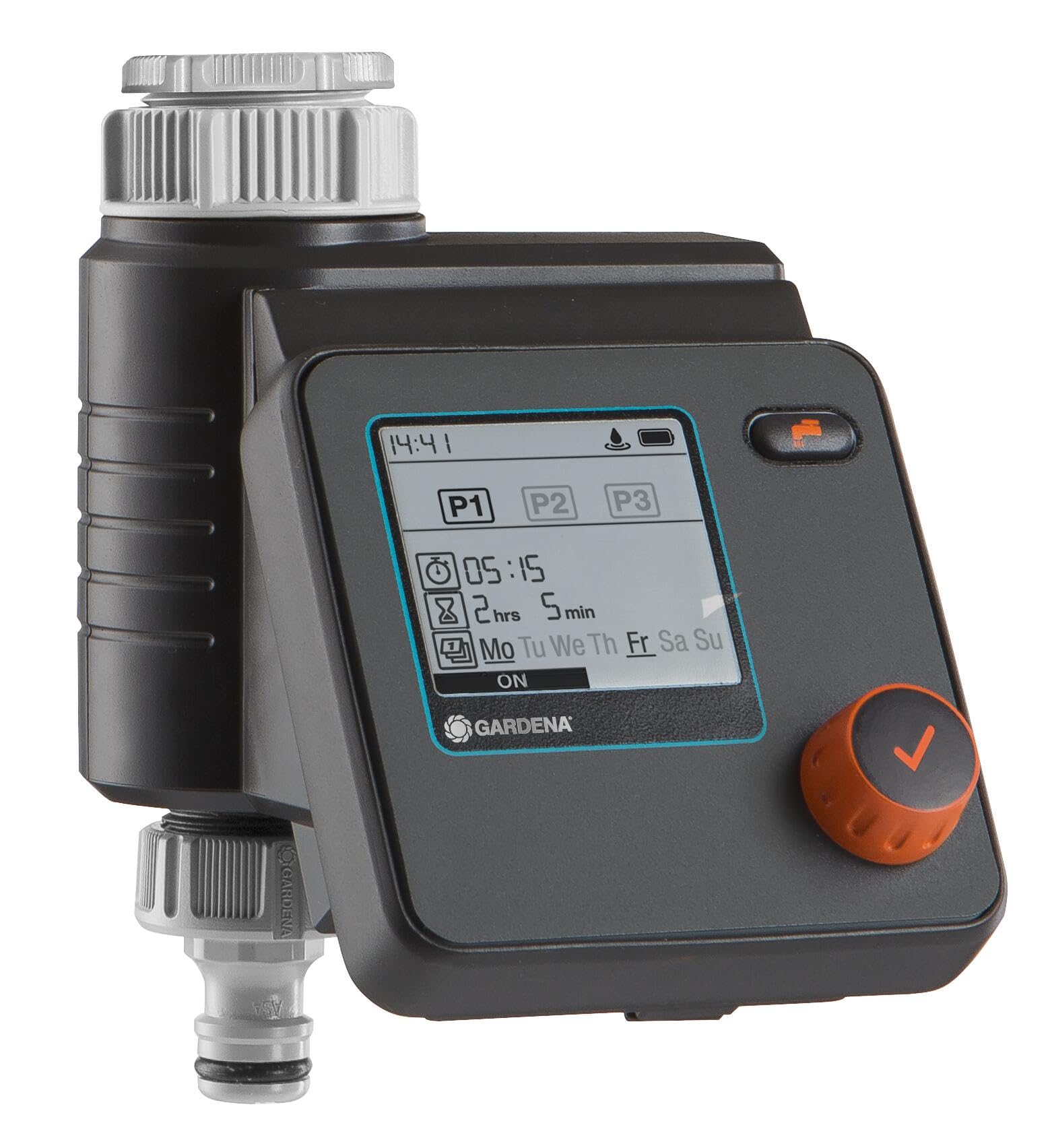
A well‑built, three‑schedule timer with sensor compatibility and simple knob control for gardeners who move sprinklers often.
Why I picked it: Sturdy construction with three programmable start times and sensor compatibility.
Best for: Intermediate gardeners who need multiple start times and durable hardware.
Higher up front but built to last.
Pros
- Three separate schedules
- Solid, long‑lasting construction
- Sensor compatible
Cons
- Can be tricky to reassemble battery compartment
- Occasional schedule hiccups reported
My take
After trying several timers over many seasons, this Gardena unit stood out for daily practical use. I set two of the three watering times and routinely switch a sprinkler to another area as I move around the yard.
The knob‑based programming is remarkably efficient — I can activate a manual run for a precise number of minutes without wrestling through menus.
I did find the battery compartment reconnect awkward the first time I opened it, and I’ve seen intermittent instances where a unit refused to follow its schedule. For me the long‑term reliability and build quality still make it the most durable option I’ve used.
4. Raindrip R675CT 3‑Dial Timer – Best No‑Fuss Analog
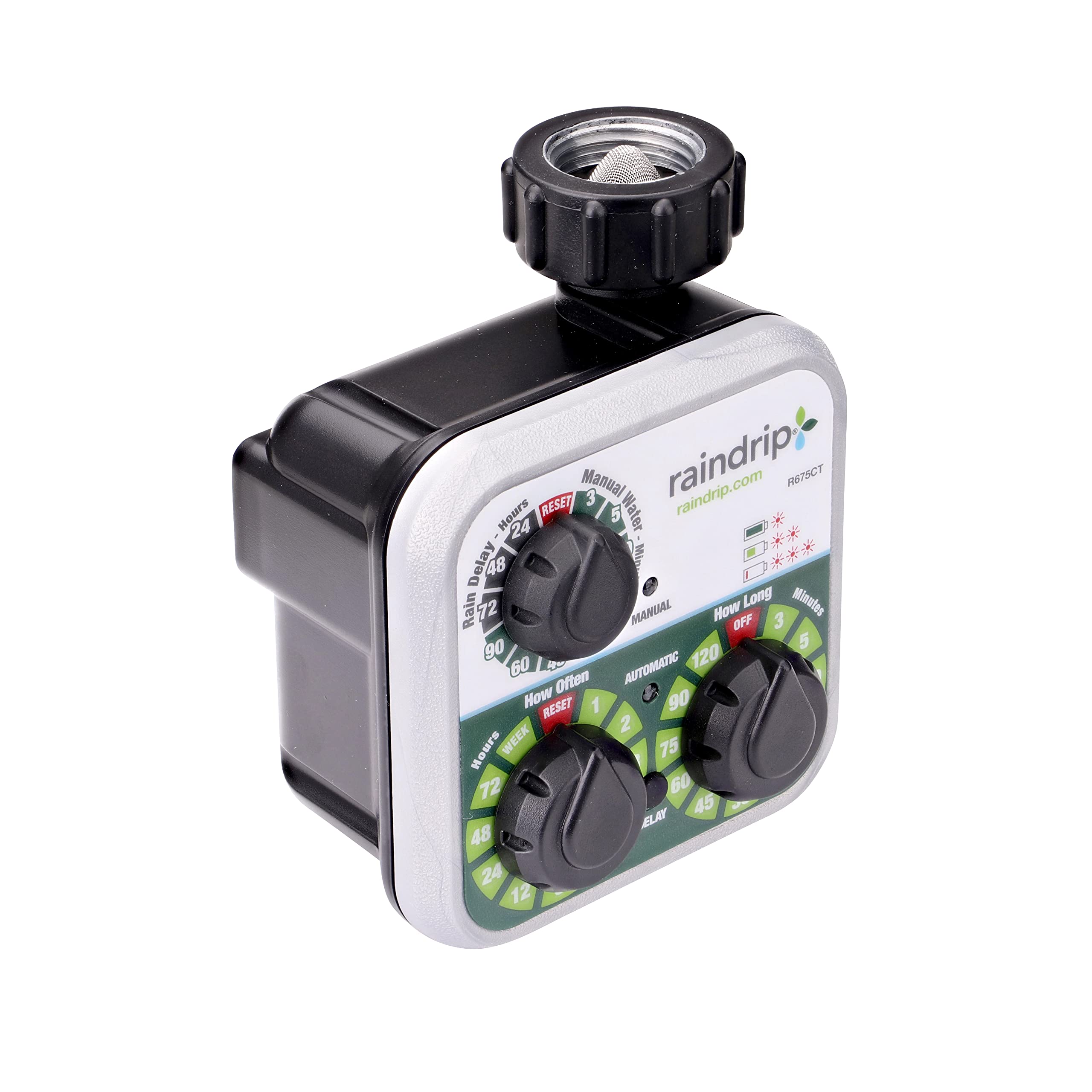
A mechanical style, three‑dial hose timer that trades digital fuss for absolute simplicity and proven longevity.
Why I picked it: Simple three‑dial control that just works season after season.
Best for: Drip systems and gardeners who want low‑tech reliability.
Budget‑minded and dependable over multiple seasons.
Pros
- Very easy to program
- Reliable over multiple seasons
- Battery saves water when depleted
Cons
- Plastic threads can leak if cross‑threaded
- Faceplate may fade in hot sun
My take
I installed several of these on drip lines and hose‑end setups and found the three dials impossibly simple to use — set frequency, set run time, and use the manual/rain delay dial when needed.
They lasted me multiple seasons; one set ran reliably for about four years in a harsh climate before showing wear. The long battery life and the automatic shut‑off when batteries die are features I appreciate.
Be careful when threading hoses: cross‑threading can produce a persistent leak and damage the plastic connector. Hand‑tighten carefully and add tape where needed.
5. Rain Bird ST8I‑2.0 WiFi Controller – Best Smart Indoor Controller
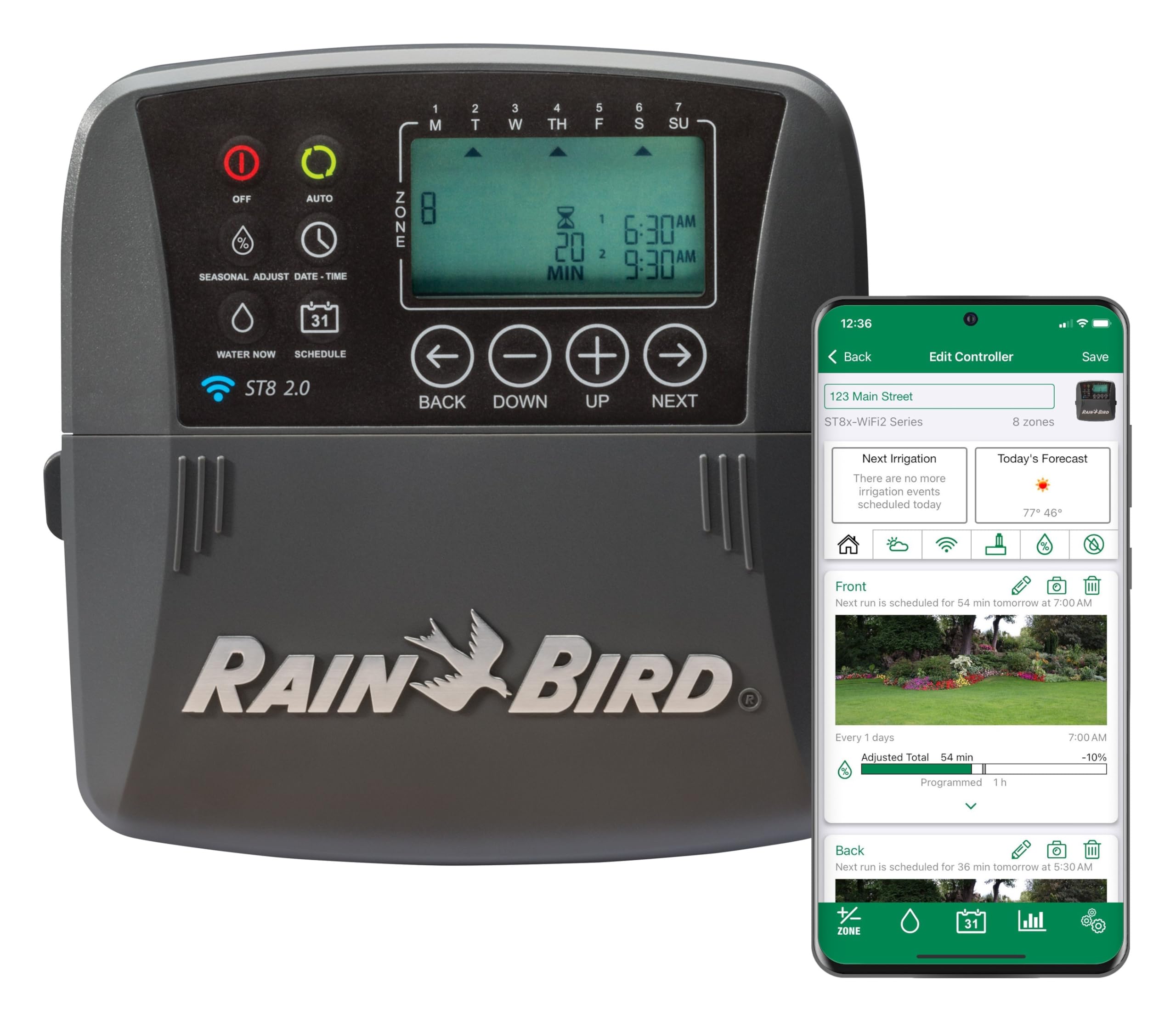
A full‑featured 8‑zone indoor Wi‑Fi controller with app control, weather‑based seasonal adjustments, and integrations for voice assistants.
Why I picked it: Robust smart features and dependable 8‑zone control for in‑ground systems.
Best for: Homeowners with built‑in irrigation who want remote app control.
Premium controller for whole‑house irrigation systems.
Pros
- App control and remote access
- Automatic seasonal adjustments
- Supports 8 zones
Cons
- Wi‑Fi setup can be fiddly
- Needs good signal where mounted
My take
I replaced an older manual controller with this Rain Bird because I wanted app control and weather‑aware adjustments. The physical installation was straightforward and the app lets me rename zones and set multiple start times.
Automatic Seasonal Adjust saved me time by trimming run time based on local weather each night. That feature alone reduced my irrigation fiddling considerably.
The Wi‑Fi setup required a couple of extra steps on my phone and I made sure the mounting location had at least two bars of signal. Rain Bird support helped walk me through a permissions issue on a mobile device, and after that the system ran smoothly.
6. RAINPOINT Sprinkler Timer V2 – Best Improved Hose Timer
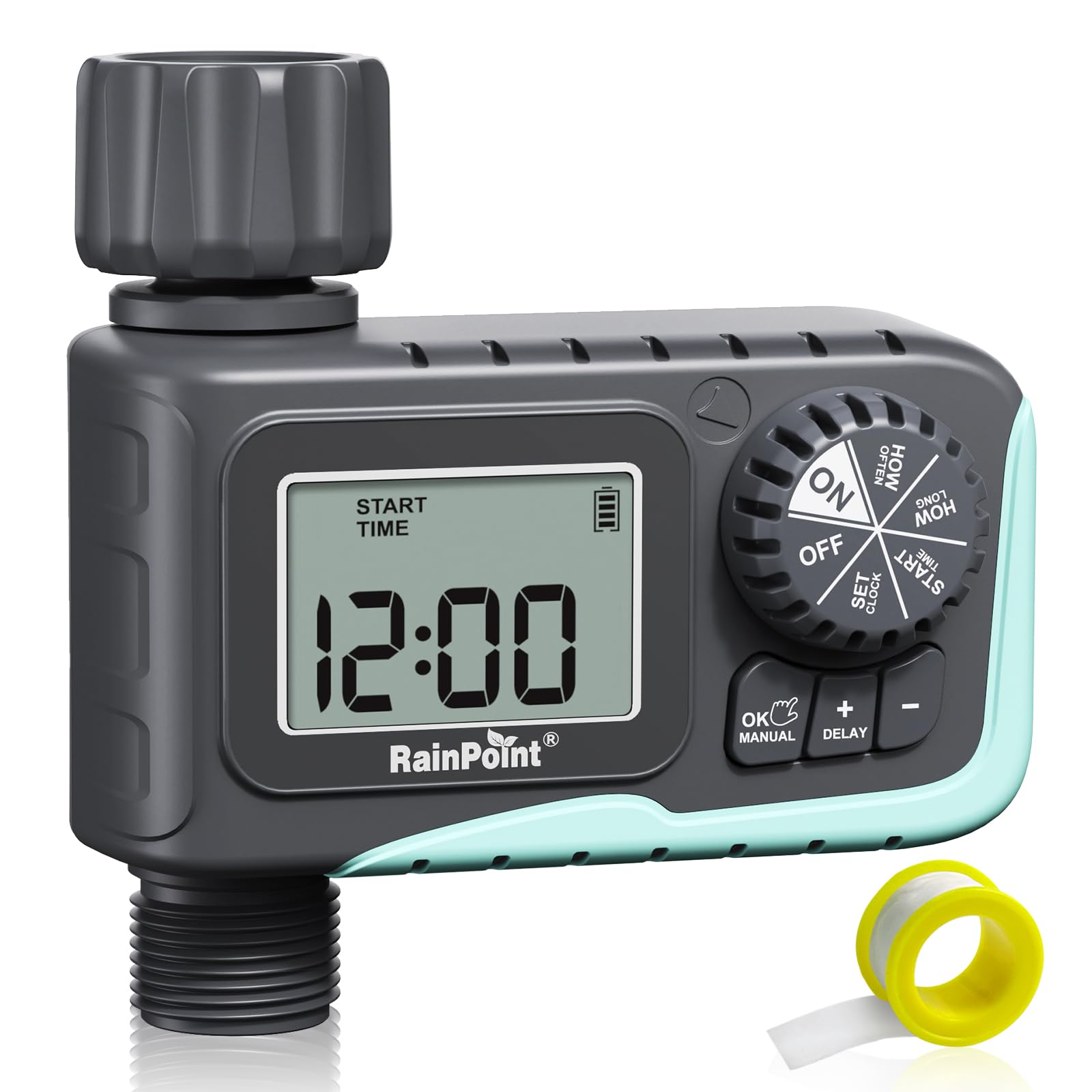
An updated RAINPOINT unit with a larger LCD, built‑in inlet filter, higher working pressure rating, and low‑battery shutoff.
Why I picked it: Upgraded inlet, leak protection, and a clear display make this dependable.
Best for: Larger gardens and foundation watering where leak resistance matters.
Affordable with improved durability over earlier models.
Pros
- Built‑in inlet filter
- High working pressure rating
- Large, easy display
Cons
- Still plastic-bodied
- Battery compartment access tight
My take
I put two of these on different spigots and liked that setup was quick and intuitive. The sealed battery compartment and gasket feel thoughtful for outdoor use.
The unit includes Teflon tape and the inlet filter gives me confidence against grit in older pipes. I used rechargeable batteries and didn't have to swap them mid‑season.
After months of daily cycles the timers held up well. For the price and features, this felt like a meaningful upgrade over basic hose timers I've owned.
7. RAINPOINT 2‑Zone Wi‑Fi Water Timer – Best Wi‑Fi Hose Timer
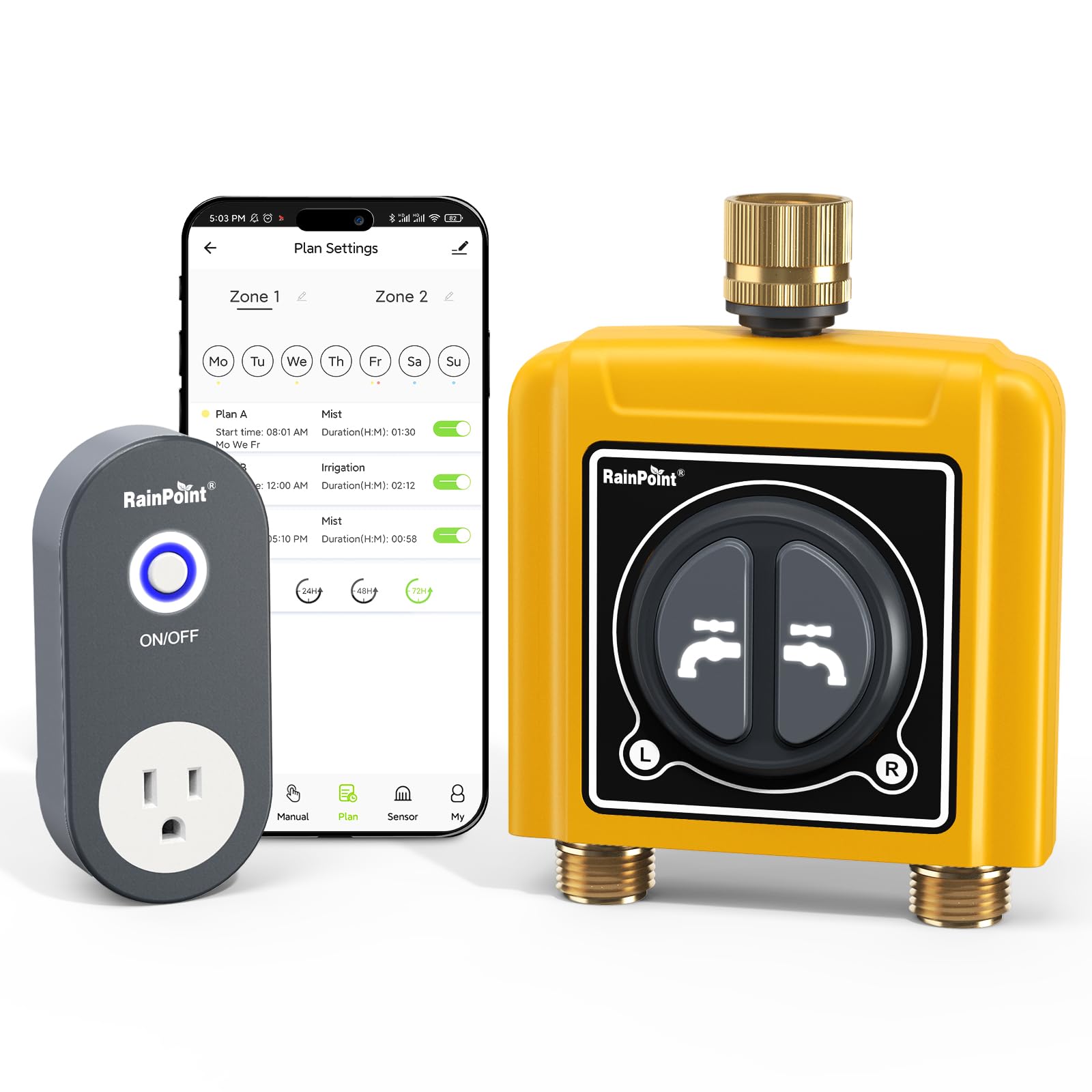
A two‑outlet Wi‑Fi timer with brass fittings, flow metering, and app control that supports weather, quantity, and soil sensor triggers.
Why I picked it: Brass fittings plus app and flow metrics make it a flexible smart hose timer.
Best for: Container gardens, planters, and portable drip systems needing remote control.
Mid‑range smart option with advanced features.
Pros
- Brass inlet and outlet
- Flow metering and usage logs
- App control and voice support
Cons
- 2.4GHz Wi‑Fi only
- Occasional component failure reported
My take
I used this on deck planters and for multiple drip runs. The brass inlet/outlet reduced my worry about leaks compared with plastic fittings.
The app is intuitive — scheduling, manual runs, and rain delays are all accessible from my phone. Flow‑based watering and the ability to pair a soil sensor give real control over how much water each zone gets.
After about six months of regular use a small component failed on one unit. RAINPOINT's customer service sent a replacement part quickly, which got the system back to full operation. Overall, the convenience and metrics are worth it for remotely managed setups.
8. Gilmour Single Outlet Timer – Best Professional Single‑Outlet
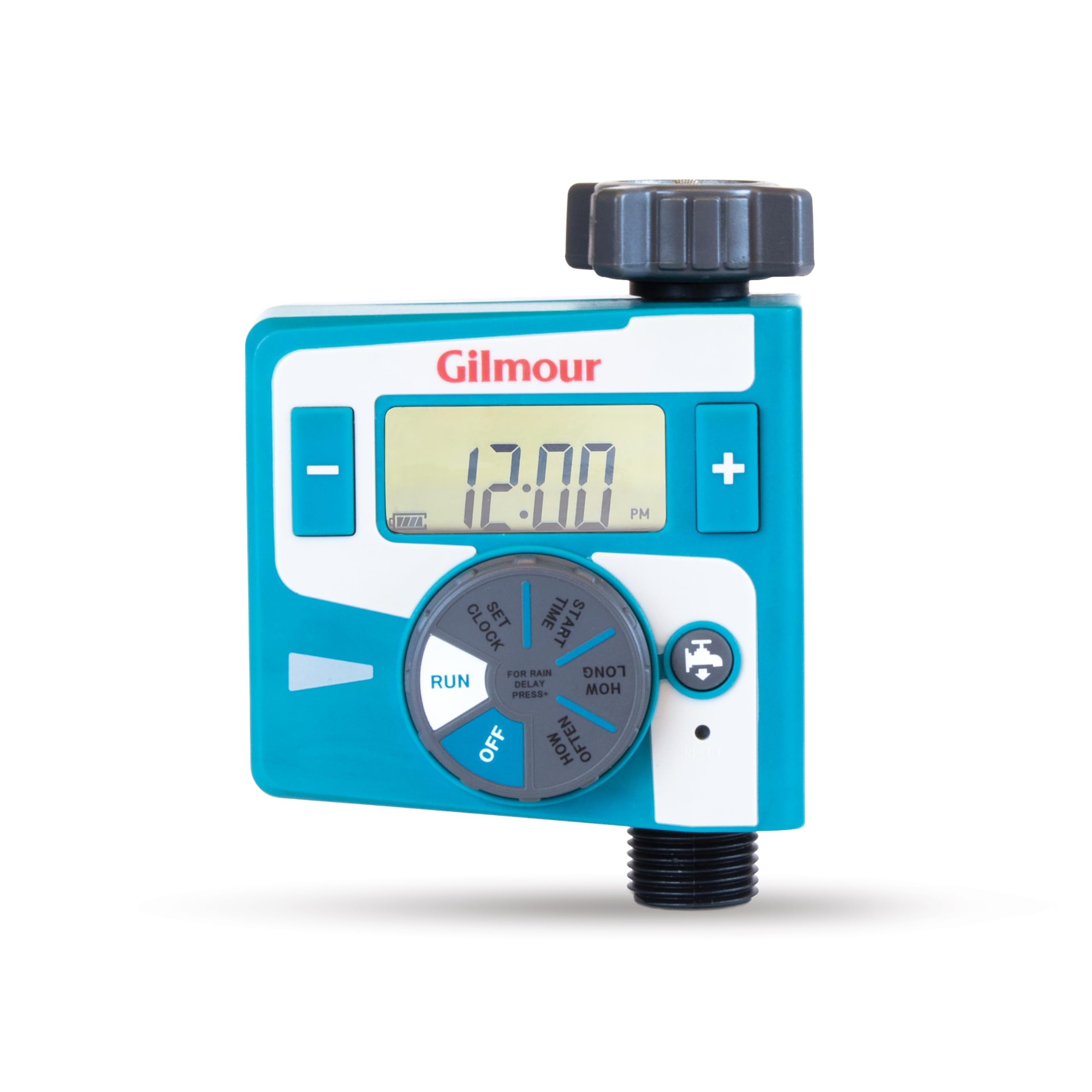
A straightforward single‑outlet electronic timer with a durable metal swivel coupling and long, intuitive run‑time range.
Why I picked it: Metal coupling and simple interface suit pros and serious DIYers.
Best for: Landscapers, pros, and homeowners wanting a rugged single‑outlet unit.
Affordable, workmanlike option with durable connector.
Pros
- Metal swivel coupling
- Run time up to six hours
- Shuts off on low battery
Cons
- Some longevity inconsistency
- Display can degrade over time
My take
I used this Gilmour on a drip irrigation line while away on a short trip and it performed flawlessly. Programming was self‑explanatory and the metal coupling felt like a professional detail.
A professional colleague told me they turn to this model when they need something intuitive that won’t tangle them in menus. For season‑to‑season use it delivered exactly what I expected.
I did note mixed longevity across older units in my experience — several seasons without issue, but occasional units eventually stopped functioning. For a couple of growing seasons it remains a very solid choice.
How I Choose a Water Timer
Types and when I use them
I divide timers into three groups: analog/dial timers for simple drip systems, single‑outlet electronic timers for hose‑end sprinklers and soaker hoses, and multi‑zone Wi‑Fi controllers for in‑ground irrigation.
For containers and small beds I prefer hose timers or the two‑zone Wi‑Fi units because they’re easy to relocate. For a permanant irrigation system I choose an indoor multi‑zone Wi‑Fi controller for reliability and remote scheduling.
- Analog dials: easiest to operate, great for drip lines.
- Single‑outlet electronic: flexible schedules without network setup.
- Wi‑Fi/multi‑zone: best for whole‑home control and weather adjustments.
Key features I look for
I check connection materials first: brass inlets or metal couplings reduce leaks and wear. If the listing mentions only plastic threads, I plan to add tape and inspect after the first run.
Battery behavior matters: a low‑battery shutoff that closes the valve prevents water loss, and a clear battery indicator saves guesswork.
- Brass inlet or metal coupling reduces leaks
- Low‑battery auto‑shutoff prevents wasting water
- Rain delay and manual override are essential
- App features: weather‑based adjust and notifications save time
- Flow metering and soil sensor support add precision
Durability and installation tips
I always hand‑tighten hose connections and use Teflon tape on threaded joints. Cross‑threading plastic connectors is the most common cause of leaks.
If a timer will stay outdoors year‑round, I store it indoors over freezing months. Several otherwise‑durable units last much longer when stowed during winter.
- Use Teflon tape on thread joints
- Avoid cross‑threading plastic connectors
- Bring timers inside or winterize in freezing climates
Frequently Asked Questions
Do I need brass fittings on a water timer?
I prefer brass or metal couplings because they reduce leaks and stand up to seasonal temperature swings better than plastic.
Are Wi‑Fi timers worth it?
When I want remote control, weather‑based adjustments, or zone-level data, Wi‑Fi timers save me time and water; for a single hose or temporary setup a simple unit is often enough.
What batteries should I use?
I use high‑quality alkaline or rechargeable AA cells and check the battery indicator regularly; a timer that closes the valve on low battery gives me peace of mind.
How do I avoid leaks at the connection?
I hand‑tighten fittings, use Teflon tape on threaded joints, and replace worn rubber gaskets. For important lines I prefer brass inlets or a metal swivel coupling.
Final Take
Across simple dial timers, single‑outlet electronics, and Wi‑Fi controllers there isn’t one perfect choice — pick the model that matches how you water and how much control you want.
If you want no‑fuss reliability choose a Raindrip or a Gilmour; for a balance of features and price the RAINPOINT models deliver great value; for full‑house smart control the Rain Bird ST8I‑2.0 is the more capable option.
I used each timer in real setups and chose these because they solved specific problems I ran into: leaks, confusing programming, and the need for smarter schedule adjustments. Pick the one that fixes your biggest pain point and you’ll free up a lot of time.
